

1998 | Hudson Soft | Playstation
Ginga Ojousama Densetsu, or Galaxy Fraulein Yuna as it’s known internationally, started off as one of Hudson Soft’s visual novel series over on the PC-Engine, in collaboration with Red Entertainment in 1992. Whom you might know from their work on the multimedia titan Sakura Wars. Much like Sakura Wars, the Galaxy Fraulein series would quickly claw its way into popularity as a full on franchise, spawning merchandise, art books, drama CD’s and OVA’s. The first two entries in the series are a set of visual novels following the adventures of Yuna Kagurazaka as she goes on to win an intergalactic beauty pageant, and becomes the Savior of Light, defending the universe from Darkness. With her newfound power she is able to transform herself into a power armored magical girl, designed by Mika Akitaka, whom prior to this worked on the MS Girls art series. The third installment of the series would initially release on the Sega Saturn as Ginga Ojousama Densetsu Yuna 3: Lightning Angel and would break the mold of the visual novel and blend it together with a full blown Strategy RPG; something made possible by the expertise on the Red Entertainment side of development, bringing the Sakura Wars style of both presentation and gameplay to life in a wonderfully stylistic title that feels like a time capsule of a bygone age of video games. The game would later release in 1998 on the Playstation as Ginga Ojousama Densetsu Yuna: Final Edition and would feature additional content, higher quality cutscenes and audio. It’s thanks to the efforts of fans that this version of the game is now fully translated into English and available to play. And boy, did they do a phenomenal job.
Ginga Ojousama Densetsu Yuna: Final Edition follows up after the events of the previous game where Yuna and Yuri are talking about the battles they’ve fought as Galaxy Fraulein and the friends they’ve made along the way. After which the earth is attacked by an invasive force of giant alien robots. The game wastes no time getting you into the action as our heroines transform into their magical girl form, which puts Sailor Moon to shame, to take on this hostile force and find all their friends amongst the chaos. An evil emperor appears as a massive projection to tell the citizens of earth that their existence is forfeit and plants a giant bomb into the Neo Tokyo bay. With no way to disarm it, our ever growing team heads into space to find the control device (as one does), and gets caught in the fight between good and evil. It’s all in the spirit of purely, unfiltered optimism, with Yuna frequently choosing to make things difficult for everyone for the sake of finding a way to be friends, which gives the game a wildly optimistic outlook. It’s incredibly refreshing with how straightforward, yet unique, the entire cast feels, and there are a lot of them. Pretty much every trope you can think of is represented in some form or way, with a plethora of proper OHOHO’s to enjoy. Where I feel a lot of games would kind of back themselves into a corner, for this game it just works. There is a sincerity to the portrayal of every character, all expertly voiced mind you, that gives the game a charm that almost makes me nostalgic for the days of watching Dragon Ball on TV.
The story itself is a tribute to the tokusatsu genre, with the larger than life villains and hordes of faceless minions standing in the way of good winning the day. Even to the point where we have a full on Megazord assembly cutscene for the big battle at the end. There is a lot to love about the story, but I do have some gripes with the pacing and repetition. The narrative itself flows at a break-neck pace; the one minute you’re fighting mecha putties on earth, the next you’re entangled in an intergalactic war. This all happens within the first hour and a half. At times it feels like the game plays all its cards too often, too soon and this causes the narrative to loop around itself multiple times. From the third chapter onward you’ll constantly encounter the same bosses, sometimes alone, sometimes as a group, and sadly this doesn’t add anything new to the story itself. While Yuna’s airheadedness is sometimes an endearing quality, especially in moments where the situation gets dark and her bright optimism obliterates all tension with the strength of a thousand suns, it also redirects any tension that might be present in the story. There are a lot of moments where the rest of the cast has to remind her that there is a giant bomb stuck in earth.
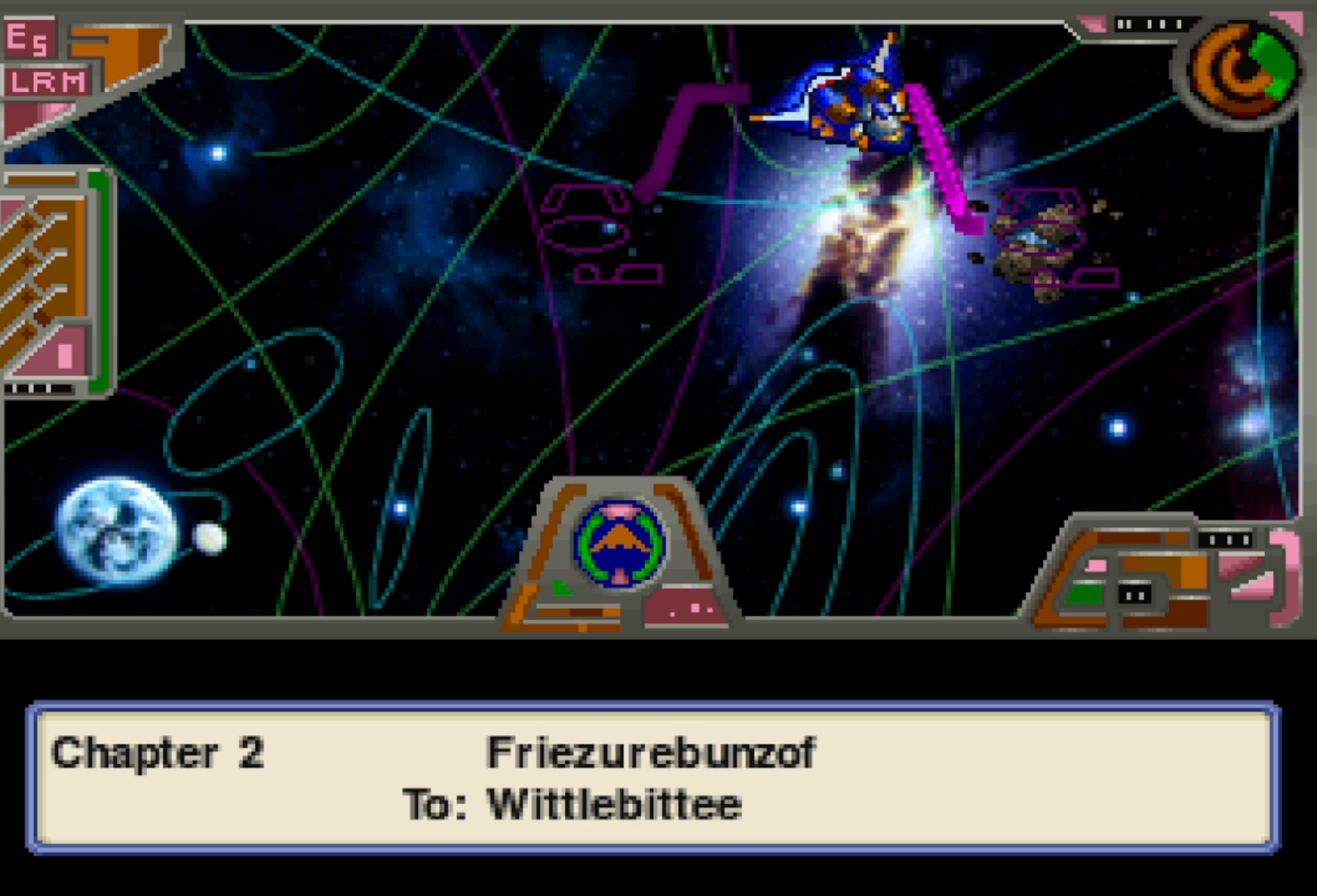
All things considered Ginga Ojousama Densetsu Yuna is a light hearted series with a surprising amount of heart to it. The optimistic nature of the majority of the cast makes the entire experience feel very uplifting, wrapped in a nostalgic blanket of late 80’s design, combined into a package of easily digestible SRPG elements. The majority of the game consists of moving from visual novel segment to an intermission with a galaxy map to the next fight. It’s thanks to this that the story flows wonderfully well and has every fight feel like an exciting reward. Most of the preparation for any of the battles is usually just buying a few items from an interdimensional spaceship and immediately diving back into the battles. Character progression is fairly linear, where you level up to make your stats go up and unlock new moves. This is another part where the large cast of characters shines incredibly well. Every character has a unique set of skills that make them feel diverse, and this avoids a pitfall that I find a lot of SRPG falling in where you have one incredibly powerful unit carrying you through the game. One of my favorite examples of this is Ayako being a walking electro magnetic pulse, focused on disabling groups of enemies, Shiori’s gentle nature being juxtaposed by her being the highest damaging ranged unit and Polylina (our Masked Tuxedo stand-in) absolutely steamrolling lines of enemies by throwing her cat at them. It creates a satisfying dynamic, in which you’ll quickly find your favorite characters to play with and how they synergize. Every once in a while the game will throw a bit of a curveball at you by having you do missions without your main team, or splitting the party up. This leaves less of a gap between your strongest team and the ones that stay on the bench. Some areas also include optional training grounds, where you can hone your skills against dummy enemies to level up and make your team the strongest they can be. Combined with the pacing of the story this makes it feel like a very streamlined experience.
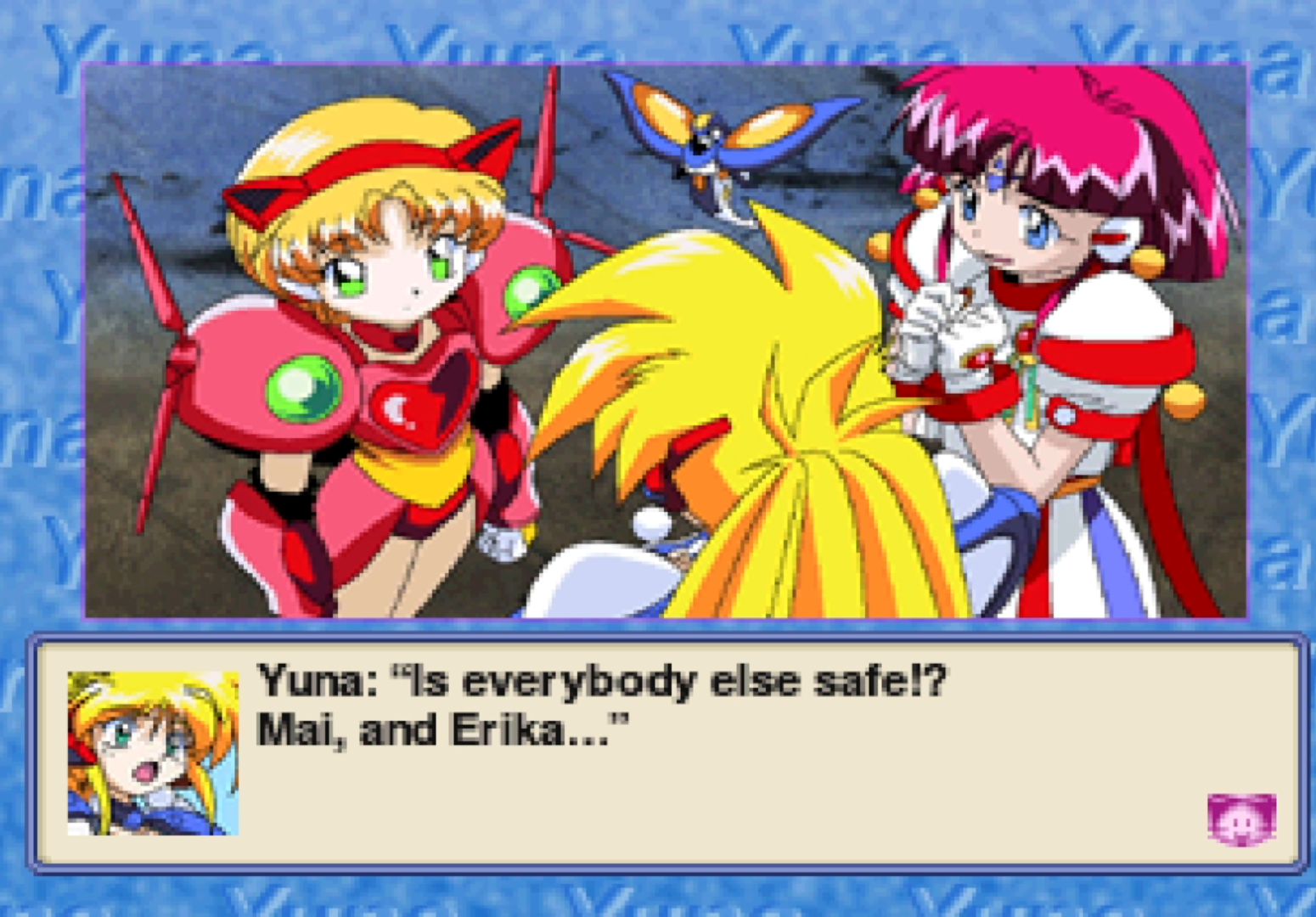
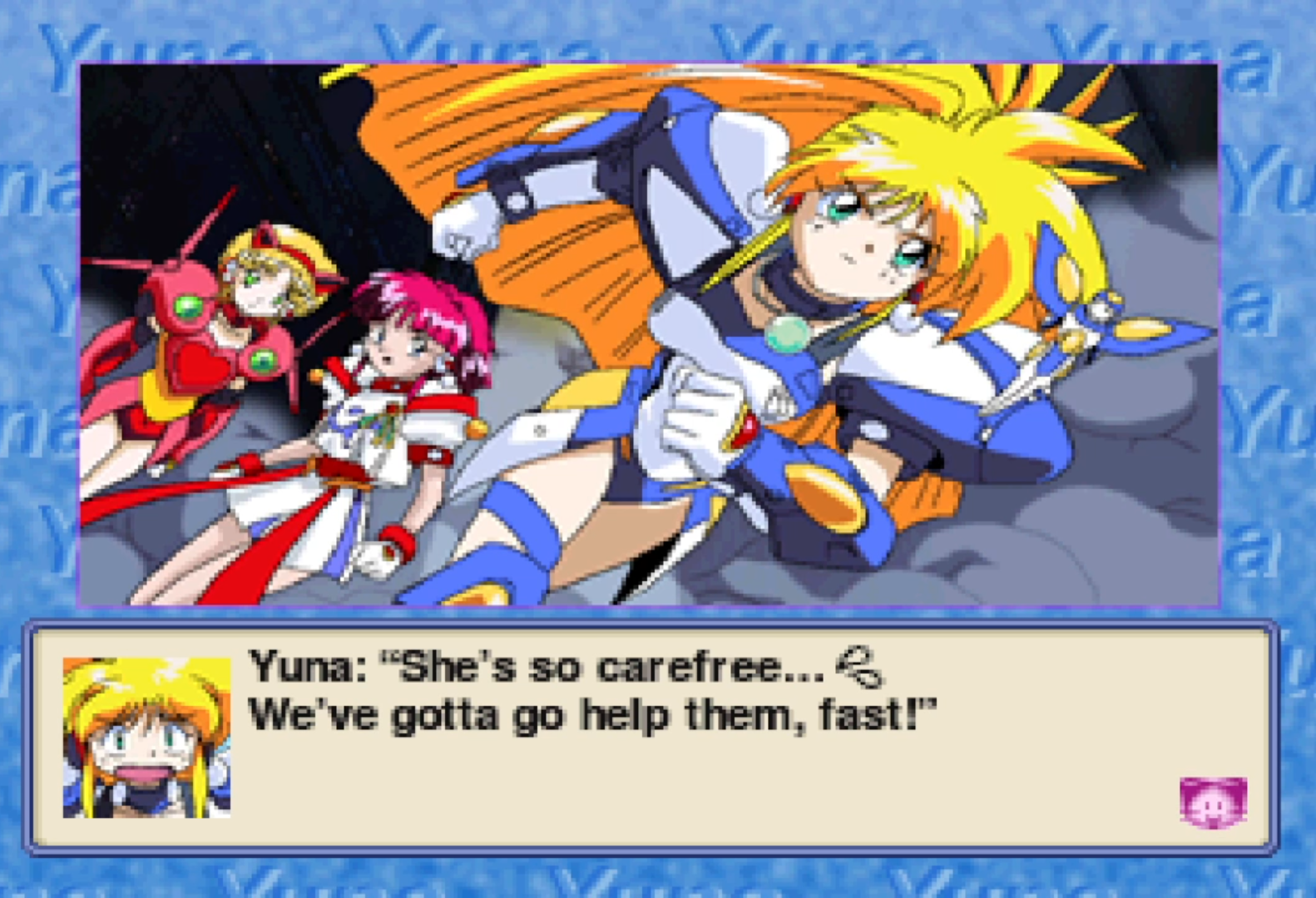
I have been an avid fan of the way that visual novels and RPG’s presented itself on platforms like the PC-98 and PC-Engine. There’s just something about the small windows filled with colorfully popping pixel art bordered by a background bolstering the game’s logo on repeat. It makes it like you’re peaking through the windows of comic panels, into a dynamically evolving story at the click of a button, waiting to be slapped across the face by a full screen piece of artwork that makes you wonder how they could’ve crammed that much detail into such a small machine. It’s a style that Red Entertainment has mastered through the years working on the Sakura Wars series and they’ve lend their talents to this series to really make it shine. On top of that, we get treated with a full blown animated cutscene when the story beats get really intense. These are absolutely stellar and adds so much to the game! The real cherry on top is a very specific explosion noise that threw me right back to the first time I watched Gundam: Wing. A weird thing to notice, but a nice little touch that just makes me happy.
The soundtrack was the biggest surprise; some of the tracks in this game are the perfect blend of groovy and energetic, reminding me of games like Critical Velocity. Some of the battle tracks bear striking resemblance to some of Motoi Sakuraba’s earlier work, alongside a composition that reminded me a lot of Golden Sun. And I do love me some Golden Sun.
Ginga Ojousama Densetsu Yuna: Final Edition is a delightful time capsule for fans of early 90’s anime alongside the Sakura Wars franchise, celebrating a visual style that brings forth the best of the PC Engine and SRPG alongside a very accessible gameplay loop. I do have a few minor problems with the game though. Primarily the way that the story handles Yuna’s air-headedness (is that a word?). She constantly steers the story away from the main threats by either forgetting about them or getting distracted by helping friends. It deflates any form of tension that the game might have had, and though I think it’s not meant to feel too serious, it does make what little tension there is feel less important. An exception being the build-up to the finale, where the rest of the cast pushes her into the severity of the situation. Don’t get me wrong, this game being the very definition of the real journey is the friends we made along the way is very charming, but the fact that she forgets there is a bomb stuck in earth the size of Tokyo 4 minutes after it happens does make it feel less important. It misses a bit of balance on this part that thankfully gets mitigated to a degree by the supporting cast picking up the pace. The other one is that the final fight is a bit of an unexpected difficulty curve. I had my main party of nearly maxed out characters and they barely survived the enemies opening move. Thankfully the game takes this into account and gives you access to all the party members rather than the standard 8. This added that the final battle felt like the whole gang banded together as a force for good.
Final Edition takes a lot of the optimistic spirit of the Galaxy Fraulein series and delivers it in a great package. It has a lot of heart to it and a fantastic presentation on top of a colorful roster of characters with a wildly diverse set of abilities. If you’re new to the SRPG genre it will serve as a great entry point as it doesn’t overwhelm the player with dense layers of mechanics. If you’re a fan of that specific few years of sci-fi anime, enjoy tokusatsu and want to bite down in a new series, then I can recommend the Galaxy Fraulein series. The fan translation team did a phenomenal job with this entry as well as the original two visual novels.
SAILOR MOON REFERENCE/10




Enjoying the review? Consider supporting TanookiChickenAttack with a coffee at;
https://ko-fi.com/tanookichickenattack

 TanookiChickenAttack