
2023 | The Brotherhood | PC

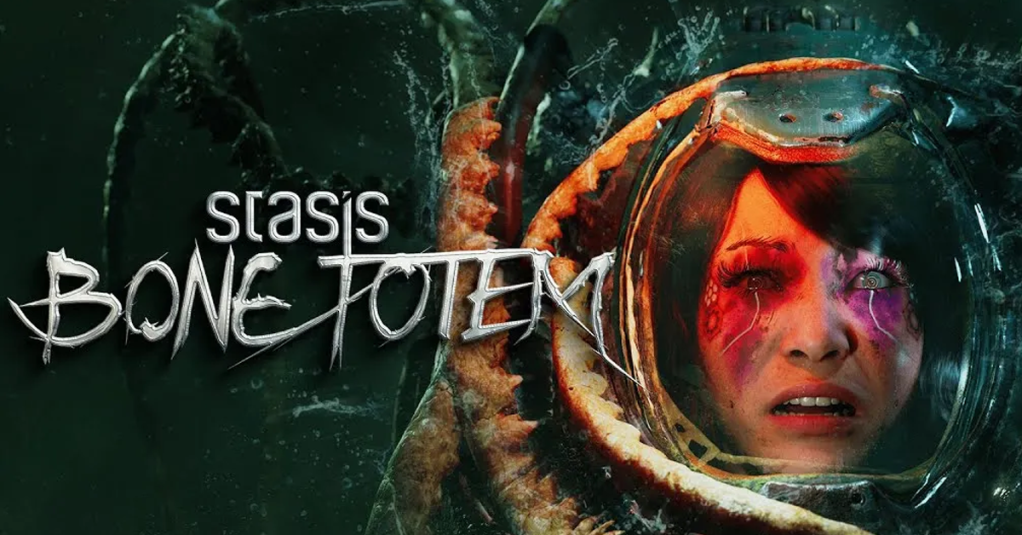
Every once in a while I get proven that sometimes I need to follow up on recommendations given to me. Stasis: Bone Totem has been on my radar for a while, with its striking key art promising a Lovecraftian rabbit hole of ocean deep proportions. And it delivered on these self set promises, to a degree. This point and click horror extravaganza has been brought to life by THE BROTHERHOOD, a three-man team located in South Africa, and is the third game in the aptly named Stasis Anthology. The series found its start in 2015’s Stasis, which was then followed up by the, free to play, CAYNE. Each of these games takes humanity quite a bit into the future, to a landscape where most of humanity has started spreading to the stars as Earth’s resources have largely depleted. Most of humanity is in the shackles of the megacorporation CAYNE, which doubles as a religious entity for what’s left of the human race. It takes corporate hold over people, deifying working for them as an almost holy revelation. The premise feels incredibly similar to Warhammer 40K’s trajectory for humanity, with CAYNE taking the place of the Emperor of Mankind. Allow me to paint a picture;
The world of Stasis is for the lack of a better word, bleak. Humanity has been reduced as produce to harvest and recycle, as grotesque biotech becomes the norm by which society functions. People go into life debts, have their family shipped off to a worker colony on the other side of space, simply because someone had a headache and the corporate overlords decided to charge him for a new head. In that same process, they sell off the human brain to the very rich, so they can prolong their life with 100% human parts. The bill then gets footed to the person whose headache is now cured with a brand new artificial brain, for which he and his family now own the company money. Humans are fabricated in stasis pods to be used as organ breeding containers, to then power the various bits of biotech that crank the wheels of the mega machine that is CAYNE. All the while this is being treated with, not only casual disregard, but also as an almost religious intervention. If you do right by Cayne, you get to join your loved ones in a virtual afterlife by means of a chip planted in your brain, called the Nexus. What remains gets recycled as biomatter to refabricate organs to power things such as diving suits, drainage systems and computer CPU’s. AI has a distinct organic taste as large computations are made possible by grotesquely engorged brains with sentience, and the most powerful of these are worshipped as the sacred Numen. Prisoners and volunteers are often stuck in stasis tubes where their brain gets plugged into a central network for extra processing power, and most of them wake up from this process either dead or with their organs replaced. In the middle of this depressing outlook on the future of humanity, we find our protagonists.
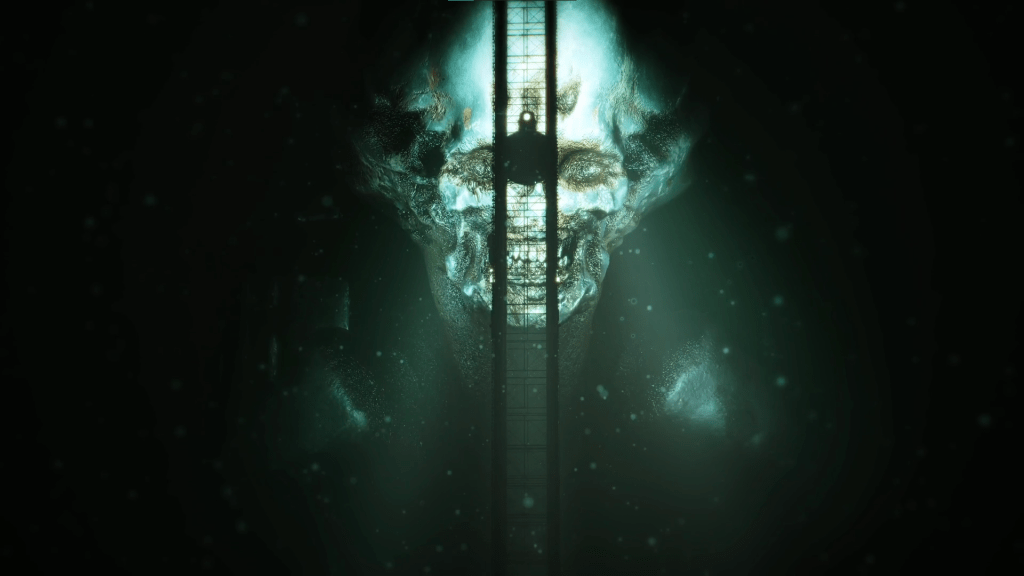
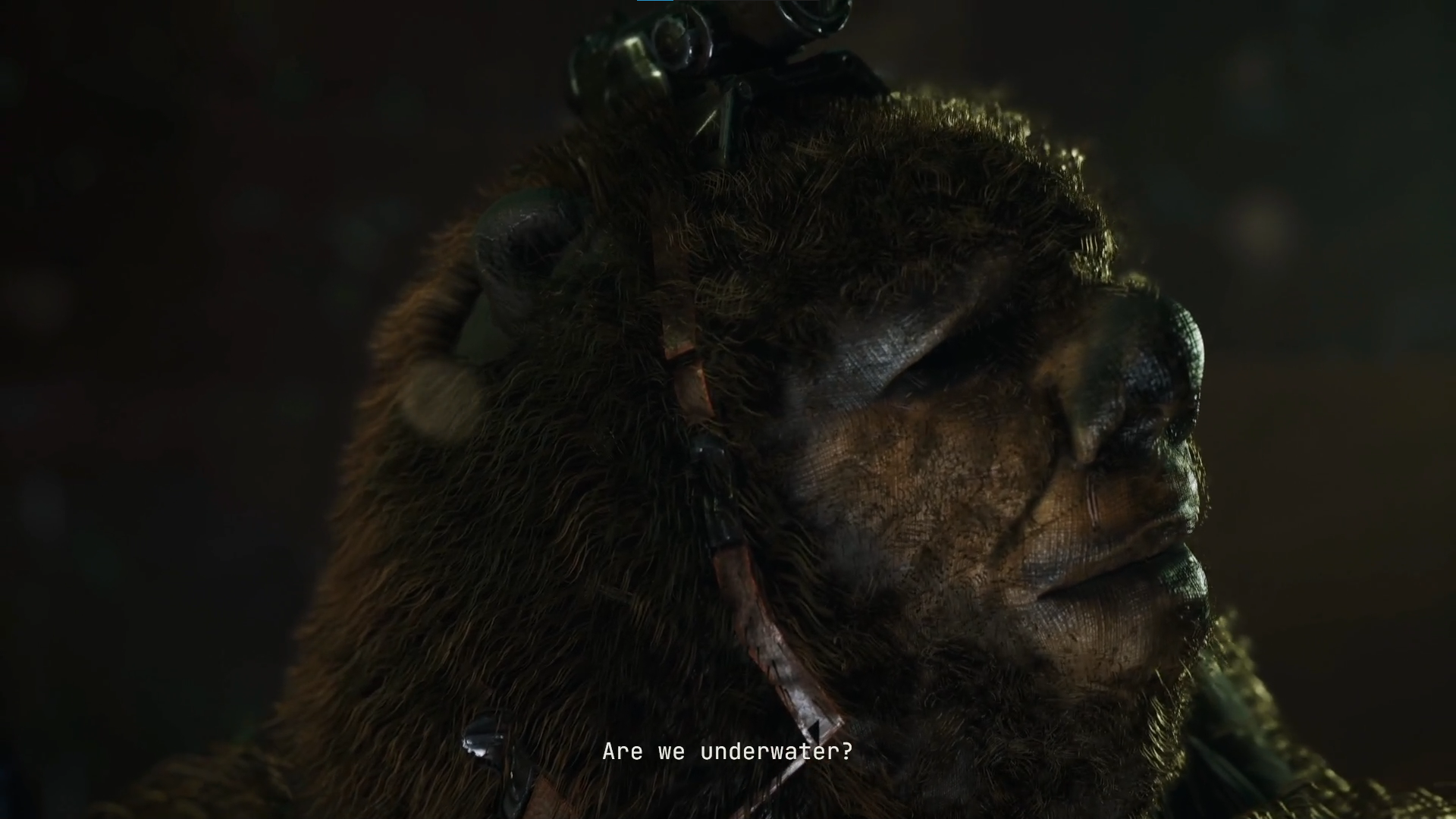
In Stasis: Bone Totem we follow Mack and Charlie, a married couple and salvage team, who stumble across a derelict oil rig of the CAYNE corporation in the middle of the ocean, seeing it as an opportunity to get enough salvage to pay off their crippling dept. From the very first steps on the rig things feel all kinds of wrong; equipment is littered around the place, either thrown to the side or hastily packed, without a soul in sight. Things seem to go from bad to worse when Charlie makes her way into the interior and stumbles across a skinned corpse, with the back of the ribcage folded open, spine removed and the intestines strung up like a pair of wings. The way Charlie brushes aside the body as something that they’ve seen before, even one as grotesque as this, goes a long way to introduce the player to the casual brutality of this world. Most of the game’s worldbuilding is done through personal logs and messages between researchers and employees that you can find on PDA’s that are scattered around. The first of which you find next to our bloodied angel. It describes experiments done in an underwater mobile laboratory, and that the rig you’re on, Deep Sea 15, is under lockdown by Cayne’s sec ops. Communications to the lab have been shut down and gunshots have been heard throughout the facility. To find out what happened here, power needs to be restored to the platform, and for that we need the help of our third, and my personal favorite, party member, Moses. Moses is an augmented super toy that’s shaped like a bear, and is their deceased daughter, Hope’s, best friend. Moses is easily the best part of this game, juxtaposing the grim and grotesque that you encounter with a child-like innocence, all the while spewing child safety PSA’s. His naïve personality often has him befriend corpses, tell Mack to mind his language and proudly proclaim that he’s a very smart bear when he does something helpful. It offsets the horror with a sparkling light that hops around to breathe some positive vibes into the darkness. With his help, the group manages to restore power to DS15 and find their way to the deep sea bell that connects the surface to the MULE. And with that, the descent into the main story as well as a whole lot of madness begins, framed by a beautiful wide shot of a massive skull watching over the group.
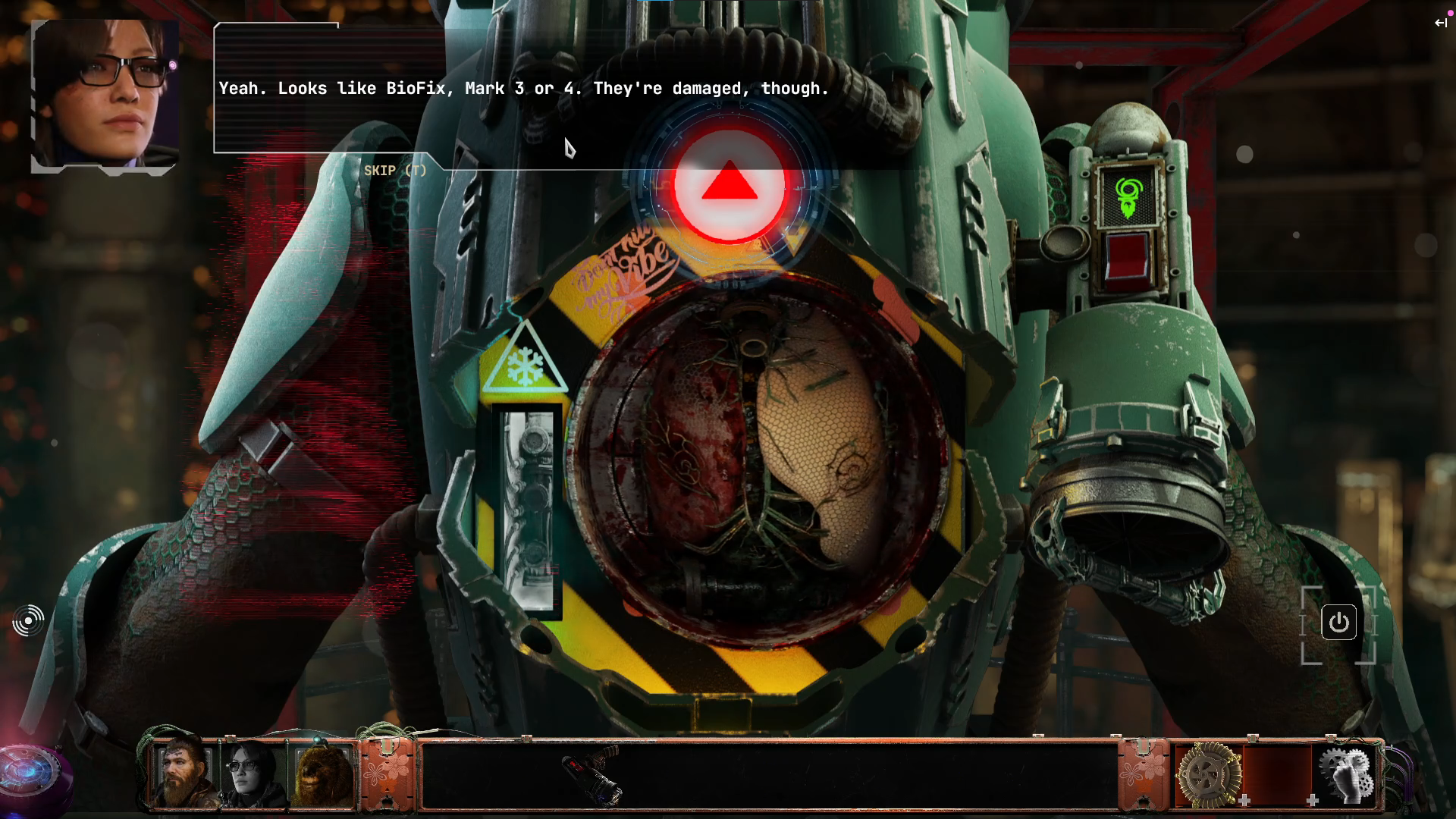
The inside of the MULE is the beating heart of this story, as you discover more of what it is that has plagued the scientists and researchers that have been working in the isolation of the bottom of the ocean. You’ll find scattered PDA’s describing lucid dreams of becoming an amalgamation of flesh within the halls of a church, a scientist falling in love with one of the products in stasis, hoping to one day elope, madmen setting an aerosol contagion of unknown properties free in the air circulation system to share his utopian dream with everyone. And that’s only the PDA’s that you find, let alone the frozen corpse of a gargantuan shark with its guts torn out that comes back alive once thawed, fetuses in stasis pods used to grow artificial organs and a bisected corpse used as a repository for surgically regenerating a pair of lungs for the station’s diving suits. Meanwhile, Moses befriends one of the only surviving researchers on the station, who helps guide the party to a rover to escape. It quickly becomes apparent that there is something going on here that exceeds the scope of CAYNE and given what we know of the conglomerate, that is saying something.
The story of Stasis: Bone Totem is largely centered around the three main characters with the previously described narrative being used as a backdrop for their motivations. Charlie seems adamant to go deeper into the MULE to find something worth salvaging, whereas Mack is more reserved and cautious. For Mack, this is an almost sacrilegious act to disturb CAYNE’s work, but he is still torn between his faith and his daughter’s legacy. Before the events of the game, their daughter, Hope, died in a drowning accident in order to save Moses, whom got swept away by the ocean. With CAYNE essentially disproving the afterlife and God, and in proxy taking its place, they’ve monopolized the postmortem with a brain chip that uploads the memory of the deceased to the Nexus. Because Hope died without the chip, Mack treats CAYNE with a more cautious reverence, and holds that belief against a more unstable foundation, which gets challenged further into the game when Mack witnesses more atrocities committed by the company. It also complicates his relationship with Moses, given that he blames the bear for Hope’s death. Charlie seems more or less okay with the atrocities for reasons I won’t spoil in this review, but ultimately her dealings with Hope’s death becomes her sole motivational standpoint throughout this story. Moses blames himself for Hope’s death, now having developed a fear of water as a result of the accident, and constantly remarks how dearly he misses her. He’ll say things like “Sharks are Hope’s favorite thing” or “Hope would’ve liked this”. It makes the little bear one of the most gut-wrenching and endearing characters in the entire game, offering a sort of light at the end of the tunnel contrast to the bleak and grotesque of the world.
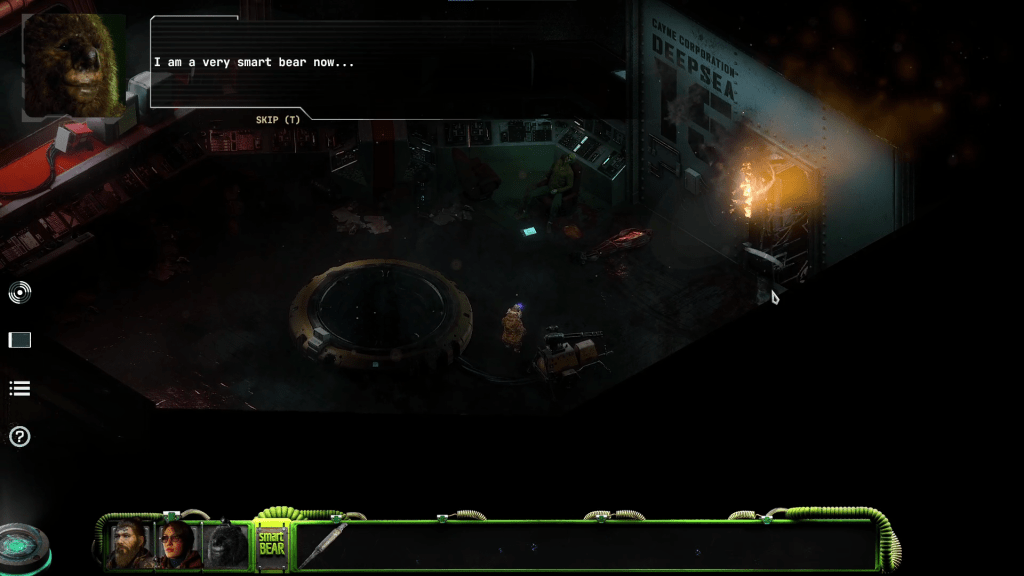
Stasis: Bone Totem bolsters an impressive level of detail given the small team, with pre-rendered backgrounds and 3-D elements seamlessly blending together, providing incredible amounts of detail and immersion. Light sources bounce seamlessly off of the environment and this, especially in the later underwater sections, gives off some wonderfully immersive visuals. The game manages to blend a cassette-futurism look with a grimy science-fiction aesthetic reminiscent of things like Event Horizon, yet the grotesque biotech you work with keep the horror elements firm in the forefront. It might be part of the day to day for our party, but certainly not for us players and that adds a Cronenburgian dimension to the whole experience. The cutscenes are extremely detailed and well animated, but the occasional desynced mouth movement and almost voyeuristically intimate camera work balances the animation quality between wonderful and uncanny. You see this especially with Moses, whom despite being a teddy bear is also made with the same type of biotech that sees artificial hearts beating in torn open corpses. His almost human-like features deliver an uncanniness to the otherwise endearing little bear.
The sound effects while well made and satisfying, suffer a tad from lack of balance, or in the cases of the optional death scenes, are missing entirely. The soundtrack, provided by Mark Morgan, perfectly enhances the atmosphere of the game with each character having their own instrument sets to accompany their journey through madness. Mack bolsters a more bombastic set of instruments with aggressive percussion and guitars accompanying his personality, whereas Charlie’s is more ethereal and Moses‘ is much more playful.
Much like other point and click adventure games, Stasis: Bone Totem offers a wealth of items to collect, combine, disassemble and reassemble. The twist to the formula is that each character has their own specific thing they’re good at. Moses can hack pretty much all systems and can crawl into small ventilation shafts, while Mack can brute force objects to tear them apart, and Charlie has the ability to combine items to help traverse the game’s many puzzles. The characters spend most of their time separated from one another, being able to transfer items between characters through a shared inventory. This makes it easier to keep track of what you have to do and what you can use to progress through the game, as most of the roadblocks can be solved by continuing with a different character until you either open the door for someone else or find the thing you need for the other to access something. It makes the journey feel less fractured and more like you’re constantly working towards the same goal. The puzzles themselves are less obtuse than you’d expect from the genre, it mostly just takes some getting used to the in-world logic to find the workings behind the machinations. One example would be a pile of flesh that you find in a microwave, which allows you to program a turret to react to a specific genetic sequence. In turn you can then stick the flesh unto a door and activate the turret to fire on it. It may seem like wizardry at first, but once you break down the individual steps, it makes sense within the context of the world, and Stasis: Bone Totem excels in this.
Stasis: Bone Totem is a rich and horrific exploration of the deep unknown, as it pushes its characters to their limit and beyond. The world building is done in a way that doesn’t require previous knowledge of the Stasis series, but presents it in a way that lights the spark of curiosity towards the rest of the games. The voice acting and presentation of the characters, as well as the progress they make, is all done incredibly. The overall presentation is impressively high fidelity and detailed, especially when you consider the team size. The game does lose a lot of tension during moments where a character is in dire need, though, especially during one of the earlier segments when Charlie’s diving suit starts to malfunction and bleed oxygen. They try to reinforce that the diving suit will fail in a short amount of time, but pressure doesn’t translate to gameplay at all. Characters will still banter back and forth and you’re free to still explore at your leisure. Tension also often deflates when you’re hastily trying to get someone, only to realize you can’t transition to a new area when someone’s talking. It’s something that happens a lot in the latter third of the game. There’s also a character that is incredible for the story, but deflates any sense of mystery of the game, at least for me. It will constantly provide, in an almost mocking fashion, every answer about everything. Although, seeing it get upset when it didn’t know something did feel funny. Overall, the game is an incredible spiral into madness, with a compelling story to tell, deep characters and incredible atmosphere. Its horrors are seamlessly integrated into the world around it, amplifying the gruesome scenes with a casual apathy towards it. The writing is mostly incredible, with a few overbearing moments of expository dialogue or interruptions from exploration due to every room having a PDA to read in the third act (optional, but it adds a lot of depth to the game).
Stasis: Bone Totem provides a unique take on the point and click adventure genre with a compelling spiral of madness that stretches both you and the characters to the extreme.
A very smart bear/10


Enjoying the review? Consider supporting TanookiChickenAttack with a coffee at;
https://ko-fi.com/tanookichickenattack

 TanookiChickenAttack