
2002 | Param | Gamecube
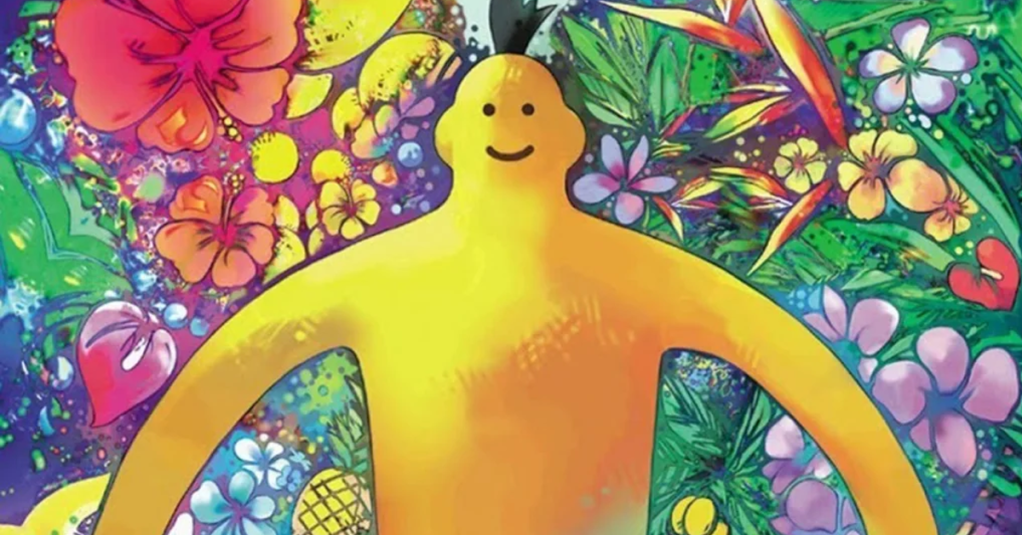
Imagine a time about 20 years ago, visiting your local game store, and amidst the collection of the now titans like Animal Crossing, Metroid Prime and Super Mario Sunshine you’d find a face staring back at you; The figure smiles, its immense arms holding up a logo which says: Doshin the Giant. I’ve always been drawn to games with unique and out of place covers, it made me curious to see what kind of worlds of wonder lay within the plastic cases. Unfortunately I didn’t own a GameCube at the time, as I was still largely absorbed by the PlayStation 2 and devouring Golden Sun on my Gameboy Advance. Even so, my curiosity to that mysterious yellow giant happily holding up that logo was etched into the back of my mind, until I got the chance to play it at a friend’s house a year or so later. And it was every bit as surreal as I’d imagine it being, back when I first saw the cover. I have a lot of fond memories of sitting there with a cup of hot coco (it was one of those rare snowed-in winters), and simply walking around in the game and just doing stuff. Fast forward about a decade and a half, and I encounter that now not-so mysterious, but still mysterious, cover at a flea market and immediately picked it up, only for it to vanish onto a shelf for a good while… Until recently!
Doshin the Giant is a God simulator made by Param, who also made Doshin the Giant, back in 2002. The original game was released for the Nintendo 64 Disc Drive, 64DD for short, as a launch title in 1999, and featured much of the mechanics that we’d later get in the hybrid sequel/remake for the GameCube. It was an impressive game, with a rather unique premise, that allowed you to change the world as you saw fit while you help the islanders flourish into civilizations. While impressive, this also came with quite a few drawbacks; namely in the form of low framerates, lack of detail and animation on the villagers (they just sort of flop around in Doshin bliss). The original release also had an expansion, Kyojin no Doshin: Kaihō Sensen Chibikko Chikko Daishūgō, which is a bizarre addition to say the least.
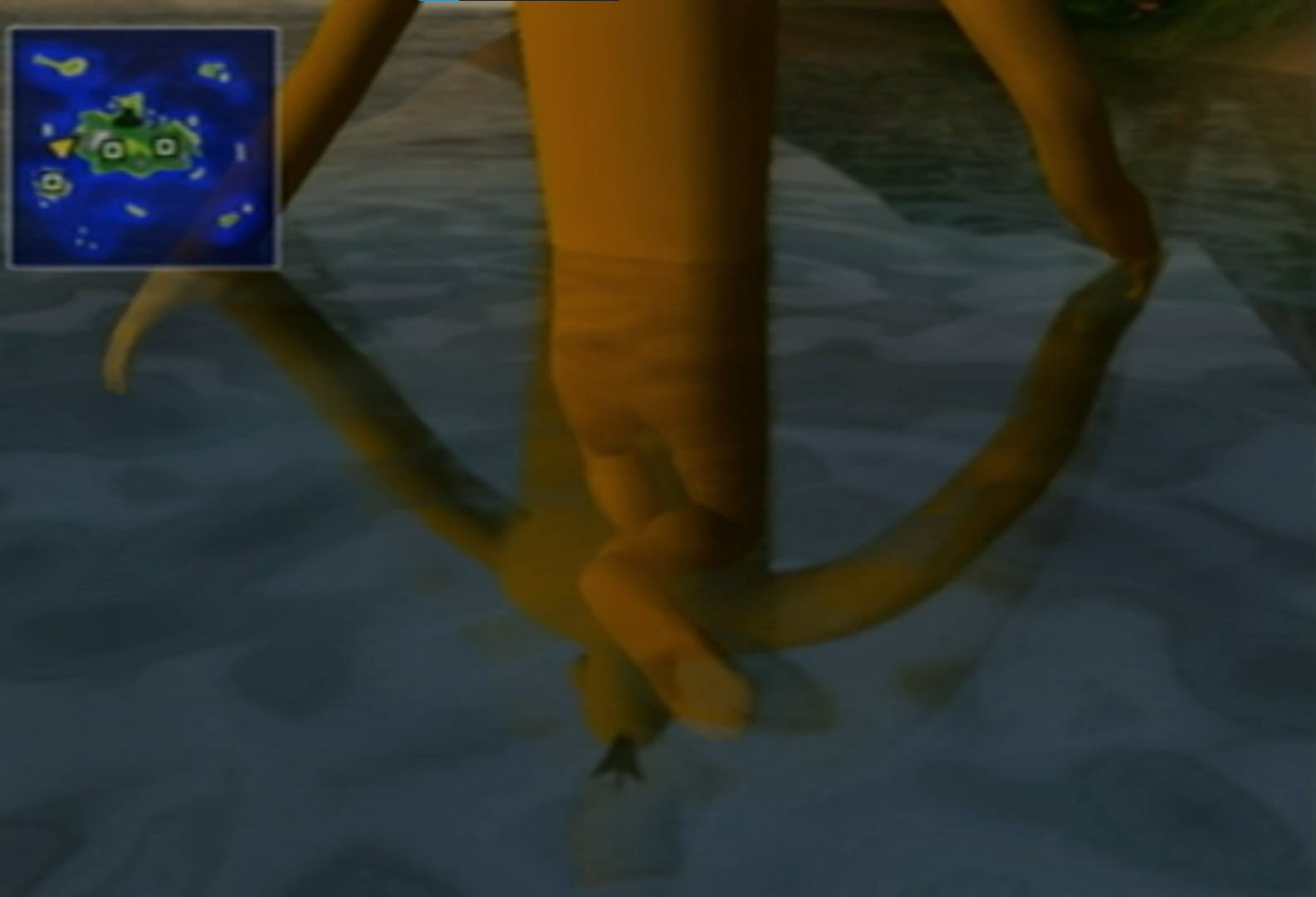
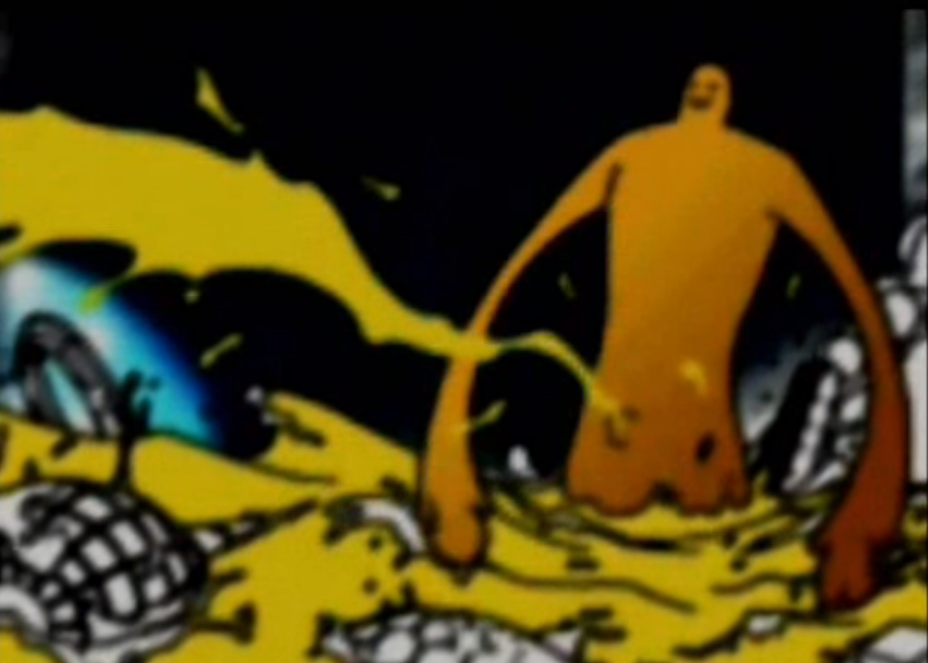
In the expansion you play as a kid that, after playing Kyojin no Doshin on his 64DD, has to go to bed. In his dreams he finds the friendly giant trapped in a steal cage, and the kid has to free him by tinkling hearts onto Doshin until he grows big enough to break the cage, and promptly destroys everything by removing his belly button and flooding the place with yellow goo. While we never got the 64DD release of the original Doshin, we did end up getting the 2002 Gamecube version, which was updated substantially in contrast to its lower poly little brother.
Doshin the Giant is one of the more unique facets of the GameCube’s catalog, but not within the portfolio of its designer Kazutoshi Iida. Prior to him founding Param in 1997, Iida was responsible for the creation of Aquanaut’s Holiday and Tail of the Sun, both of which feature overlapping themes of player freedom and the goal of constructing an object to draw in others. In the case of Aquanaut’s Holiday it’s exploring the ocean at your leisure, with the goal of constructing a coral reef to attract fish. While in Tail of the Sun you’re free to explore the world as you please, with the goal of constructing a tower to reach the sun. Both of these games offer a level of freedom that can also be felt in Doshin the Giant, wherein you have to take care of villagers with the ultimate goal of getting them to construct monuments in honor of you.
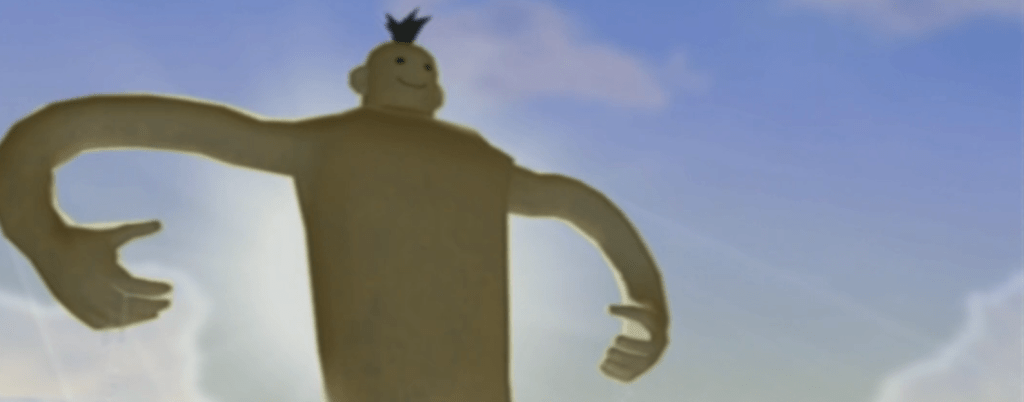
Doshin the Giant tells the story of the island of Barudo, where legend has it that a friendly yellow giant rises out of the ocean when the morning sun rises. This friendly giant, as you might have guessed it, is Doshin. A giant yellow smiley faced giant with long arms, 5 hairs sprouting out of his head and a suspiciously prominent belly button.
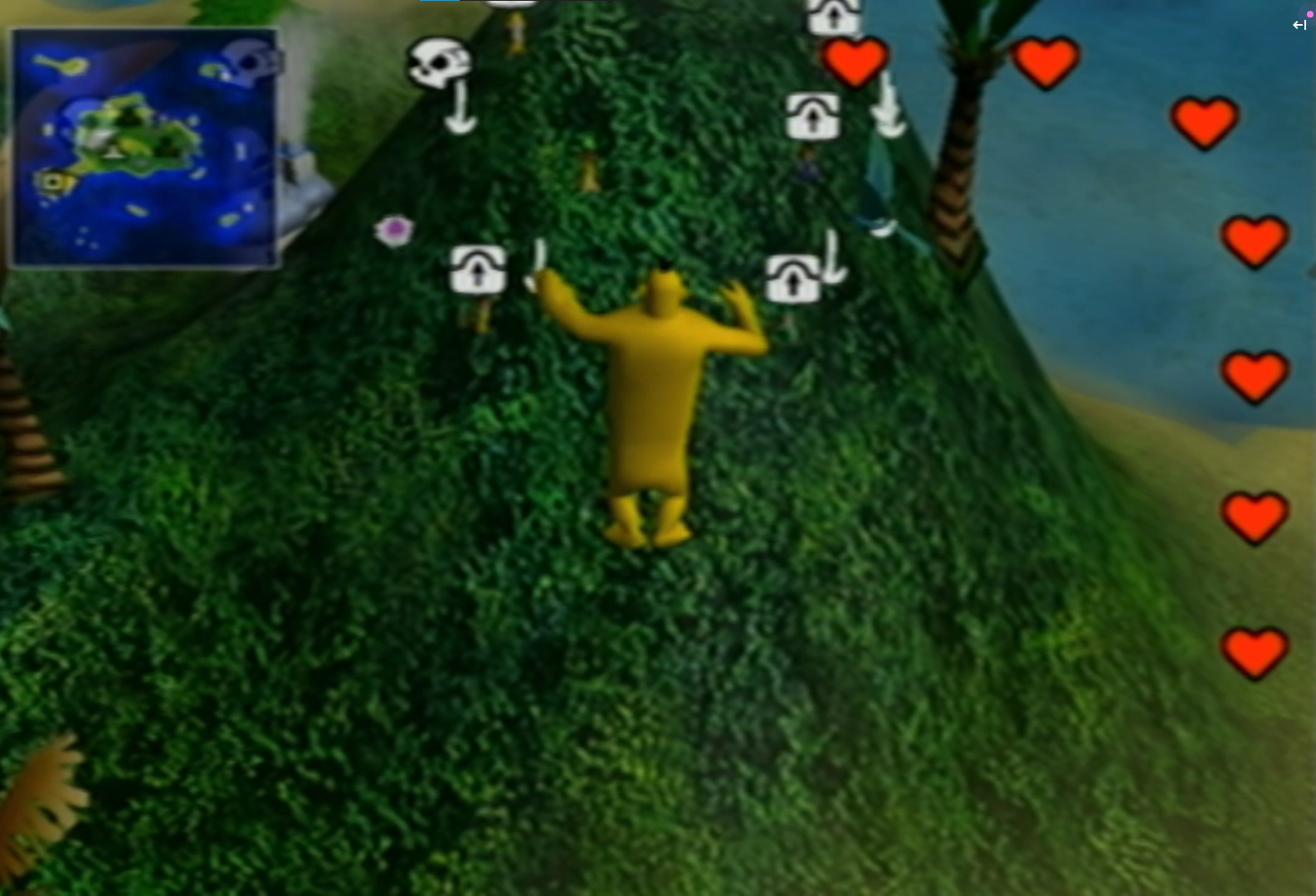
You take control of Doshin as you help the islanders build their towns by fulfilling their needs by using your special powers. Doshin has the ability to pull the land up, as well as lower and raise terrain by flopping his arms around, and is able to use this to shape the land as he, or you in this case, see fit. The villagers will sometimes cry out requests for higher ground, or a valley, or request green energy, which you can give them by planting trees near them. After a while the villages will flourish with larger populations, small farms and even build monuments for you. Doing this will earn you love in the form of hearts, and if you earn enough hearts, you grow a bit bigger, giving you access to more things to do. If you do things that the villagers dislike or if you accidentally stomp on one of them, they will send a skull your way. These also cause you to grow, but only give extra powers to Yashin, the Hate Giant, an evil counterpart to Doshin. This form gives you more destructive powers, among which is the ability to blow up buildings with energy blasts.
When the sun sets, the day ends and Doshin returns to the sea. At the end of each day you get a report on various stats, as well as a few encouraging words from the villagers in the form of thank you notes, or the occasional questioning of the use of your existence. After this you’re booted back to the main menu to start the day fresh with a very small Doshin.

Doshin the Giant is very simple when laid out like this, but that’s part of the appeal. Your ultimate goal is to get the villagers to construct all 16 monuments, which you achieve by picking up and combining villagers. The game gives you yellow, green, blue and red to start with, but by combining these they will build a wild variety of monuments inspired by real life examples (such as the sphinx). Every once in a while the game will throw you a few curveballs to up the tension a bit in the form of natural disasters. There are downpours which threaten to wash the cities away, volcanic eruptions shaking the land and wildfires burning down your handiwork, to keep you on the lookout and make sure that the people you helped come out alright at the other end. It’s surprisingly easy to get deeply invested into a particular village, especially once you get to the final few monuments. There was a moment during my time playing where I created an archipelago to populate with a few different tribes, to build some of the last monuments I needed, only for typhoons and earthquakes to blow away and shatter all the progress I had made. I wasn’t too upset about the loss of the monuments, but rather found myself worried about the villagers that I felt responsible for. After all, I was the one who ripped a few folk from their home in order to found the civilization I needed. It’s rather astonishing to feel any level of responsibility in a game that lets you do whatever it is you want.
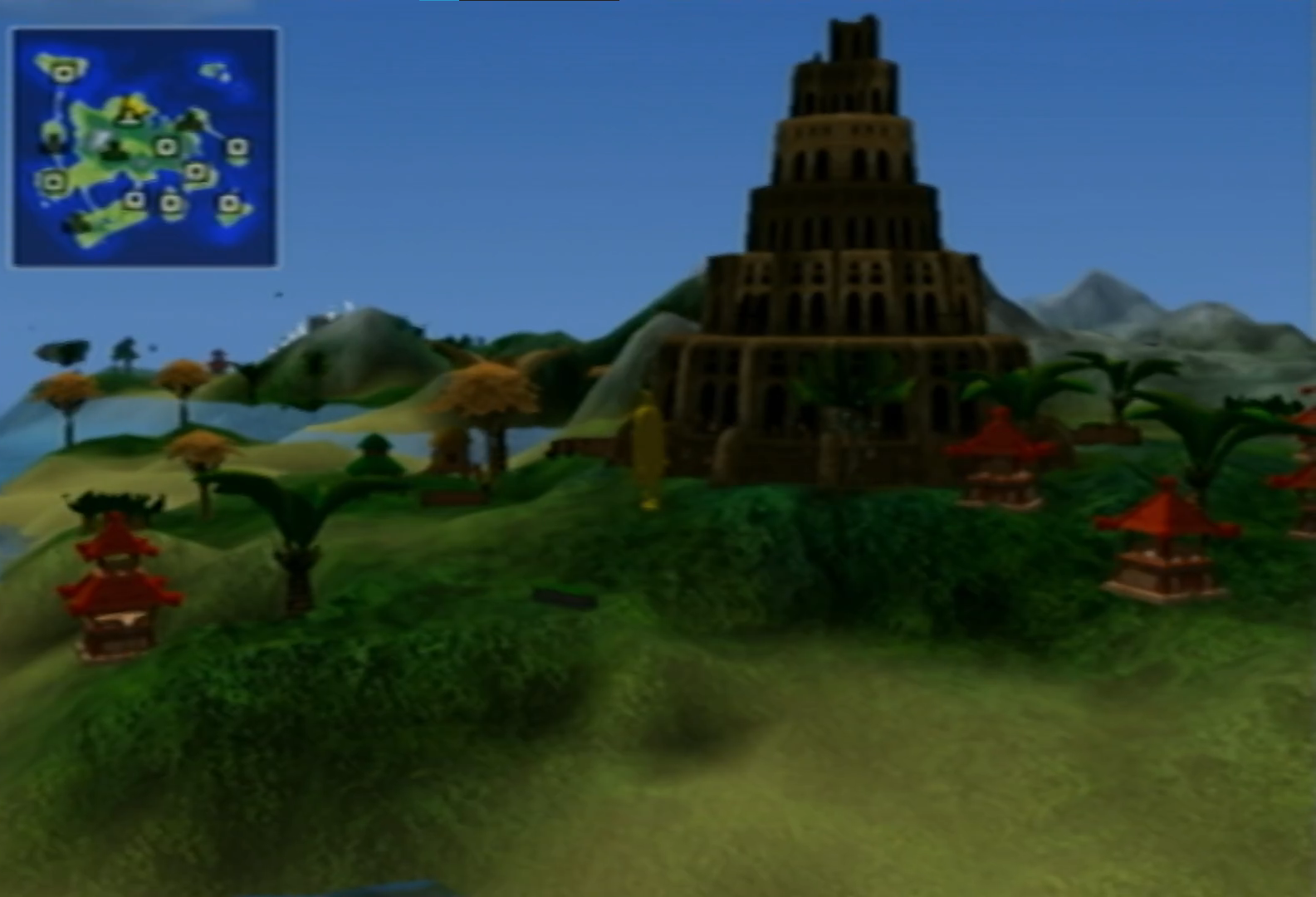
It was a long struggle, but in the end the people of the island of Barudo took matters into their own thematic hands, and started construction of the mother of all monuments: The Tower of Babel. In true Babylonian fashion, however, this proves to be a mistake of biblical proportions as upon completion of the tower, the island collapses under its weight, nearly causing the entire population to be destroyed.
The GameCube version adds an additional ending to the game in which the original Doshin becomes the new island, now inhabited by aliens, who then build a rocket to go to space. A truly bizarre ending to a bizarrely great game.
Doshin the Giant is an utterly brilliant game that’s equally difficult to put into words. The only training wheels you’re given is through the narrator giving contextual hints as to what you can do, but beyond that you’re completely left to your own devices to do whatever the hell you want. This sensation is incredibly liberating. From the very first steps, you don’t get the feeling of being pulled by the narrative, and instead are able to soak in the sunshine and explore the island at your leisure. The islanders might be demanding that you make a hill in their backyard, but that doesn’t mean you have to do it. It’s like being given an infinite amount of LEGO to build whatever it is you can imagine. The game never, at any point, expects you to do something, except for the things you want to do. The only thing it provides is a means to an end. If you want to make a village that has blue and green inhabitants, you can make an island off the coast somewhere, plant a few trees and then tear a male and female islander away from their families as the Adam and Eve of your latest creation.
While the game feels somewhat lacking behind other titles of the time on the same platform, it doesn’t shy away from providing ample amounts of detail for you to explore. The villagers will respond with unique animations, in contrast to the wild flopping of the 64DD version, based on whether or not they like you. They also have roles within their villages; you’ll see people dancing around on balls to entertain the workers, farmers tend to the crops, and the animals are herded around the island. Sometimes a villager doesn’t feel like doing anything, but they are very useful to pick up and use as an improvised treasure detector when carried around. The buildings of the tribes are all different, inspired by older civilizations, and the monuments also present a lot of interesting details. Want to build the Great Pyramid next to the Aztec Temple, whom in turn is neighbors to Odin’s cabin? Well, do I have good news for you. Each monument is presented in pretty impressive detail, based on various civilizations that lived throughout human history.
The amount of moving parts that Doshin the Giant juggles at the same time is bordering on the insane. The draw distance keeps a lot of elements loaded into the game at all times, and with how much you can interact with the world, this does come with a few downsides. The biggest downside is that whenever a day ends, the game saves a state of your current world instead of your progress. When that state changes too fast or in a way the game doesn’t anticipate, the save will fail and you’ll have to start the day over. I also encountered a weird bug, likely caused by having too many objects loaded in close proximity, that caused earthquakes to level most of the map without showing the progress. So, when I went into the menu to check the monument list, half of humanity simply vanished from the map. These things can feel a bit frustrating, especially when close to the end of the game, but when you consider how strong the foundation of this game is, it doesn’t feel detrimental. You can always try to rebuild, or in my case, destroy all of the monuments that were marked completed and start fresh.
Doshin the Giant is a refreshing experience that doesn’t expect much from its players. It hands you the tools to interact with the world and then frees you from all responsibility and urgency. I found this game incredibly relaxing and almost therapeutic to dive into every time I booted it up. And every time I did, it gave me some insane stories to talk about at the dinner table. While I genuinely love the way this game looks and feels, it’s not the prettiest game on the GameCube, nor do the controls feel like anything other than a drunk swamp march. Picking up specific objects or accidentally flattening an entire village, because the diagonal surface became slightly to vertical for a few frames, can feel clunky at the best of times and just unfortunate at others. What lies beyond these limitations is a vibrant game with a strikingly designed giant that gave me so many hours of blissful joy that can last you for as long as you want it to. The unfortunate side effect of the cancellation of the US version of this game, left it into relative obscurity. But for those that are willing to look, it’s a treasure trove of the weirdest and best time you can have on the system.
An Awkwardly Angled Thumb/10
Enjoying the review? Consider supporting TanookiChickenAttack with a coffee at;
https://ko-fi.com/tanookichickenattack

 TanookiChickenAttack