
2004/2023 | Monolith Soft | Switch
It’s hard to imagine a time where Monolith Soft didn’t dominate the RPG scene with the now cult hit series Xenoblade Chronicles. However, their history with creating massive, mesmerizing and abstract worlds all traces back to the release of Xenogears in 1999, after which Tetsuya Takahasi would found the company we all have come to know and love as Monolith Soft. The company immediately got to work on the wildly elaborate Xenosaga series to follow up their PS1 cult classic. There was a part of Monolith that started working alongside tri-Crescendo on a unique RPG exclusively for the GameCube, that would help fill a scarcity within the genre. The result of this collaboration was Baten Kaitos: Eternal Wings and the Lost Ocean. It is a fairly unique turn-based RPG that had players construct decks of cards from the souls of every day objects to battle monsters, evil empires and Gods. The game would receive a sequel with Baten Kaitos: Origins a few years later, though PAL territories never had the pleasure of playing this game without importing. That is, until quite recently, when Bandai Namco decided to revive the series for the Nintendo Switch with the Baten Kaitos I & II HD Remaster.
It is a collection that is about as quirky as the games themselves. For the first time, people in the EU have access to Baten Kaitos: Origins, but, in a weird reverse Uno, this version is not available in the US. There are also a lot of changes made to the games themselves; gone are the odd echoes on voice lines that made the game stand out so much, both in a good and bad way, and are now replaced with a partially remastered and redone Japanese dub. However, in a move that caused me a severe whiplash, the opening cinematic is STILL in English. My best guess is that the original English voice-over was deemed unusable, at least when looking at the tin canny quality of the audio itself, and had to be replaced with a cheaper option. But it doesn’t make it feel less weird to go from English to Japanese with the press of a button in the main menu. One of the other major features is a speed-up function for the entire game, which can be toggled inside the menu, but more on that later. Regardless, it’s a neat collection with a lot of hours of game packed in a small Switch cart.
The world of Baten Kaitos is divided into five island nations floating in the sky after a cataclysmic event shattered the earth and polluted the oceans. Each island developed its own culture and ruling body, but one nation wanted more than its own borders, and has started an aggressive campaign against the other nations in a war of conquest and subjugation. In the middle of all this we find our protagonist, Kalas, injured and without memory in a forest near the village of Celbarai. After waking up in a hospital bed, we learn that Kalas in on a path of vengeance against the people that killed his brother and grandfather. Thusly, we set out into the wilds of the island to find transport. Along the way the party expands with the addition of Xelha, a mysterious girl looking to find the End Magnus. In the world of Baten Kaitos each and every thing, person or phenomena has an essence that’s called the Magnus, a sort of soul, which can be harnessed in the form of cards. During the calamity, the God of destruction, Malpercio was separated into five of these cards and spread across the world for safe keeping. These are called the End Magnus.
After beating the first boss, we also find the first of these End Magnus, which gets intercepted by none other than the person Kalas wants take revenge on, Giacomo! With the crew not being strong enough to stop him, Giacomo steals the End Magnus and sets in motion the main plot of the first part of the game. From this point, Baten Kaitos becomes a rat race between Team Kalas and Team Empire as they fiercely search for the remaining four End Magnus. Along the way we strengthen the party with a few new faces; Gibari the disgruntled fisherman, Lyude the betrayer of the Empire, Savyna the former soldier and Mizuti the Great, who is just great. Each of these additions to the party bolsters a fantastically unique feeling design and perfectly represents the nations which they all originate from.

The second half of the story inevitably leads to the confrontation with the God of Destruction, Malpercio, and the build-up to that finale and the finale itself are structured in such a way that I’ve come to see as Monolith-core. The majority of the story itself is rather well paced out, with breadcrumb trails leading the way to reveal much later in the story. Things that happen much later will be foreshadowed in rather natural ways throughout the first half.
I’m specifically emphasizing first half, because the second half is where, for me, the problems start to emerge from the shadows. The cast of Baten Kaitos is rather good; I grew especially fond of Lyude’s struggle between the right thing and loyalty to the Empire. His entire story arc revolves around coming to terms with breaking the indoctrination of the Empire and betrayal to pursue a path of helping rather than destroying. When the story takes you to the front door of his house, it becomes brutally apparent how intolerant everyone he once knew had become of his existence. There is a lot of foundational work put into building up Lyude’s struggles of loyalty and morality, only for it to fade into the background during the final third of the game. You see, this is a game about Kalas, Xelha and Mizuti (the Great). Therefore all other characters turn into a cheerleading squad for the main trio, whilst having their arcs resolved in ill placed optional sequences. It makes their stories irrelevant to the overshadowing plotline of having to fight the same boss fights over and over and over. It’s honestly a shame, because the conclusion to Lyude’s brilliant arc is relegated to an optional dungeon right before the final dungeon (and despite it being optional it still brought me to tears).
The last third of Baten Kaitos feels more like a template for the storyboard prior to the editors’ notes being taken into consideration. It’s palpable through the events of the story, but also through the encounters you have to fight through. Right before the final dungeon we get to take a little side trip to a mountain cabin, where we have to fight the exact same fight twice in a row. It adds virtually nothing to the story at that time, resolves into absolutely nothing and felt like an absolute black hole of a time sink. This part felt like pulling teeth, and it’s not the only time we get to do this exact loop. In the final dungeon we face a whopping total of five of the same bosses, but the gimmick is that they all are of a different element. Then we fight the final boss twice. That makes for, what is essentially, two boss fights on repeat.
It’s fascinating to see the duality of Monolith Soft be present in one of their earlier games. Some of these design elements are still present in some of their newer entries as well, and it always leaves a bunch of conflicted feelings linger after the credits roll. On the one hand we get simply phenomenal writing, with breadcrumb trails to follow deep into multiple playthroughs, but on the other we get a finale that puts the endings to Return of the King to shame. It’s not going to deter everyone from playing these games and fully immersing themselves into the world, but for me these ways to lead to the conclusion of a 60+ hour playthrough feel like a chore sometimes. When the game is good, though, it gets really good. I found myself on the edge of my seat during the mid season finale and was brought to tears by one of the most brutal psychological teardowns of a character I had seen in a while. It’s these moments that still keep Batan Kaitos feeling like a worthwhile game to experience.
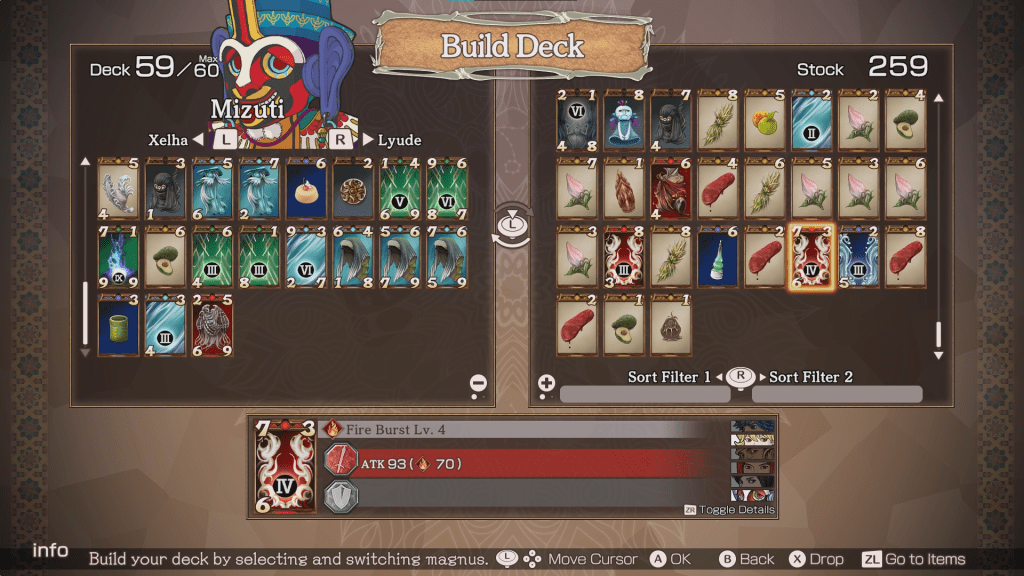
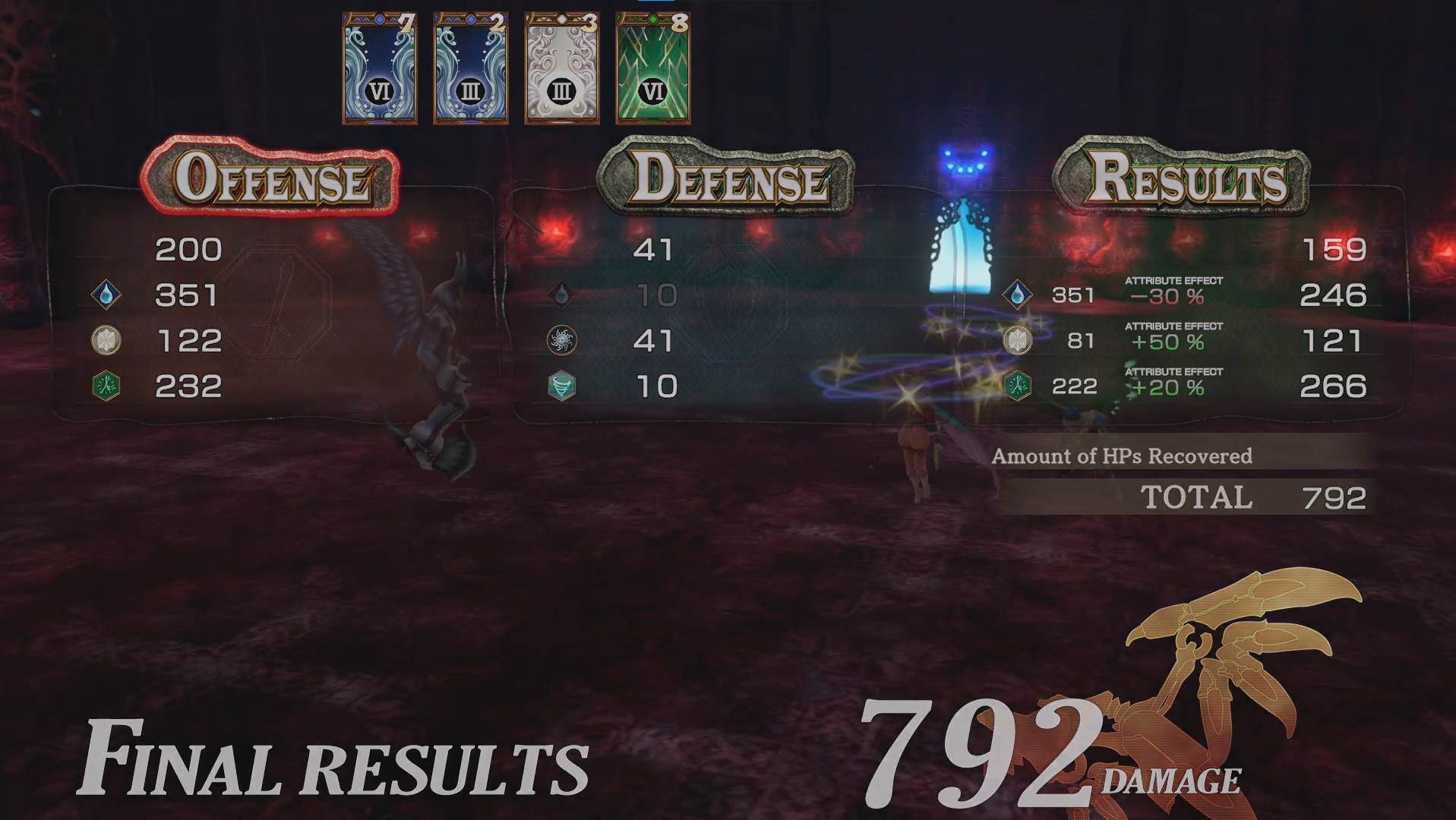
Baten Kaitos is a stand-out RPG from nearly every aspect it has to offer, one of the biggest being the combat system. As mentioned earlier, this is a turn-based game with deck building elements. Each object, lifeform and element has an essence to it that can be harnessed in the form of cards. These cards, or Magnus, are divided into different elements; Light, Dark, Fire, Water, Wind, Chronos and Neutral. In battles you select from a hand of cards pulled from a deck you build to attack your enemies, defend from their attacks and heal your allies. You’re essentially building a balanced arsenal of offensive and defensive Magnus to deal with your enemies. Each element has a directly opposing element that neutralizes part of the damage dealt. This means that by defending with a water Magnus against a fire attack you will reduce the fire part of that attack’s damage. So a large part of doing anything in Baten Kaitos is preparing your cards to suit your needs and the situation at hand. Elemental advantages make or break this game. When progressing through the game you also get to expand your hand and deck size, but there is a trade-off. With each upgrade the first card you play has to be played within a specific timeframe that gets shorter with each upgrade, and this makes every turn an on the fly decision making process. To add an additional layer to this already complicated mechanical cake, each Magnus also has numbers on them. If you pair numbers, or make a sequence of numbers, with the combo that you’re selecting, you boost the final damage results of your turn. This works in the defense as well, meaning that you can compensate any incoming damage by placing a combo that has the correct elements and/or numbers on them. It seems like a whole of lot of complexity, but the system itself works quite intuitively and eases you into the deeper layers one step at a time. The ability to upgrade your hand is optional, so if you’re ever feeling overwhelmed with keeping track of all the different elements and numbers, you can also take a bit of a step back to a more comfortable pace. This way you can choose to challenge yourself whenever it feels like the right time, instead of having it forced upon you. It’s a great way to balance player progression with player comfort.
The cherry on top of the complexity cake is that the Magnus are dynamic. The game keeps track of an in-game clock that passes time for the cards. This means that you need to keep track of things like food or more natural items, as you’ll often find that the healing item that you once relied on is now a rotten pear that does poison damage. Or the bamboo sprout has turned into a large stick that can now be wielded as a weapon. It’s a fun way to get players to scavenge for cards and consider long and short term benefits for the decks they’re building. You can also buy Magnus at shops, but for that you need money and money doesn’t fall from the monsters turned corpses. Instead, photography is the preferred vocation for those looking for riches. Among the many Magnus are also various models of cameras that you use to snap pictures of the monsters you fight. Depending on the quality of the picture, you can catch a fair sum of cash to supply yourself with funding for new cards. In an insane move on Monoliths side, you can also utilize a hidden exposure value by using light and dark attacks in battle. This directly affects the quality of the photo and turns a simple action into a strategic quest for the perfect scoop. It’s brilliant how well all these mechanics naturally mesh together. While certain elements in combat are challenging to learn and master, they are intuitively designed and never feel out of place. They’re simply there as an option for the player to invest into to benefit themselves more.
The remaster introduces quite a few changes and additions to the game. The backgrounds are redone, creating stunning painted backdrops to accompany your adventure. Some of the 3D elements are nearly seamlessly incorporated into the backgrounds, creating a homogenous, vibrant world. The remaster, as of writing this, only has Japanese voice acting for both games. Despite the original release having English voice acting, it had this odd tin echo to it, as if you were listening to someone through a wall, underwater. While I’m not certain of this, the voice lines for the Japanese dub are largely remastered or redone and are very clear in quality. The game also received a retranslation to have the on screen text match better with the spoken dialogue, though sometimes the translation does take a bit of creative freedom to make the lines more cohesive in English. The audio mixing is still a bit off, with the phenomenal tracks of Motoi Sakuraba often drowning out spoken dialogue. It’s not something I have a problem with though, because the soundtrack is incredible, and we’re talking synthesizer shredding, bass sweeping levels of Motoi Sakuraba.
With the remaster also comes a speed up option to alleviate some of the lengthier animations, however this also speeds up any timers in the game. Cards will spoil faster and instead of the six seconds you have to play your first card, it now becomes three. So, unless you’re a veteran player, this feature is kind of useless. It would’ve been better to implement a speed toggle to press whenever an enemy was doing a long cycle of animations. My best guess is that this would’ve conflicted with a lot of the global timers, so it makes sense to me why they did it this way.
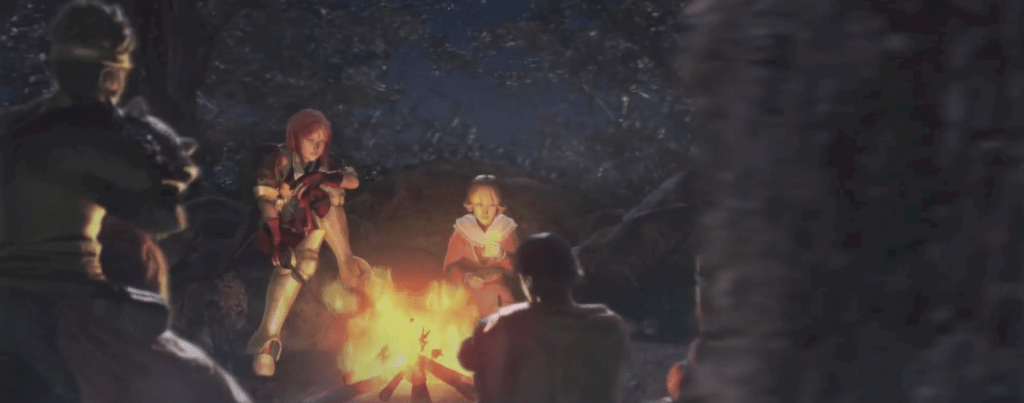
What does not make sense, however, is the implementation of the English opening cinematic for the game. While they could’ve gone with the Japanese opening, they instead rewrote, remastered and redubbed some of the original English release. The cinematic itself is a remnant of what were meant to be the original FMV cutscenes that would play during the game, hastily edited together. Voice lines overlap and the compression on the opening is downright awful, but it is really funny. Especially Lyude briefly channeling his inner Farquaad with his Shrek like animations. It’s incredibly goofy and charming.
Baten Kaitos is a massive game, with a ton of additional content that I haven’t even touched yet. It’s a game of incredible heights, but ultimately an ascend taken with wax wings that causes it to plummet at the zenith of the story. The first half of the game has one of the strongest, most well laid out, pay-offs that I have seen in quite a while, and it shows that there is an excellent narrative laid at the foundation. However, each foundation crumbles over time and the latter half erodes the carefully planned puzzle pieces with some of the most egregious bloat I have experienced in any RPG. The game would’ve greatly benefited from a second pass through the cutting room in order to make the story flow more concise and cohesive.
Despite my criticisms and the glaring pacing problems that the game faces, I was deeply charmed by the characters, the gameplay and the world design. Every new location was a feast on the eyes and on the ears, with some phenomenal backgrounds and music. The towns and islands felt distinctive with their own flourishing cultures and people. I wouldn’t recommend this game for its satisfying conclusion, or lack thereof, but rather to go on adventure in a weird, mysterious and magical realm. To marvel at stunning art and delve deep into deck building. Baten Kaitos is a game that felt like a standout and unique experience between a growing number of titans within the genre. I’m still incredibly divided by it, but the good times I had with my playthrough overshadow the bad of its finale.
Baten Kaitos serves as a great time capsule to put under a microscope when looking at Monolith Soft’s approach to designing large and fascinating worlds, but it also stands proudly on its own two feet. Albeit a bit drunk before 5pm.
A LOST OCEAN/10


Enjoying the review? Consider supporting TanookiChickenAttack with a coffee at;
https://ko-fi.com/tanookichickenattack

 TanookiChickenAttack