

2021 | Team Ladybug | Playstation 4

When thinking of the tabletop roleplaying scene today, things like Critical Role, Dimension 20 and Acquisitions Incorporated come to mind as groups and stories that are now cemented in the culture as titans. Before the recent rise in popularity of Dungeons & Dragons there was Record of Lodoss War that defined the fantasy genre within manga and anime for decades after its original inception in 1986. While originally published as a replay serialization, a transcript of the tabletop sessions, the sheer popularity of the series made dungeon master Ryo Mizuno adapt the story for a series of novels. These novels in part followed the journey of Parn, Deedlit and the rest of their party on their adventures through Lodoss. The first volume formed the foundation for the legendary 1990’s OVA produced by Studio Madhouse and would cause a massive impact on the fantasy genre as a whole in Japan. To say that Record of Lodoss War was a phenomena is a gross understatement to the influence it had at introducing and defining the genre. The series would go on to spawn a plethora of novels and a follow-up anime that took place after the original OVA series, and of course video games!
The first Record of Lodoss War game, subtitled Haiiro no Majo (The Grey Witch), was developed by Humming Bird Soft and released for PC-88, 98 and MSX, and was a first person dungeon crawler that loosely followed the events of the first novel. A sequel released for the PC-98 in 1991 which was a similarly Western styled RPG that took place a decade after the events of the first game. Humming Bird Soft would later release two turn-based RPG’s in 1992 and 1994 on the PC-Engine, titled Record of Lodoss War I and II, and closely followed the events of the OVA and the follow-up anime. The series then received a strategy RPG, also titled Record of Lodoss War, for the Sega CD by Kogado Studio in 1994 and a turn based RPG for the Super Famicom by Thinking Rabbit in 1995, also titled Record of Lodoss War.

Despite the numerous games released in the series, it wouldn’t be until the year 2000 that the West would receive its first interactive experience of this series with the Dreamcast release of Record of Lodoss War: The Advent of Cardice. While the main character in this Diablo-like RPG is a completely new character for the series, some familiar faces from the original party do join along the way. For the next 18 years this game would be the only official English game release in the franchise until Team Ladybug unveiled Record of Lodoss War: Deedlit in Wonder Labyrinth. Originally announced in 2018 the game would reach Steam Early-Access in 2020 and officially release in 2021 on PC and all major console platforms. The development of the game and especially its story was closely supervised by series creator, Ryo Mizuno, and leads up to the events prior to the Covenant of the Crown story.
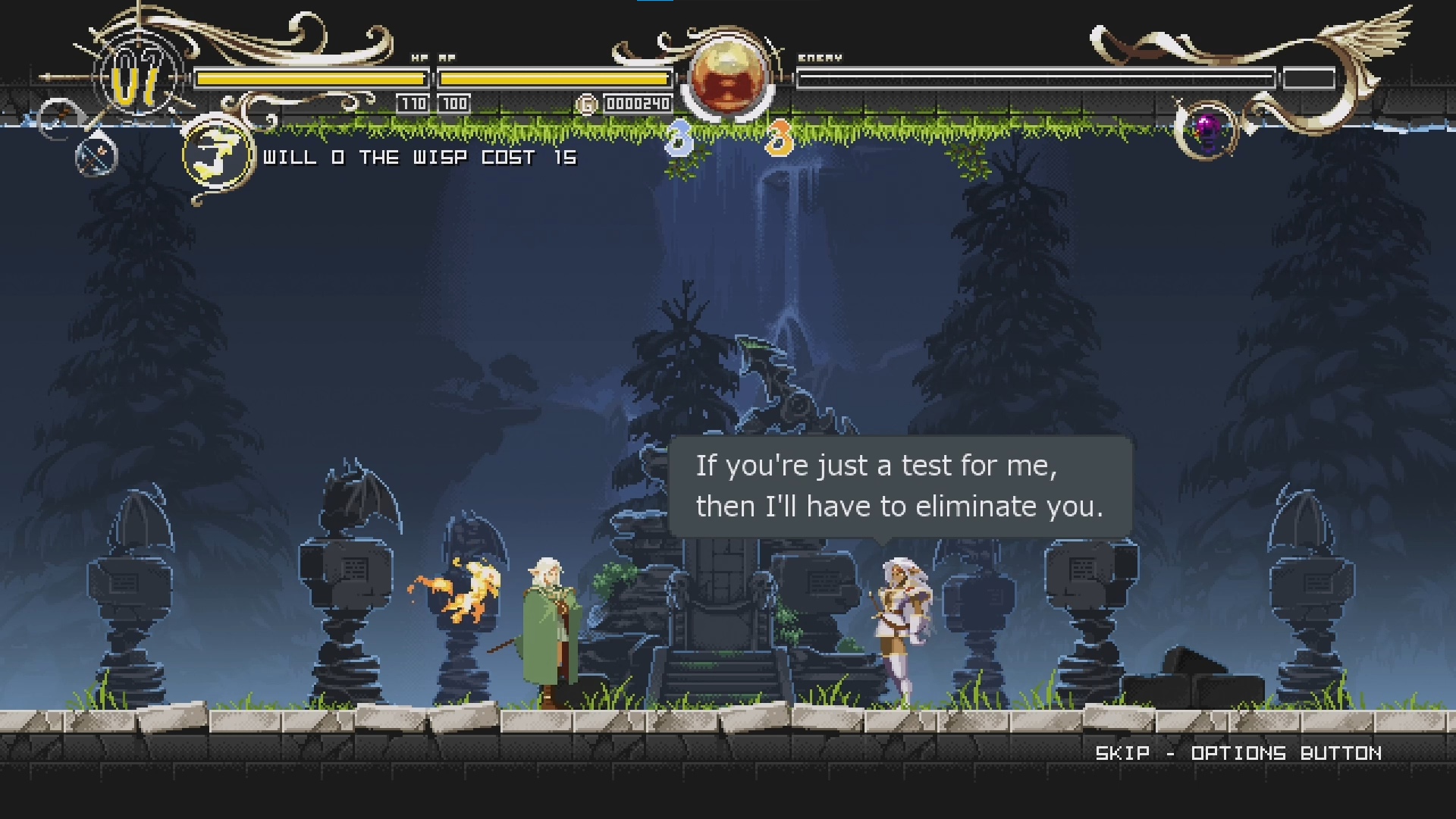
Deedlit in Wonder Labyrinth follows the titular high elf, Deedlit, as she awakens in a strange realm filled with ghosts of her past. After a bit of exploration we encounter Karla, the Grey Witch herself, as she tells us about trials that we need to overcome. Throughout your journey in the Wonder Labyrinth you’ll encounter various characters and enemies from the original OVA that will either help you on your journey, or cryptically elude to the larger plot at hand. To go along with the theme, a lot of bosses are major enemies from the first stories. At the roll of a dice we encounter the dragons Narse, Bramd and Shooting Star, as well as other antagonists. Throughout the game you also get into various fights with your dark elf counter-part; Pirotess, who also seems caught in the labyrinth to fulfill her goal of resurrecting the evil king, Ashram, but is thwarted by Deedlit along the way.
Ultimately, Deedlit in Wonder Labyrinth conveys the hollow dreads and imminent regrets of outliving your companions and the ones you love. A deep rooted message of coming to terms with the pains of the past to live for the future permeates throughout the narrative and is constantly out to test Deedlit on her resolve to carry on. In the end we see a shift in Deedlit’s attitude towards the painful memories of losing Parn to the cruel hands of time and starts remembering her journey more fondly before the credits start rolling, now more hopeful rather than nihilistic.

Most of the gameplay of Deedlit in Wonder Labyrinth will look and feel familiar to those who played through Castlevania: Symphony of the Night. Instead of a castle, though, we explore a vast network of tunnels and ruins in a quest for answers as to the nature of the labyrinth. It does give its own spin on the metroidvania genre and adds a bit of spice through the Ikaruga inspired Spirit mechanics. On your journey you will encounter the spirit of the wind, Silph, and the spirit of fire, Ifrit, which can then be used interchangeably. These grant you the power of levitation and heat resistance. By switching spirits you can absorb any projectiles and obstacles of their respective color as mana to use on spells. Each spirit can be leveled up by absorbing mana and can be raised to a maximum of 3, after which the spirit at maximum level starts healing you. The catch is that each time you get hit, it subtracts experience from your spirits, making them less powerful. The game makes excellent use of gradually increasing the complexity of ways you can incorporate them. At the start it will be as straightforward as using the levitate to hover over attacks, but quickly devolves into frantic dodging and weaving between waves of projectiles.
Alongside the spirits Deedlit also gains experience as she kills more enemies. This doesn’t really influence any other stat outside of your attack and defense; to upgrade your HP and MP you need to scavenge for items across the map. Your arsenal of weaponry starts off as Deedlit’s signature sword and quickly expands with a bow and a hefty plethora of devastating spells. The implementation of the bow is simultaneously brilliantly implemented and the clunkiest thing you can imagine. Certain doors can only be opened by shooting a rope or a gear, with the arrows being able to bounce off of metal plates on walls, floors and ceilings. This leads to elaborate shots bouncing around the room at impossible angles that make Wanted look tame. It’s wildly satisfying to hit these complicated shots and made me do the dorky celebratory fist pump upon successfully opening a door. The downside is that aiming the bow locks you into place to allow you to aim the shot. As you can imagine this makes using the aim feature of the bow in battle a tough act, however the game does remedy this with a horizontal quickfire.

Record of Lodoss War: Deedlit in Wonder Labyrinth is a wonderful bite-sized metroidvania that hits the perfect balance between comfortable exploration and challenging boss fights. There’s never a severe punishment for dying outside of spawning back at the many save points littered throughout the land. This provides a comfortable experience when exploring, urging you to take more risky paths and experiment with move combinations, rather than feel restrictive when it comes to the risk and reward. It is a mesmerizingly beautiful game to look at with some gorgeous sprites that are insanely well animated. This is all accompanied by a surprisingly fitting soundtrack that immediately transports you back to the OVA and makes it a real feast for the senses. While it is not a long game, it does its best to explore the themes of loss and regret as best as it can, though it does often favors cryptic exposition over dealing with the subject at hand. The story only takes the real center stage near the end of the game and leaves you, literally, chasing ghosts for the majority of it. Despite this it manages to convey the story well enough so that the player can get some narrative closure. Deedlit in Wonder Labyrinth is an utterly fantastic game, with smooth controls, fun exploration, challenging fights and an interesting premise to delve into. It doesn’t stick around for more than it needs to, yet leaves a deep impression in its wake. The tabletop influences are constantly present through little things like having the stage number be a dice roll. Despite experiencing a nearly two decade long drought for new entries of one of my favorite fantasy franchises that left me starved for more, Deedlit in Wonder Labyrinth presents itself as a three star, five course meal. Absolutely delicious!
Confronting the past/10


Enjoying the review? Consider supporting TanookiChickenAttack with a coffee at;
https://ko-fi.com/tanookichickenattack

 TanookiChickenAttack