

2013 | Japan Studio | Playstation 3

Oh, Japan Studio, how I miss you so. Every time I boot up one of their games the feeling of pure glee at the anticipation of what I’m about to play is firmly anchored with the melancholy of them no longer being around. Japan Studio was responsible for some of my favorite titles of the Playstation 3 era, including Rain, Tokyo Jungle and White Knight Chronicles II (developed alongside Level-5). The incredibly powerful creative prowess that was presented through these titles was immensely satisfying and inspiring to experience, and no game represents this creativity and solid execution better than 2013’s Puppeteer!
Japan Studio is one of the foundational pillars of Sony’s first party games. Since its founding in 1993 they were consistently putting out some of the most creative and high-quality games for the Playstation, starting with the first person shooter/RPG hybrid, Crime Crackers in 1994. From 1996 the studio was managed by former president of SIA Worldwide Studios (now Playstation Studios), Shuhei Yoshida, who created some of the now iconic teams within the company. Under his supervision Team Ico and Team Siren were formed, which included the incredible talent of Fumito Ueda and Keiichiro Toyama. These teams were responsible for some of the most incredible innovations and creative outlets (with a touch of the insane) on the Playstation 2 with games like Forbidden Siren, Shadow of the Colossus and Ico, alongside a huge catalogue of incredible Playstation 1 titles, like Legend of Dragoon, Vib-Ribbon, Wild Arms and the Arc the Lad series. With these games Japan Studio had firmly cemented itself as a powerhouse within the gaming industry. In 2008, Yoshida became studio head and started preparing the company for the launch of the Playstation 4 and VITA, while handing of the reigns of production management to Santa Monica’s Allan Becker to handle the ongoing projects. Under his supervision we saw some of the most incredibly creative works pop-up on the Playstation 3’s storefront, with absolutely mesmerizing titles like Rain, Tokyo Jungle and, the subject of todays review, Puppeteer. Japan Studio continued to prove itself by consistently delivering really solid and creative titles, the majority of which are now regarded as some of the biggest cult classics for their respective systems. As of 2021, Japan Studio as we knew it got disbanded and what remained merged into Team Asobi, who is now working on Sony’s mascot series; Astrobot.
Puppeteer was the brainchild of the game’s director, Gavin Moore, whom previously worked as an animation director for Siren: Blood Curse, a Playstation 3 re-envisioning of the Playstation 2 horror series. The game was originally revealed at Gamescom in 2012 during a time when Sony was heavily focusing on the home adoption of 3D in games and movies. As such a lot of the advertisement for Puppeteer would heavily promote the game alongside the dedicated Sony 3D Display tv. The game featured a 3D mode that layered the different depths of the stage props to create a similar effect as you would get when playing in 3D on a Nintendo 3DS. It made Puppeteer one of the few games that felt rather comfortable to play using this feature, in contrast to the sometimes dizzying effects of titles like Killzone 3. Part of the viewing comfort comes from the fact that you’re mostly watching a single screen at the time, as the camera rarely moves. As a side tangent; there was an incredibly cool feature in which two players could wear glasses and each have a different part of the screen calibrated to them. This allowed for a couch co-op experience that gave both players a different viewpoint on the same screen.

Puppeteer presents itself as a rather dark children’s story presented as a puppet theater show, with our headless protagonist, Kutaro, taking center stage. After the Moon Goddess got overthrown by her subordinate, Little Bear, by absorbing the power of the black moonstone and seizing the magical scissors, Calibrus, the now tyrannical Moon Bear King and his zodiac generals rule with an iron paw and claw. One day, Kutaro finds himself and other children changed into puppets and mysteriously transported to the castle of Grizzlestein. With his soul now trapped inside of a puppet and his head ripped off in a temper tantrum from the King, he now has to find a way to escape the castle. With the help of a flying cat, the pixie princess of the Sun, and the Moon Witch, Ezma Pots, he manages to steal Calibrus and escapes the castle. Now armed with the magical pair of scissors, Kutaro has to face the twelve generals to take their Moonstone Shards to become strong enough to face the Moon Bear King.
The whole story is constantly and brilliantly narrated by Marc Bretonniere, and serves to tell the story to the in-game audience. As the game progresses the narrator becomes increasingly more involved with the story and frequently (and hilariously) devolving into fourth wall shattering banter. The characters are absolutely brilliant as well, with each providing a unique dynamic to their respective scenes. The woe is me melodramatic Moon Bear King provides each scene with some hilariously unhinged slapstick comedy as he batters his generals around, which is in turn contrasted by Pikarina’s constant stream of complaining and moping with the added royal flair of sounding like a valley girl. The disgruntled cat, Ying Yang, is probably one of the more grounded characters that shows devoted care and want towards Kutaro’s success, were it not for the fact that his vernacular is equally devoted to cat puns. These characters are a large part of what makes the game so incredibly enjoyable. Particularly if you’re a fan of Terry Pratchett’s Discworld series, as the comedic tones of the game have an incredible overlap. Puppeteer constantly balances the darker undertones of its story, with creative scenarios and brilliant quips that keep the game fresh from start to finish.
Puppeteer takes place entirely on a theater stage, with the screen being framed by curtains. To fit the tone and feel of this, each screen has its own stage props set up to help you traverse from the start of the screen to a twirling vortex of sparkles that marks the end of the screen. Each screen is immaculately designed, giving each new part of a scene an almost handcrafted feel. It’s difficult to describe exactly what I mean by this, but essentially the whole game feels like the developers reached into the screen and placed each set piece with incredible care, by hand. The amount of effort it must have taken to fill a nearly 10 hour game with sets catered to each and every single moment feels incredibly monumental, and it delivers on this consistently. The team at Japan Studio emptied a warehouse worth of ammunition and simply never missed a shot. I will admit that the energy with which the stages shift feels like it borders on hyperactive, with the player getting very little time to settle in the moment to take in the tiniest of details. However, I didn’t find it bothering me too much, nor did it feel exhausting. It rather motivated me to want to replay the game to absorb more of those juicy details.

The basics of the gameplay in Puppeteer are relatively straightforward. It’s a platformer that has you run from the start of the screen to the end of the screen, whilst avoiding obstacles by jumping. The most notable exception to this is the mechanics behind Calibrus, the magical scissors. In another layer of fourth wall breaking, meta design, you can cut your way through parts of the stage as a means of traversing gaps. Whenever you stumble across a stream of leaves fluttering to the air you can press the square button repeatedly to cut your way through the decor and make your way across the gaps and obstacles. This also lends itself towards some incredible boss designs that sometimes lean on the unintentionally brutal. In most cases you have to avoid a few moves until the boss presents you with something you can cut. This is either by dodging attacks or reflecting them with your shield. Once you’ve made it past the pattern, the bosses then reveal a weak spot for you to sink your sheers into. This can range from simply cutting the cape of off an enemy, to giving a tiger a long overdue teeth trimming and fang removal (by scissor). I’m not sure whether the brutality of some of these fights are meant to be comedic or not, but it certainly displays the willingness of the game to use the puppets to their maximum potential. Even if that means giving a dog a lobotomy…. Twice.
The game takes head-up quite literally as your health bar is represented by the heads that Kutaro finds along the way. You can carry up to three of them at any given time and they also represent the amount of times you can get hit. Should Kutaro find himself properly decapitated without a back-up noggin, he dies. After you get hit there is a brief moment during which you can retrieve the head you lost, so there is at least some lenience. Outside of being the thing holding our hero together, each head is also themed and plays a little animation whenever you hit down on your d-pad. In certain parts of the game there will be glowing symbols of certain heads. If you play the animation on the corresponding head while you see one of these symbols, you unlock various rewards, such as bonus levels. While it is rewarding to find these stages, I quickly found myself glazing over these on my first playthrough as I was much more invested in the story. The head collecting is definitely something I recommend for a second playthrough though. Puppeteer is also one of the few games that manages to implement quick time events in a good way. Each boss ends with a cinematic sequence that has you press different buttons when prompted, however each button is tied to its corresponding action in-game. This means that you press X when Kutaro indicates he wants to jump, square to attack with the scissors and so on. These prompts do get expanded upon as you unlock more tools and weapons, but, despite becoming challenging, they never become overwhelming or deviate from their buttons.
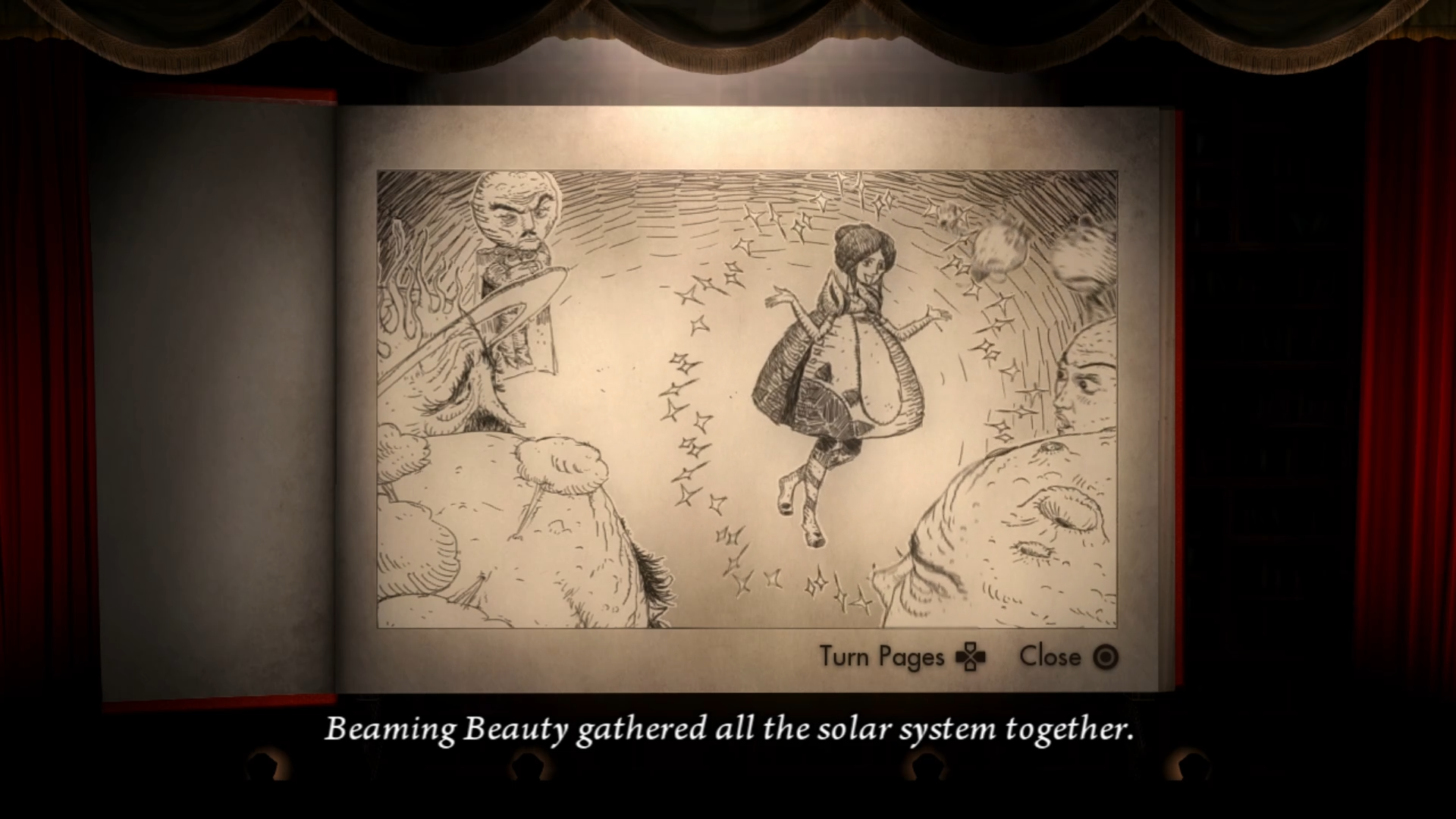
Puppeteer is a downright brilliant game in its incredibly creative approach to creating an interesting platformer. The story presentation is immaculate and despite having similarities to LittleBigPlanet in terms of its design and gameplay, it feels elevated far beyond that with a personal touch that gives the entire experience an artisan feel to it. Along with the main story, there’s a collection of side stories presented as a children’s picture book that delves into the background of some of the supporting cast. These add an extra layer of depth and ambiguity to the story that is just downright delicious. The soundtrack provides a mesmerizingly energetic and grand backdrop to the game, which is already overflowing with energy. The dialogue is really clever, and I’m still not sure whether the game was originally written in English or localized in spectacular fashion. One of the few downsides I found with Puppeteer is that it sometimes feels like they don’t fully commit to an idea, despite the game already spilling over the edge with boundless undulations of creative juices. There are a few scenes that tease an overhead perspective while the stage props are still set up like a regular level. If they had committed this idea to practice, the game would have provided a more varied menu to eat from during its runtime. Despite this minor complaint, I never found the game to feel monotonous or stale. Each new scene provides a fresh and unique look that stays just as long as it needs to, and with each world having such vastly different themes, it lends itself well to providing constant variety. While I initially found the constant talking a bit jarring to deal with, as it is an endless flow of back and forth dialogue, I found it to be one of the games more endearing parts as I got used to it. Puppeteer is a game that really emphasizes the strengths of Japan Studio’s incredible ability to execute satisfyingly upon the most outlandish ideas. It’s a game that exudes endless creative energy and left me hankering for more like it. It’s a must play for anyone owning a Playstation 3.
Just wanted a hug/10



Enjoying the review? Consider supporting TanookiChickenAttack with a coffee at;
https://ko-fi.com/tanookichickenattack

 TanookiChickenAttack