

2016 | WayForward | Playstation 4
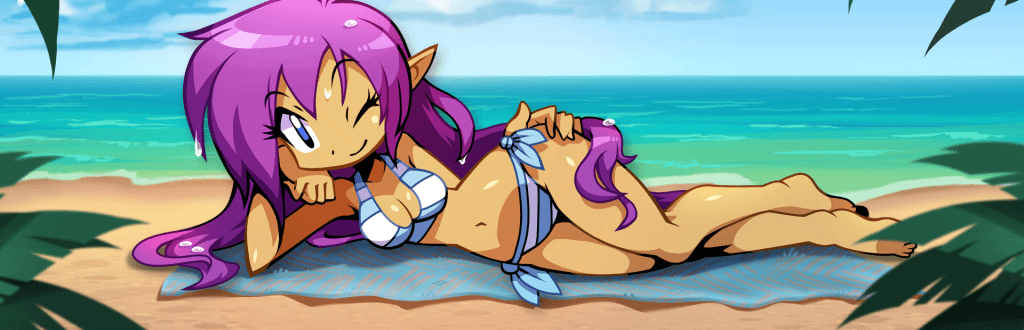
Over the last few months I’ve started to notice a lack of energy in trying to play long RPG’s, and as a remedy I’ve started exploring the metroidvania genre a bit more to cleanse the palette. To reset the taste buds if you will. While my usual go-to within the genre would be Symphony of the Night or Bloodstained for some vampire killing action, I figured it’d finally be time to jump into WayForward’s Shantae series with its fourth installment; Half-Genie Hero. Even though the series has been on my radar for quite some time I never really jumped into it outside of a modest foray into the 3DS version of Shantae and the Pirate’s Curse. So let’s take a look at what this bubbly and bouncy franchise has to offer, naturally starting with its fourth installment!
WayForward has been around for a lot longer than most people would probably realize. The company was founded in 1990 by Voldi Way, and got their start in the gaming industry creating various licensed and educational games. Their first title, 1992’s FunPack was a compilation released on PC of various games including a Pac-Man and Break-Out clone. From 1994 until 1997, WayForward would focus on developing educational software in partnership with American Educational Publisher. From 1997 onward they’d change their strategy to function as a developer for hire to work on numerous licensed titles, as well as continue to work on educational titles. It wouldn’t be until 2002 that they’d release their first original title and first installment of their, now flagship, series Shantae. This was the brainchild of series director Matt Bozon who designed the game after a character that was created by his wife, Erin Bozon. The first game was a platformer with heavy emphasis on exploration, featuring designs that feel reminiscent of Castlevania II: Simon’s Quest. It featured day and night cycles making the enemies stronger depending on the time of day, and various towns to explore on your quest to stop the evil pirate, Risky Boots. Despite gaining critical success the series was met with a financially rocky start as the first game released a year into the Game Boy Advance’s launch. This was largely due to the publisher, Capcom, holding the release. This in turn lead to poor sales, with a very low print run being produced, making it one of the more coveted Game Boy Color games amongst collectors. It took a rough 8 years for the series to make a return with 2010’s Risky’s Revenge for DSi Ware. Shantae and the Pirate’s Curse would later release in 2014 for the 3DS and Wii U, bringing the series into a more mainstream spotlight as well as becoming a critical success on the 3DS.
Shantae: Half-Genie Hero marks the series’ first departure away from the handheld platforms and was originally funded through Kickstarter to secure funds to self-publish the game. The initial goal to fund the game was set at an ambitious $400.000 with stretch goals unlocking new costumes and game-modes. The Kickstarter campaign was a success, reaching over double the initial goal, raising well over $900.000, and would eventually launch on all major home console platforms and Playstation VITA in December of 2016. Most of the backer goals, minus a few items, were added as DLC. A limited-release physical version was released alongside its digital counterpart, published by Xseed Games, and became one of its fastest selling products. It’s safe to say that Half-Genie Hero was a financial success upon its release. In 2018, WayForward would release an updated version of the game with all the extra game modes and costumes included for Playstation 4 and Switch, with Xseed once again publishing the physical copies for North America and PQUBE handling the European release. Shantae: Half-Genie Hero, alongside the 3DS release of Pirate’s Curse, are currently the only games in the series to receive a physical European release.
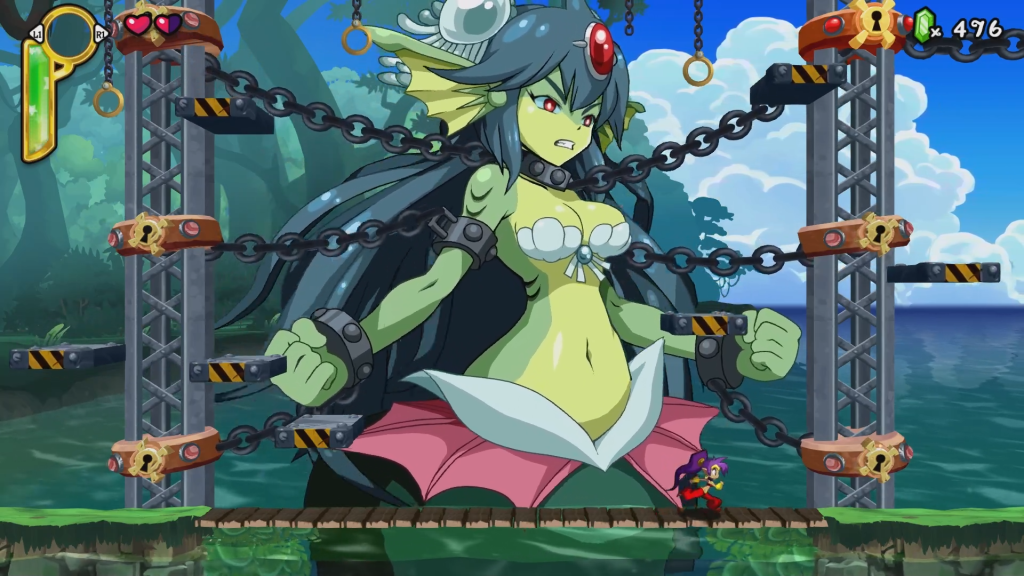
I absolutely love delving into the background and history of a game’s conception and Shantae: Half-Genie Hero stands in an interesting position. It’s a game made possible by fans, for fans in the truest extent. One of the pieces that was missing from the story was a motivation as to why WayForward turned to Kickstarter to fund the game, so, as a shot in the dark, I sent an email with the questions I had remaining. I was absolutely delighted to find my questions answered by none other than company founder, Voldi Way, and series director, Matt Bozon. Their response to the questions helped put into perspective how we very well could’ve gone from Shantae and the Pirate’s Curse to Shantae and the Seven Sirens without a Half-Genie Hero in sight. They also provided insight into the design of the series, some of the unique challenges that come with a Kickstarter campaign, and how we ended up with the Ultimate Edition later down the line.
What was the motivation to start a Kickstarter for Shantae: Half-Genie Hero?
Voldi: Being pixel art, we were able to self-fund Risky’s Revenge and Pirate’s Curse, but Half-Genie Hero had 2D-HD animation with full 3D backgrounds, which was much more expensive than we could fund on our own.
Matt: This is a case where it was truly up to fans. We decided to leave the fate of the next game entirely up to fans. There was no plan B. If fans funded it, we’d make it. If not, we wouldn’t, and the team would’ve moved on to a work-for-hire project.
What were some of the challenges tackling a home console release vs hand held?
Voldi: We had released other console games using wfEngine, so this wasn’t a problem.
Matt: Before HGH, all Shantae games were love letters to a single handheld: Game Boy Color, Game Boy Advance, Nintendo DSi, and Nintendo 3DS. HGH would be the first game to spread the love between all consoles and PC right out of the gate, and be designed for the living room. Like Voldi mentioned, the tech was there…though we did have to create some alternate versions of certain content for Playstation Vita. We leaned heavily into DLC and regular updates, which was still fairly new for the Shantae series. During the campaign we updated Risky’s Revenge with a new costume, which was sort of a baby step in that direction.
Were there any challenges going from the Kickstarter campaign to the initial release, and subsequently the release of the Ultimate Edition?
Voldi: We had planned on including all the content from the Ultimate Edition in the initial release, but everything took so much longer than we expected, that we decided to release things piecemeal to minimize how long our backers would have to wait before being able to play anything.
Matt: Running the Kickstarter campaign was a daily challenge while also making the game! Having thousands of bosses to answer to added the need for additional communication to fans, which was a ton of fun, but also time consuming. Many delays were caused by timing, with the game’s development cycle having to bridge console generations. Nintendo, Sony, and Microsoft were all introducing new hardware while we were knee-deep in development. In the end, we’re extremely proud of the game that we were able to make with help and input from so many fans!
It is thanks to the combined efforts of the support from the fans and the work from the development team that we got to enjoy such a complete package with the version that I ended up playing; Shantae: Half-Genie Hero Ultimate Edition!

Shantae: Half-Genie Hero continues the adventures of the titular Shantae as she’s awoken one day by a mysterious voice, which guides her to a hidden basement underneath her uncle’s workshop. The voice warns her of a looming danger that will threaten the Genie Realm if not stopped. The next morning Shantae wakes up, thinking it was all a dream, and goes to visit Uncle Mimic to see a new invention he’s been working on, the Dynamo. The Dynamo is a device that is supposed to help protect and provide power to Scuttle Town. However, before the elevator pitch is over, the town is put under siege by the pirate Risky Boots and her Tinkerbat goons, and they manage to steal the blueprints for the Dynamo.
From here we go to the town square with the help of Shantae’s friend Sky and her overgrown bird, Wrench, to give chase to Risky and retrieve the blueprints. And so our first steps into Half-Genie Hero commence with a town ablaze and pirates infesting every crevice and crack. The high paced opening gives a great first impression at the energetic and bombastic vibes of the game. Your first foray is accompanied by a pounding music track that provides an excellent spring board of adrenaline to get your day of half genie heroics going. After defeating Risky and her sentient boat, the mayors declaration of gratitude comes in the form of firing Shantae from her duties as guardian of the Sequin Lands due to the extreme damage to the town. From a logistical standpoint its a somewhat sensible decision, but the timing is a tad sour. However, now armed with the once stolen, now retrieved, blueprint, Shantae and friends set out on a journey across the Sequin Lands to find the missing components for the Dynamo.
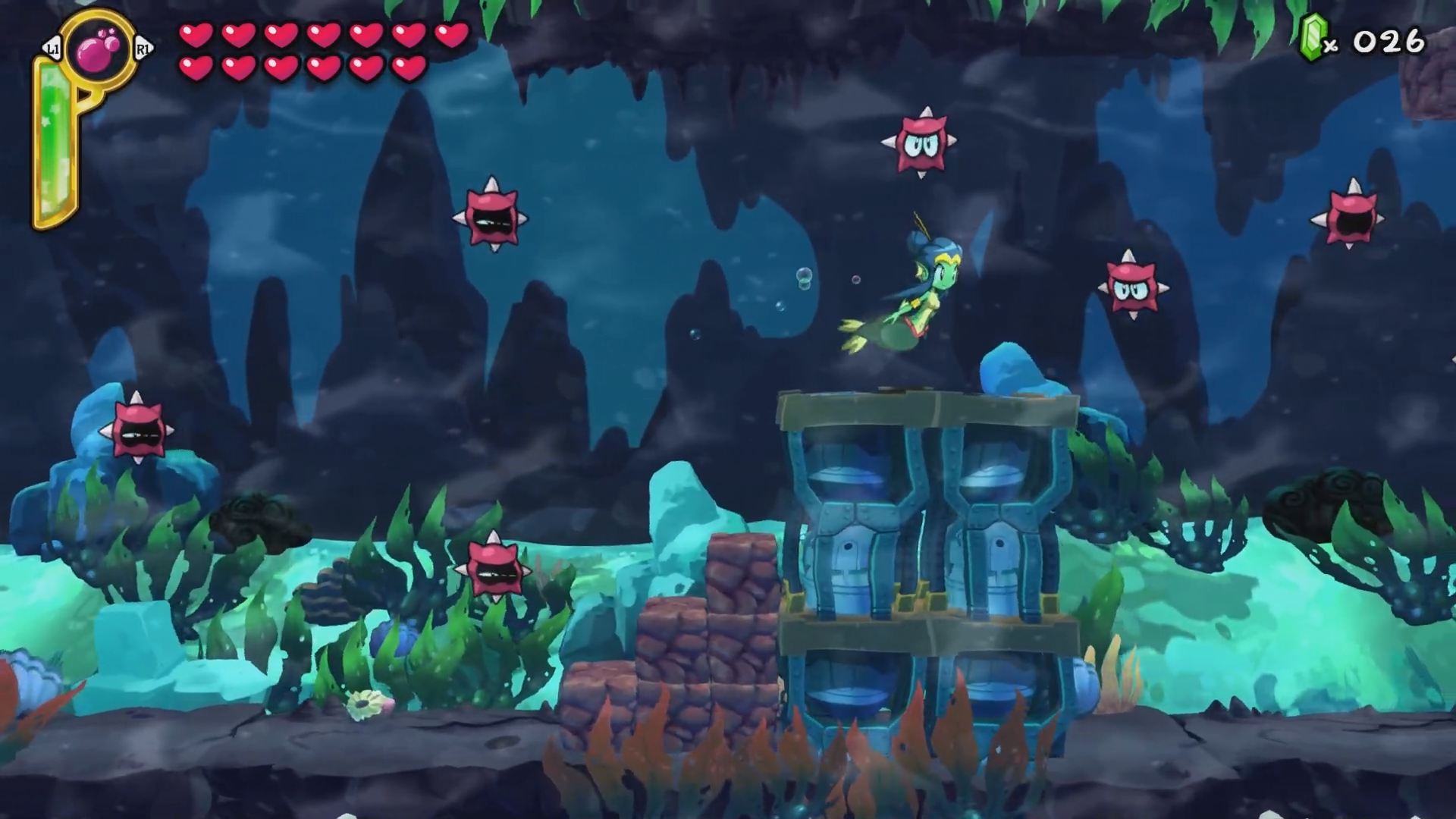
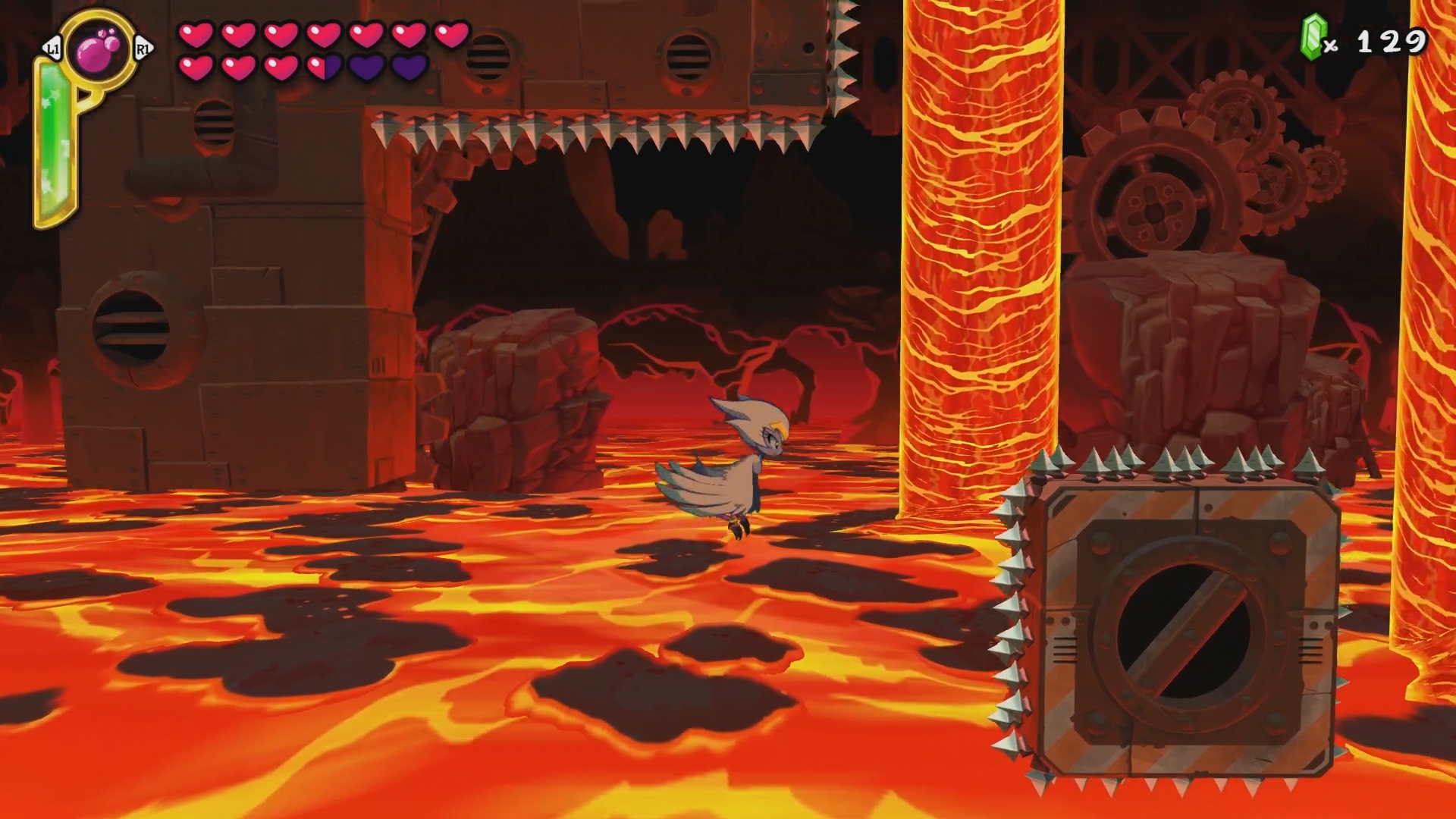
Half-Genie Hero presents itself as a set of stages that you can freely explore and revisit, with Scuttle Town serving as a hub area. While it’s not a metroidvania in the sense that you have a large interconnected world in which you find items that grant you access to other segments of the map, it is very much metroidvania in its overall design. Each stage can be completed by going from the start to the level and beating the boss at the end of the level, however, along the way you can find various items that give you access to hidden parts of these stages. One of the key gameplay elements is Shantae’s ability to transform into various animals to help assist in your exploration. The monkey allows you to enter smaller areas and jump real high, the crab lets you crawl on the ocean floor and snip angrily at trespassing toes and the elephant allows you to romp and stomp across the stage to break large boulders (and step on small, innocent flowers). The way that these transformations are implemented isn’t just good, it’s satisfying and rewarding. The levels are designed in a way that it’s very easy to remember what you can explore with the new transformations. Alongside the power to turn primal when dancing, Shantae also possesses powerful hair which can be used to attack enemies. You can upgrade the speed and power by purchasing hair care products at the item store in Scuttle Town.
We can’t talk Shantae without Jake Kaufman’s incredibly energetic contribution to the game’s soundtrack. From the moment the game boots up, you’re greeted with a non-stop barrage of incredible tracks that provide the game with a unique energy. This is complimented by all the little animations from the townspeople and, of course, Shantae’s idle dancing. Everything moves and bounces to the rhythm of the music, perfectly complimenting the exceptionally energetic soundtrack with fantastic animation work. Half-Genie Hero is filled with a lot of love and care to sew every bit of gameplay and animation together with a musical thread.
Shantae: Half-Genie Hero is an incredibly fun, vibrant and satisfying game to play. Each stage is laid out in a way that allows you to complete it with a certain flow of momentum that makes it feel like you’re zooming around at the speed of sound. While some of the later side quests in which you have to collect a certain amount of an item can feel a bit monotonous, it doesn’t make revisiting the stages to discover more secrets any less fun. These item gathering quests are mostly located at the end of the game, so by the time you get there you’re more than likely to have grabbed a few of the requisite collectibles already. In contrast to some metroidvania’s Half-Genie Hero doesn’t hide things too far out of plain sight, allowing you the satisfaction of discovery without the process feeling too overbearing. The extra modes included in the Ultimate Edition, which were DLC for the original release, provide a nice bit of variety with new kits and threads for Shantae, and modes to play as Risky Boots. Half-Genie Hero is relatively straightforward in its approach to how it wants to challenge its players. Rather than providing a slew of enemies to whip through, the levels are designed as a sort of puzzle to solve. A large part of the later stage exploration is spent in transformation and provides new angles to approach situations. For instance, the spider form not only hooks to ceilings, but also to the conveyer belt rings. It’s also made extremely easy to get through stages by means of a whistle to go back to the overworld and a dance that allows you to warp to next part of the stage. This provides you with means to quickly explore certain bits of a level and with the areas feeling so different it also becomes almost second nature to remember certain parts that you haven’t checked out yet.
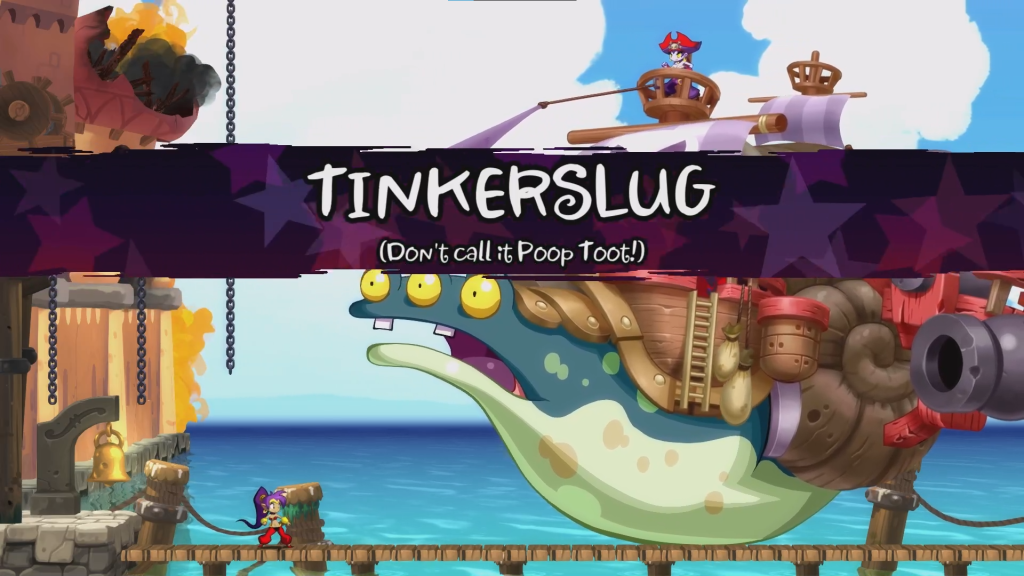
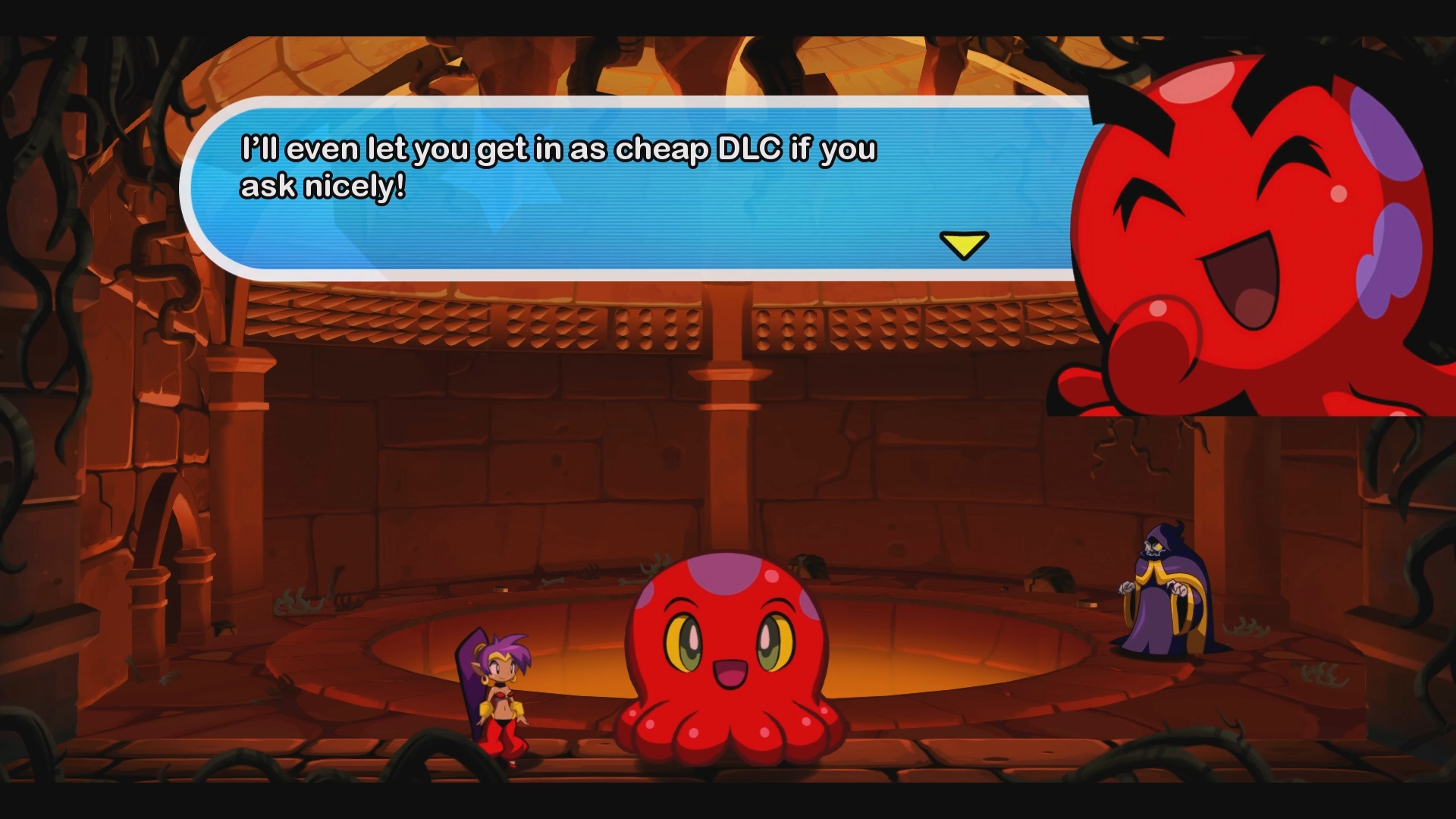
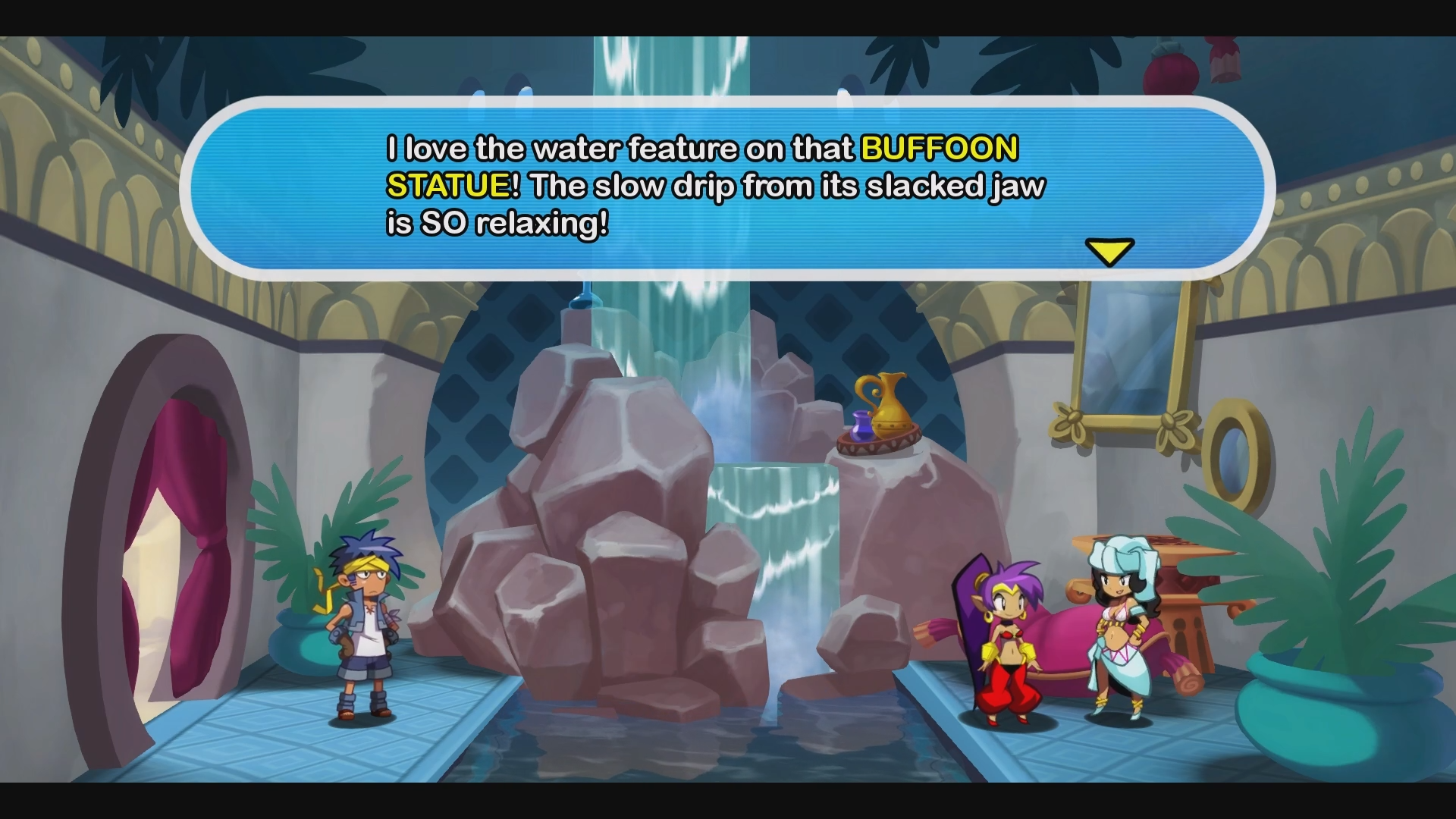
Shantae: Half-Genie Hero is such an incredibly fun game both to play and in its presentation. It feels like waking up on an early Saturday morning to blanket up on the couch and watch your favorite cartoons. Shantae and her motley crew of misfits are an energetic and loveable bunch that give the game a lot of heart and character. Even the villains are incredibly likeable, with my favorite being the fourth wall shattering mid-boss of misery, Squid Baron. Every bad guy is extremely memorable and they all have some fantastically goofy lines to bring to the table. The humor permeates through every pore and pixel, with some delightfully spiteful jabs interspliced with some really funny animations, mostly at the expense of Risky’s boat (don’t call it poop toot) and Squid Baron’s career as a video game character. These characters give the game so much heart and make it an incredibly enjoyable time to join them on their adventures. The gameplay feels incredibly smooth and intuitive and the transformations add a whole new layer to exploring the stages. That combined with Jake Kaufman’s brilliant soundtrack serve as a constant stream of good vibes. As an introduction to the series, Shantae: Half-Genie Hero serves as a brilliant stepping stone to introduce players to the world of Shantae as well as a great introduction to the general idea of the gameplay. While each other entry in the series offers some variation and unique mechanics, they never deviate too far from the core concept, so if you enjoy Half-Genie Hero, you’re very likely to enjoy the rest of the series! The Ultimate Edition also provides some refreshing takes on the same levels straight out of the box. I’ve grown particularly fond of the Mighty Switch Force themed DLC that has you explore the same stages, but traversing them by alternating blocks between the fore-and background. These extra modes breathe new life into already visited locales and do an excellent job at re-imagining the core game through different mechanics. Shantae: Half-Genie Hero is a fantastic game that provides a gigantic amount of content in a single package and got a new fan of the series out of me!
A massive thank you goes out to Matt Bozon and WayForward’s Tyrannical Overlord, Voldi Way, for taking the time to answer the questions I had, as well as the great interactions I had with their PR!
Poop Toot/10

Enjoying the review? Consider supporting TanookiChickenAttack with a coffee at;
https://ko-fi.com/tanookichickenattack

 TanookiChickenAttack