

2014 | WayForward | PC

With the three most recent installments of the Shantae franchise in the pocket, it was now time to delve a bit more into the roots of the series. It provided an incredibly interesting retrospective that really made me appreciate the evolution of the Shantae games, but in reverse. Not just that, but WayForward once again managed to exceed my expectations once again with some incredibly unique approaches to exploration, and that made me giddy to keep playing Shantae: Risky’s Revenge Director’s Cut.
After nearly a decade, WayForward released the first sequel to the Shantae series for the Nintendo DS in 2010 through DSiWare, with an iOS port releasing shortly after. The initial plans for the Shantae series was to follow-up the original Game Boy Color game with Risky’s Revolution for the Game Boy Advance, however due to a lack of publisher interest the game was put on hold (until later this year that is!). This was likely due to the challenges the original faced by releasing into the reign of the Nintendo’s newest handheld juggernaut and being one of the last Game Boy Color games to get released, thusly receiving a rather low print run. The flagship series would go dormant for a good while, before the reveal in the latter part of 2009. In 2014, the game was ported to PC (and subsequently all major platforms from 2015 onward) as Shantae: Risky’s Revenge Director’s Cut. This version featured the Magic Mode from the iOS version, that decreased the cost of using magic, but also increased the damage you’d take for the players needing an extra bit of oomph. It also featured an updated warp system for easier traversal of the map. Some of the ideas that carried over from Risky’s Revolution to Risky’s Revenge give the game a distinctly Game Boy Advance feel to the overall experience.

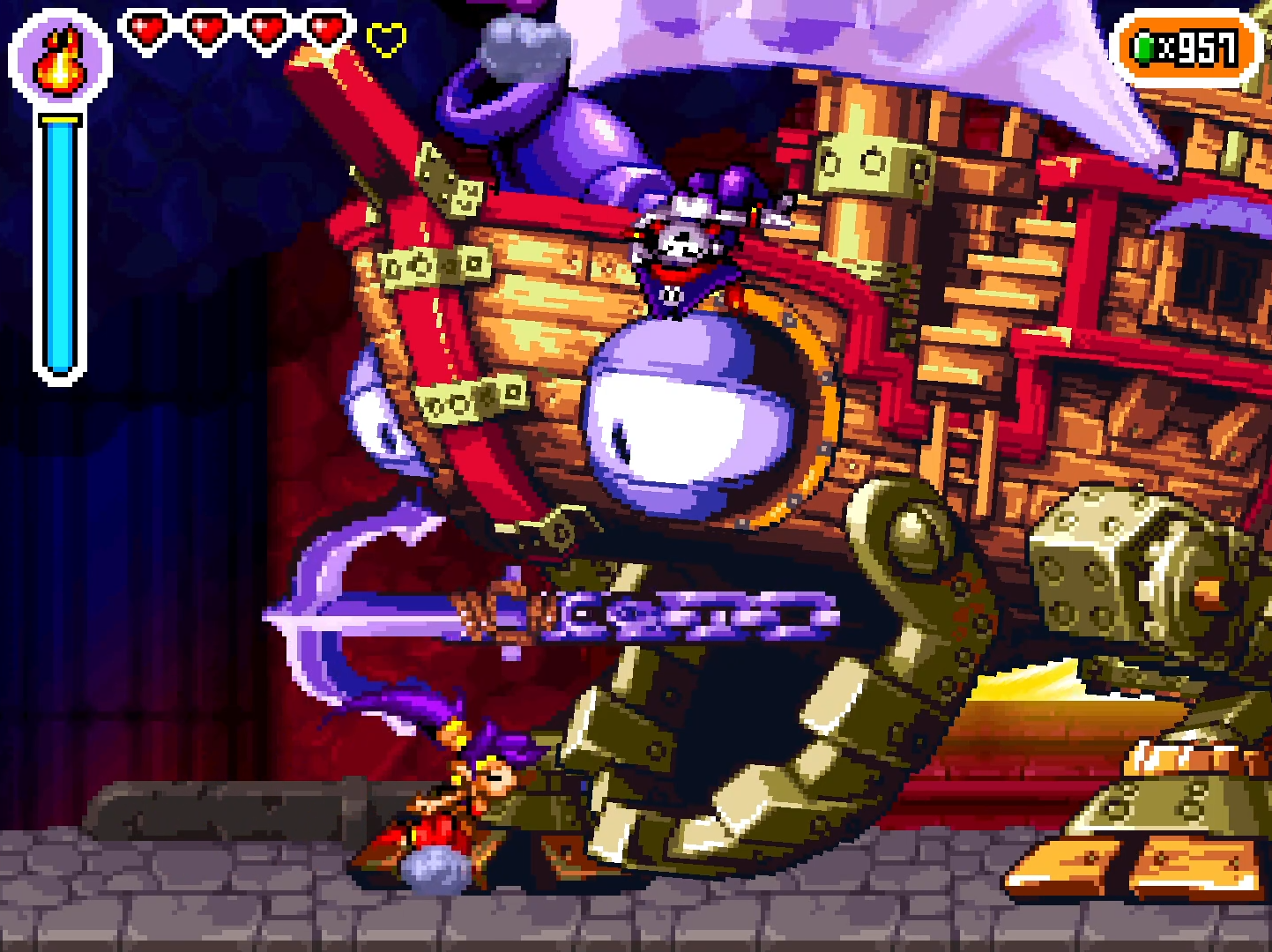
In Risky’s Revenge we get to visit the Relic Hunter Expo, where Uncle Mimic is ready to show off an incredibly rare artifact he recently excavated; a mysterious lamp. While the crowd is in awe of the enigmatic artifact, the party is crashed by none other than Risky Boots, Self-Proclaimed Queen of the Seven Seas! After Shantae fails to defeat her, Risky leaves the town in complete shambles and this kickstarts the trend of the Mayor getting upset and firing Shantae for failing in her Half-Genie duties. Despite this, Shantae is determined to find out what the mysterious lamp is and why Risky went so far as to steal it. This leads to the start of your quest to find three magical seals from the three Barons, with a bit of help from Sky, Bolo and Rottytops of course! This entry also serves as an introduction to a few now staple characters that serve as recurring villains and unlikely allies, depending on your point of view. It’s also the introduction of the squid, the myth, the legend, the collectible kraken of the seven seas; Squid Baron! While the game structures itself as a metroidvania, the acquisition of the three seals gives you a diverse list of tasks to complete. From arranging a takeover of a town, finding a dog to inspire, getting a chef to cook a tasty meal, to simply challenging a dungeon and defeating the boss at the end. It makes the bulk of the story feel incredibly fresh and exciting as you’re constantly surprised at the rich variety of stuff you can do. During the quest for the three seals, Risky manages to trick Rottytops and her brothers into kidnapping Uncle Mimic, enticing them with lifetime supplies of coffee, as well as Shantae’s grey matter. Shantae immediately goes to the rescue, and by immediately I mean collect a few baby squids to get a final upgrade, and rushes through the underwater tunnels towards the boathouse. This leads to a final confrontation between Risky and Shantae, where it is revealed that the lamp is actually a Genie lamp, which allows Risky full control over the powers of the Genies. After absorbing the magical half of Shantae into the lamp, the final confrontation pits you against Nega-Shantae, an evil manifestation of Shantae’s Genie half. The confrontation leaves Risky defeated and Shantae more human than ever, with her magic powers now sealed away.
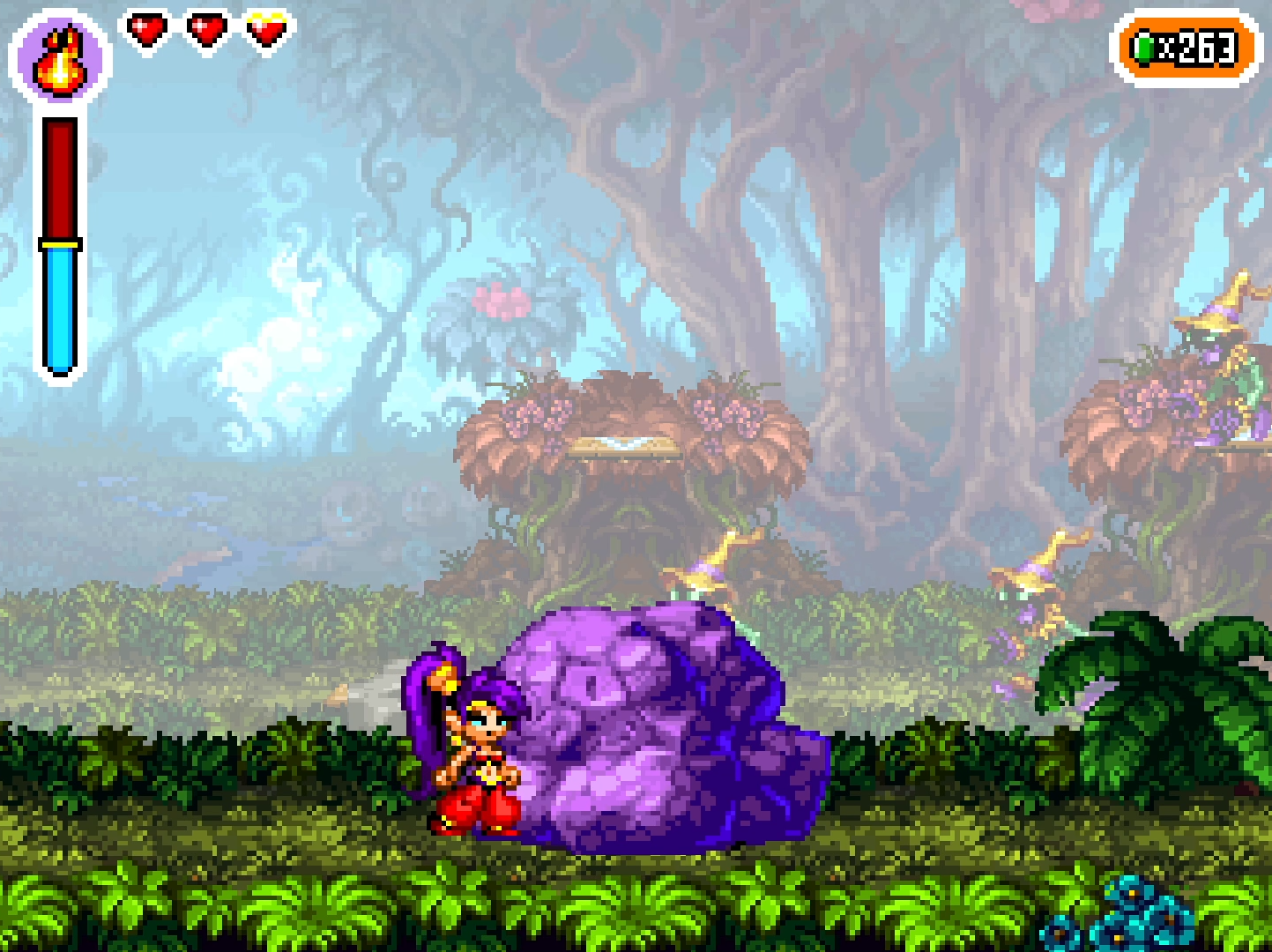
Shantae: Risky’s Revenge Director’s Cut takes a few footnotes from the original, released a decade earlier. Much like the other entries in the series, Risky’s Revenge provides you with a large open map to explore and mess around with. The twist is that certain areas are layered instead of a layout on a singular plane. This gives the game quite a unique feel, in which you’re hopping back and forth between the fore- and backgrounds to explore the Sequin Lands. Unfortunately this is kind of relegated to Scuttle Town and the first major area of the game. It gives the game a very unique feel to it that adds a lot of depth as well as a surprising level of depth to exploring. Overall the experience of running through the Sequin Lands is surprisingly stream-lined, mostly due to the map being relatively compact. This is in part due to certain areas being more vertically condensed instead of horizontally spread. It makes scouting for optional rewards, like the heart squids and extra abilities, rather satisfying to do. It does help that there are Warp Squids scattered around that you can interact with to warp to locations you’ve previously visited. The overworld gets accompanied by a nice assortment of challenging dungeons to tackle, ranging from a timed race to the top, to the classic obstacle course to the boss. The dungeons are quite challenging, with a slew of precise platforming to traverse, however it always threads that line of being challenging, it’s not overtly difficult. This makes for an incredibly satisfying gameplay experience.

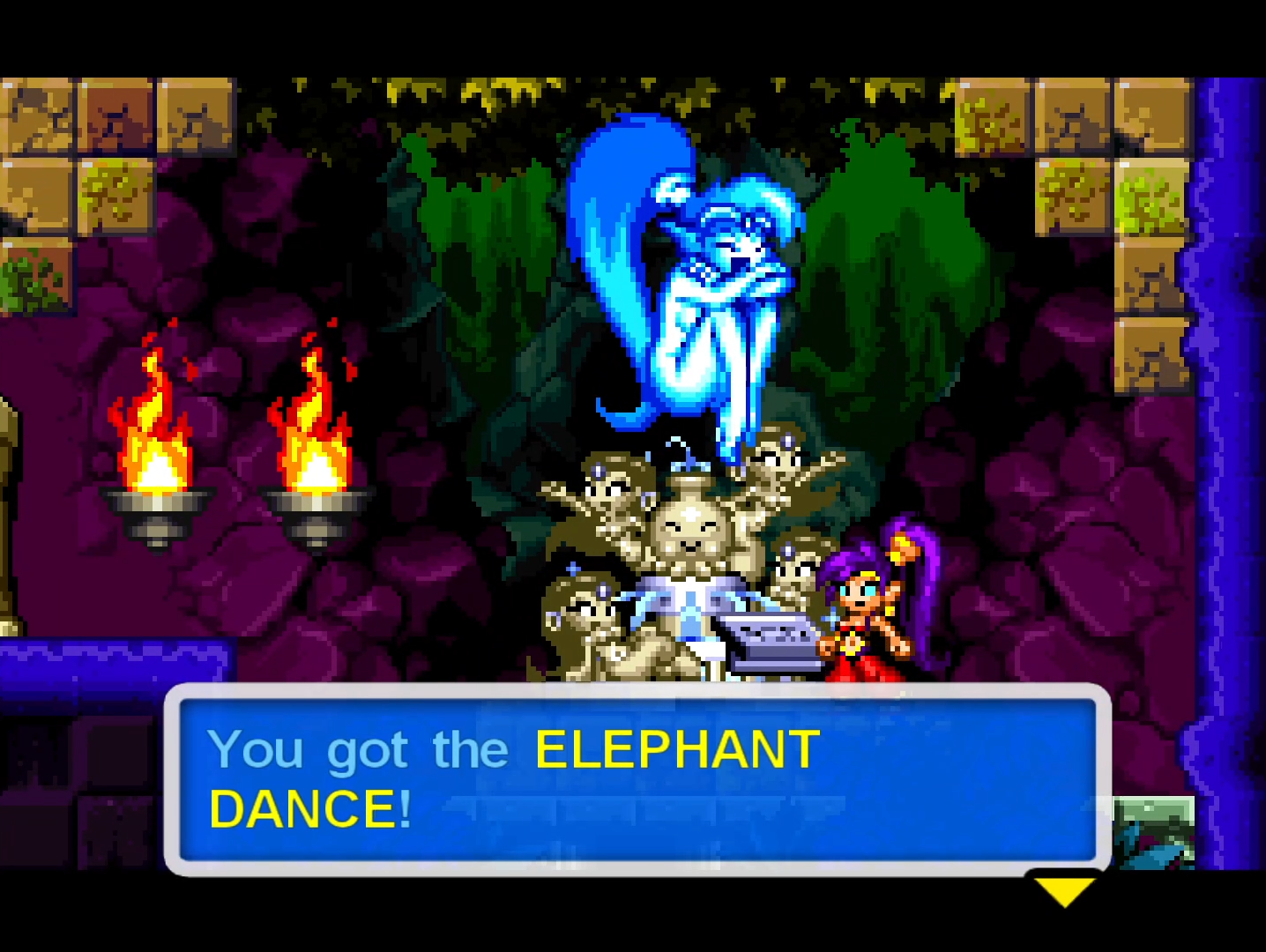
Most of the now staple mechanics of the Shantae series can be traced back to Risky’s Revenge, at least in some iterative form. Throughout the game we unlock a few transformations to help you traverse the overworld and dungeons. Each of these are accessed through the dance mode, and the transformation you pick is chosen by what beat you stop the dance on. The first beat lets you stay in your regular form, but the second gives you access to the Monkey form, which allows you to cram into small spaces, stick to walls and jump extremely high with. The third beat turns you into an elephant, which stomps and storms through breakable objects. The final beat is reserved for the bird form, that lets you fly and claw your way through the world. While it may seem somewhat disruptive to the gameplay flow by going into a dance mode every time you have to transform, it rarely felt this way as it quickly becomes an intuitive process to associate the form you’re looking for with the beat you’re on. This allows you to swap forms on the fly as part of the general flow of gameplay instead of having it halt your thought process. It’s a nice transition from the rhythm mini-game you had to perform in the original. It’s still a far cry from the buttery smooth pirate tools in Pirate’s Curse, or the instant transformations of Seven Sirens, but the dance mechanic does incorporate well enough into the game that it makes the pacing feel relatively seamless.
Shantae: Risky’s Revenge is a fantastic experience, especially if you’re a fan of that sweet GBA aesthetic. The pixel art is downright stunning, and the character portraits are gorgeous and vibrant. It’s been an absolute treat to visit this entry retrospectively, since you can tell what parts of Risky’s Revenge influenced the later games. Jake Kaufman lends his skills to the soundtrack of the game, providing it with the bass-pounding, energetic music that has since become so synonymous with the series. The layered maps in the game are amazingly designed, however I do feel like this idea is very underutilized, especially in dungeons. Maybe it’s to prevent players from getting too lost, but I would’ve loved to see more of these parallax layered areas. The idea of a boss fight taking place on multiple layers, where you have to chase the enemy back and forth across the fore- and background is a concept I would’ve loved to see fulfilled. With the more complex areas also comes a complex map for you to puzzle over. It’s not the most difficult map to read, but it does take a minute to really internalize the layered areas as they are presented, partially due to there simply not being a whole lot of these areas. Risky’s Revenge feels like an incredible evolution of the first installment and a tremendous foundational work for the series moving forward. The dance mechanics are intuitive and the newly introduced characters are a boatload of fun. I also really appreciate the game ending on a somewhat bleak note, depending on your viewpoint. To leave Shantae completely powerless at the end was a bold move on WayForward’s part, and it lends itself incredibly well for the plot of Pirate’s Curse. This choice makes Shantae feel much more like a character, rather than the extension of her powers. Shantae: Risky’s Revenge is a fantastic metroidvania, however I did run into a few issues when playing the game on PC. The biggest problems I encountered were resolution settings not being saved, causing the game to crash when plugging in a controller after launching, as well as the game having a general aversion for tabbing out. Take these with a grain of salt though, as I am notorious for breaking games in the weirdest ways. Overall, Shantae: Risky’s Revenge is a phenomenal game that lays the foundational work for an equally phenomenal series. It stands proudly on both legs, while holding the rest of the franchise on its shoulders
Genie in a bottle/10




 TanookiChickenAttack