
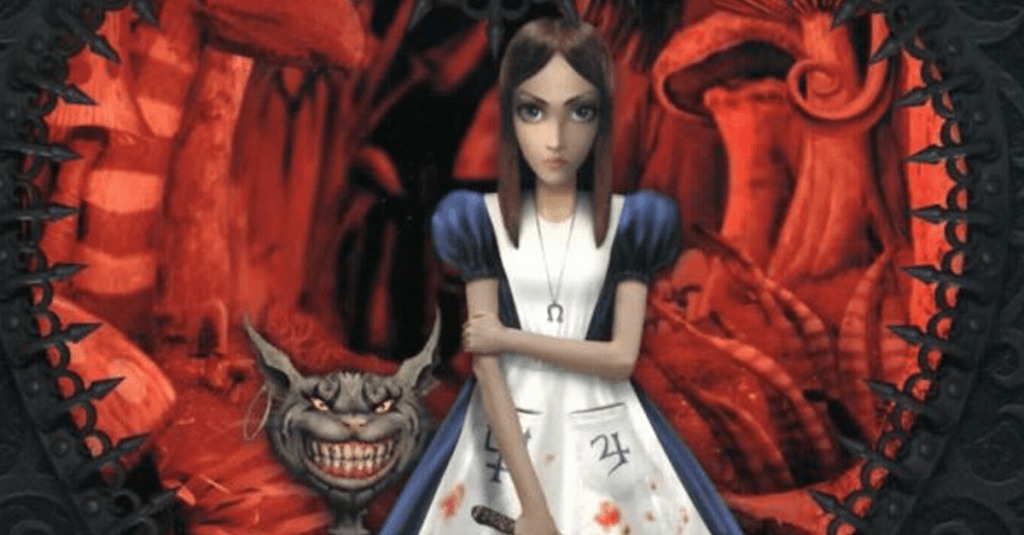
2011 | Rogue Entertainment | Playstation 3

This review deals with very heavy subject matters.
When Alice: Madness Returns released in 2011 it came with a little voucher that contained a code for a port of the 2000’s PC game; American McGee’s Alice. At the time, and to this day, this was the only way to get your hands on the digital download of the first game that was contained within the menu of the second game. I was mesmerized when I first played the original release of this game. I would play until deep in the night, surrounded by an ever expanding fortress of soda bottles that I confiscated from the fridge downstairs. The bizarre and grim atmosphere of the game drew me in, in a way that very few other games could, so when I got the chance to replay it with the release of the sequel you can imagine how excited I was. While I do remember really enjoying my revisit the first time, this time around was a very different story. I do have to state beforehand that this is a review that covers the American McGee’s Alice HD version on Playstation 3 and doesn’t reflect the quality of its PC counterpart. This ride is about to get very bumpy.
American McGee is best known for his contributions as one of the level designers for the original Doom and Quake. He got dealt a pretty damn poor hand in life. American grew up with his eccentric mother, having only had interaction with his father at age 13, who drunkenly assaulted him. When he was 16 he came home to an empty house, his mother seemingly packed her things, sold the house and left. From here he’d work the odd job to make ends meet and eventually ended up in an apartment complex, where he’d meet John Carmack. At age 21 he was offered a job as tech support by John Carmack at id Software. Here he worked in a supporting role on Wolfenstein 3D. After this projected he was promoted to level designer, where he designed levels for the original release of Doom, as well as overseeing the design for the Atari Jaguar port of the game. Throughout his career at id Software, American worked on some incredibly iconic shooters, as well as getting more experience with 3D as shooters got an extra dimension with Quake II. In 1998 he was fired from his position at id Software due to unknown reasons, outside of speculative reporting on the matter. He didn’t take it badly though. In fact, he took the experience he gained during his time there and started to walk his own path in the industry. This path would lead him to work as a creative director at Electronic Arts, where he would develop the game, with Rogue Entertainment, that he would be most known for; American McGee’s Alice. A lot of his personal life would help shape the foundation of the game’s concepts. And it’s part of what makes the game feel so authentic.

American McGee’s Alice is a deeply personal feeling tale about processing trauma and loss. The story follows Alice Liddell, whom after being awoken from her dreams of Wonderland by a house fire, is left heavily traumatized by the loss of her parents, and the crushing guilt she experienced for feeling responsible for her their demise. She’s left in the Rutledge Asylum, completely catatonic and mentally withdrawn into the dream-like world of Wonderland, now slowly getting corrupted by the effects of the trauma. After several years of failed treatment, she is seemingly awoken by the call of her stuffed rabbit, and fully retreats into Wonderland to answer the cry for help. She quickly finds that the Queen of Hearts has left Wonderland in a dystopian, desolate, despondent state. The once whimsical characters that she shared a cup of tea with are now deformed, grotesque shades of their former selves, corrupted by the influence of the Queen of Hearts. Guided by the Cheshire Cat (in the most lovely of snarky tones), Alice is tasked with liberating Wonderland from the corrosive grasp of the Queen. During your travels through the desolate Wonderland you’ll encounter many familiar faces, albeit usually detached from the body they originally inhabited, or mangled and maimed to be more metal than flesh. At one point, during your exploration of the Mad Hatter’s (now truly mad) factory, you’ll encounter the rabbits from the tea party strapped to a surgical table, stripped of most of their limbs and internal organs. Instead these are replaced with mechanical components, leaving them as a husk of suffering and torment. And a lot of Wonderland follows a similar path; death is a constant companion while you’re fighting back against the forces of the Queen of Hearts.
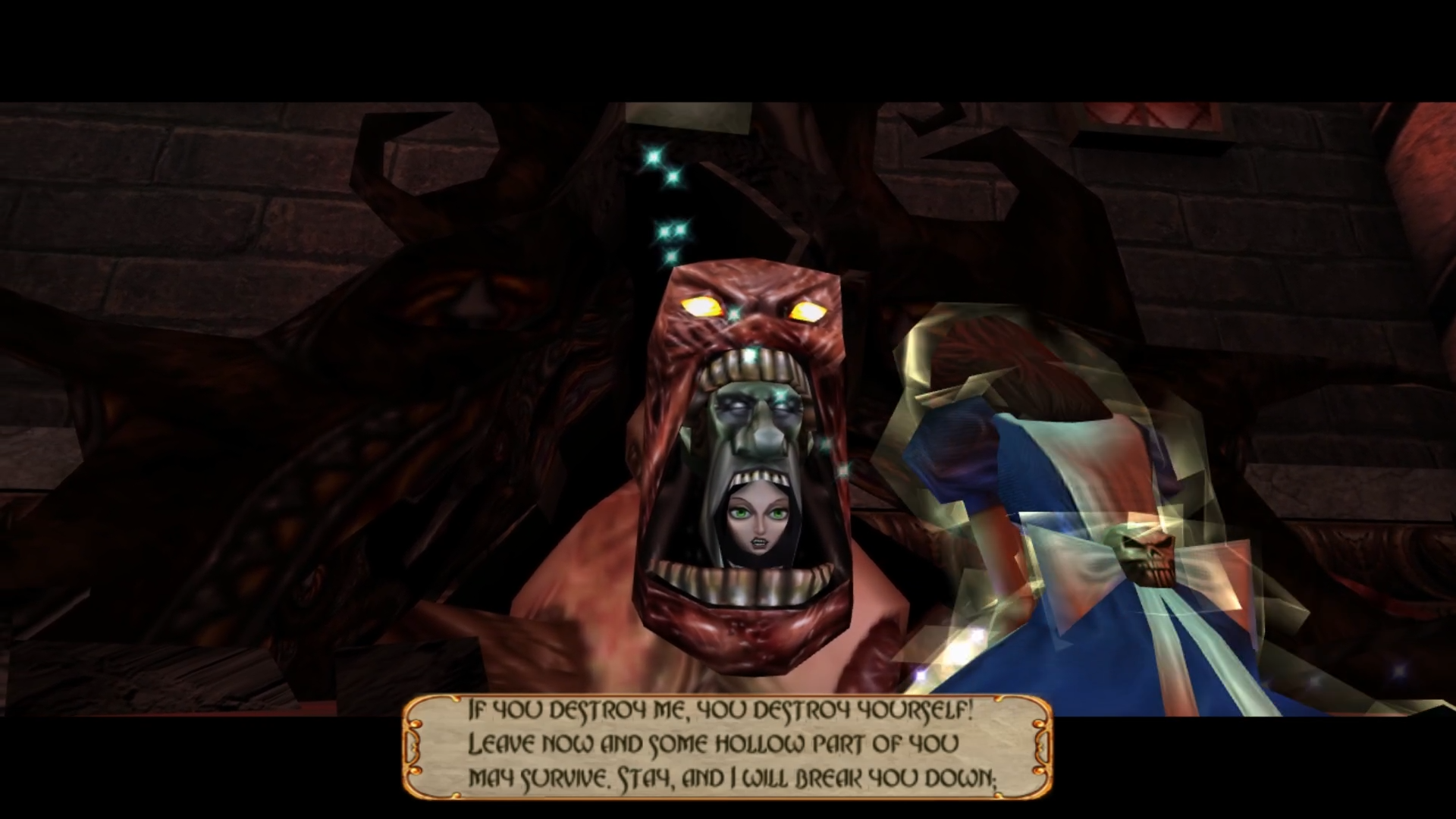
A lot of the game is centered around the idea of fighting back against a fractured, broken psyche. Each facet of Alice’s Wonderland that has been corrupted seems to represent a certain part of her that she needs to overcome. The two centerpieces to this theme are the Queen of Hearts and the Jabberwock. The Jabberwock can be seen as a manifestation of her guilt, constantly mocking and berating her for being unable to save her parents from the fire. The Queen of Hearts, however, represents a deeper duality of both Alice’s own view of herself and the trauma that puppeteers the monstrous reflection she sees in the mirror. The Queen shows herself to be a twisted version of Alice, the monster she herself believes her to be. Once defeated the form of the Queen is overtaken by the most literal interpretation of inner demons as the trauma she endured becomes this gargantuan blob of tentacles. Throughout the game, the many creatures of Wonderland show similar thematical overlap. I’ve always interpreted the cat’s sneering push towards aggression to be Alice’s anger towards the world around her.
American McGee’s Alice takes the whimsy of the Lewis Caroll story and twists it into manifestations of the deepest, and darkest, amalgamations of the human psyche. It’s a game that allows you to, instinctively, read very deep into the narrative and find overlapping elements of the story closely mirroring, not only the dreadfully challenging task of facing ones trauma, but also the life of its creator. It’s a deeply personal story. In a sense it feels like the creator put all of himself on display to parallel the journey Alice takes in the game to overcome the reign of the Queen of Hearts, as a means to defeat his own inner demons. It’s sometimes hard to find the line where the game starts and the creator ends. This game is heavy when approached on a surface level, it is soul crushing when viewed through the looking glass. Where the original tale was deeply intertwined with themes of escapism and the death of childhood, this iteration of the story focuses more on the confrontation of the real world and learning to deal with hardship. As dark and malicious as the game might seem at first, there is a glimmer of hope blazing the trail for overcoming your inner demons and living your best life.
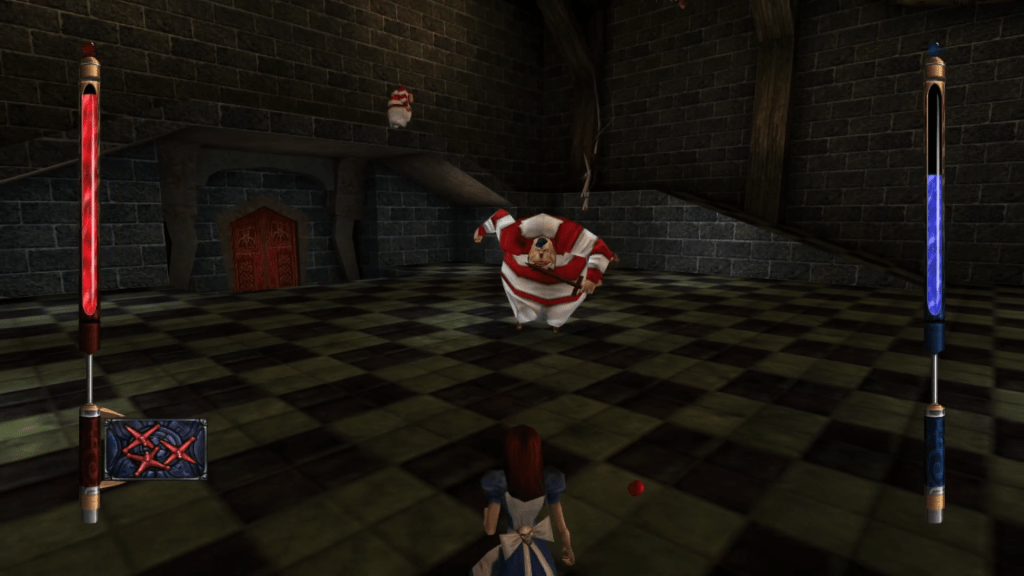
The Playstation 3 version of the 2001 PC original presents a few challenges, and with those challenges comes a lot of passes and fails. More fails than passes, unfortunately. The game is designed as a PC platformer. Geometry can be scaled freely, and a lot of the ways you move through the game with the camera stuck to Alice’s back makes you immediately miss a mouse to aim with. Luckily the team behind the HD remaster did a pretty decent job at translating the game’s design to fit the controller in your hand. While most of the game still feels like a PC title designed in the early 2000’s on Quake Engine (which it is!), the game feels smooth to control, albeit with a few compromises. The platforming feels a bit floaty at times and the jump acceleration caused me to frequently overshoot my targets. This can, however, also be attributed to my own inability to play platformer games without panicking with every jump. It is a lot of fun to be able freely scale walls and rocks wherever there’s even a pixel worth to stand on. This leads to some really funky routing where I accidentally bypassed an important thing in the game and skipped an entire segment by scaling the mountains surrounding a gate. The platforming itself is a lot of fun, but you have to really get accustomed with the way that these types of games telegraph their paths.
Unlike most console platformers, where paths are highlighted through easy to read environments or the classic yellow paint, Alice opts for a more natural approach. While the game certainly keeps pathfinding in mind, these paths tend to blend into the surroundings, or require unorthodox approaches for those unfamiliar with these designs. It’s a weird juxtaposition to experience when you’re sitting there with your Playstation controller in hand, playing a very intrinsically PC game. It’s not bad though. In fact it feels exciting and almost liberating to be able to just hop on anything you can reach. The other caveat is that the weapon selection is now a scrolling toggle. To switch weapons you press a button to cycle through the selection of tools at your disposal. It’s really odd to see a mechanic like this that should be working, actively work against the game’s designs. To give context to this; Most enemies in the game have a weapon that they are weak against, and part of Alice’s combat is being able to, on the fly, switch between your arsenal to find the tool best suited for the situation. The weapon cycle frequently causes you to trip up with your immediate strategies, which is exacerbate when you start to unlock more weapons. The PC version of the game circumvents this by hotkeying each weapon to a number key on the keyboard. While it is an inevitable change to make when porting a game to console, I feel that it makes the entire experience a hell of a lot clunkier.

While the port does a pretty good job at translating a game that is so mechanically rooted on PC as a platform, it does come with its fair share of problems, and this is where all the positivity I have left towards the game will take a bit of a backseat. There is a lot of merit to the attempts being made here to provide the game to an audience that sees Alice: Madness Returns on a shelf in a gamestore and is intrigued by the premise promised. The first and foremost is accessibility. Most of the digital distributions of American McGee’s Alice are no longer available on platforms such as Steam and GOG, and outside of a workaround with the Origin version of the game, you can’t access it anywhere. The second is that it allows players to get introduced with the story from the start when they have both games available. There’s a massive caveat to this though. Both the XBOX 360 and, more so, the Playstation 3 versions suffer from abysmal performance issues. The most prominent is a freeze that happens when too many enemies spawn at once, or if you get a bit excited with certain explosives. I’ve also encountered quite a lot of sequence breaks, but I’m unsure if that was already in the game. The biggest problem I had, however, was that it also crashes on input. For whatever reason the game will sometimes get you stuck moving in a certain direction and the controller will become unusable when this happens. This was handsdown the most infuriating part of the game and the reason why I put extra emphasis on the version specific review. I haven’t been able to find a consistent cause, but it becomes more prominent in the late game, and it makes this version an absolutely infuriating port to play.
I deeply love the original release of American McGee’s Alice, and while the PS3 version didn’t deliver on the nostalgia fueled fever dream I had hoped for, it did provide a good look at the sheer excellence of the game. It’s a deeply personal tale that reflects the journey its creator took to get to the point of making a game. As such, the story and the twisted visuals that represent Wonderland in all its grotesque glory not only provide some deep contextual narratives to dissect, but also serve as a window into the real world. And through this window is a reflection of yourself to observe while you play this game. The port is by no means perfect, more often a harrowing experience in fact, but that doesn’t detract from the mesmerizing beauty that lies beyond the problems. American McGee’s Alice is a beautifully ugly game. The world it depicts are filled with the darkest facets of humanity and the way the fractured psyche ties into the world, the gameplay and even the way you fight is incredibly well executed. It’s a game that was, at the time, an outlier amongst the crowd of Quake’s and Unreal Tournament’s, but it continues to gracefully carry that badge of honor in present day. The game itself is an incredible experience, however it’s probably best to avoid the version that came with Alice: Madness Returns. At least on console. The constant technical problems will give you a one way ticket to Rutledge Asylum.
Down the rabbit hole/10



TanookiChickenAttack is made possible by supporters on Ko-fi. If you enjoyed the review, consider becoming a supporter through https://ko-fi.com/tanookichickenattack

 TanookiChickenAttack