
2008 | Japan Studio – Project Siren | Playstation 3
Okay, so remember how, when Godzilla first released in theaters in the west in the 50’s, it included new footage of an American reporter? Siren: Blood Curse is kind of like that, but not… quite? Siren: Blood Curse has always been an incredibly fascinating game, that, without context feels like a fever dream of non-contextual sequences (and a few laser swords). It does however require a bit of leg work to get an experience that doesn’t feel disjointed and awkward. A playthrough of the original Playstation 2 game is considered mandatory curriculum for those attending the Blood Curse academy. Even with the certificate of completion decorating your bedroom wall, the game does feel a bit strange still. The big question is; Why?
Team Japan does The Grudge
After the creation of Silent Hill in 1999, series creator Keiichiro Toyama left Konami’s Team Silent to work for Sony’s Japan Studio under the newly formed Team Siren. Under Team Siren he’d create the first installment of the Siren series, which released in late 2003 in Japan and in the rest of the world in 2004. The first installment, dubbed Forbidden Siren in Europe, was a complex and often obtuse survival horror game. The game was divided into stages spread across different areas that could be accessed by one of the 10 different characters in an interwoven narrative, where the actions of one character could affect the other. The stages would be organized in a calendar-like navigation menu, called the Link Navigator, that allowed players to select different points in the timeline. The game also introduced the series’ core mechanic; Sight Jacking. This allowed players to temporarily hi-jack the view of enemies and NPC’s to navigate around them. A standout of the game’s visual design is its use of photographs of the actors faces to model the faces of the in-game characters. This firmly cements the game into the uncanny valley and gives it a unique, unsettling feel. The first game was heavily criticized for its immense difficulty and obtuse means of progression, but got enjoys a sizable following of fans that praise it for its story, characters and atmosphere.
A sequel would be released in 2006 in Japan for Playstation 2, and would receive a PAL exclusive localization in 2008. The sequel, Forbidden Siren 2, managed to greatly improve on the rather stiff gameplay of the original, and its difficulty was drastically dialed back. While this made the game more accessible, it lost a bit of its identity in the process. Unlike the first game, Forbidden Siren 2 released with both a Japanese and English dub, instead of the English audio for the western release. Due to its exclusive release late into the Playstation 2’s lifespan, the game received fairly few copies and is often overlooked within the horror genre for the system. Coinciding with the Japanese release of Siren 2, a movie (Siren) was released based on the setting of the games, but telling a new story. The series received its third and final entry in 2008 with Siren: Blood Curse for the Playstation 3. This reimagining was made available as an episodic experience and received a physical release shortly after. The game retells the events of the first game documented by an American documentary crew. Think 2004’s the Grudge, but it’s the American screening of the original Godzilla (told you; similar, but not quite). The game streamlined the complexities of the original into a chronological retelling, without the Link Navigator.
Simple, yet complex
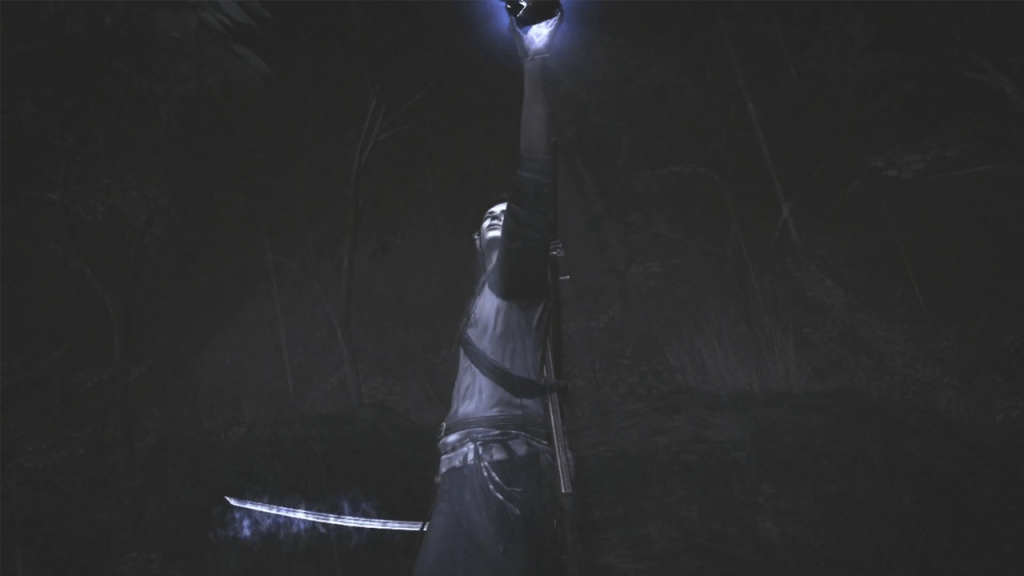
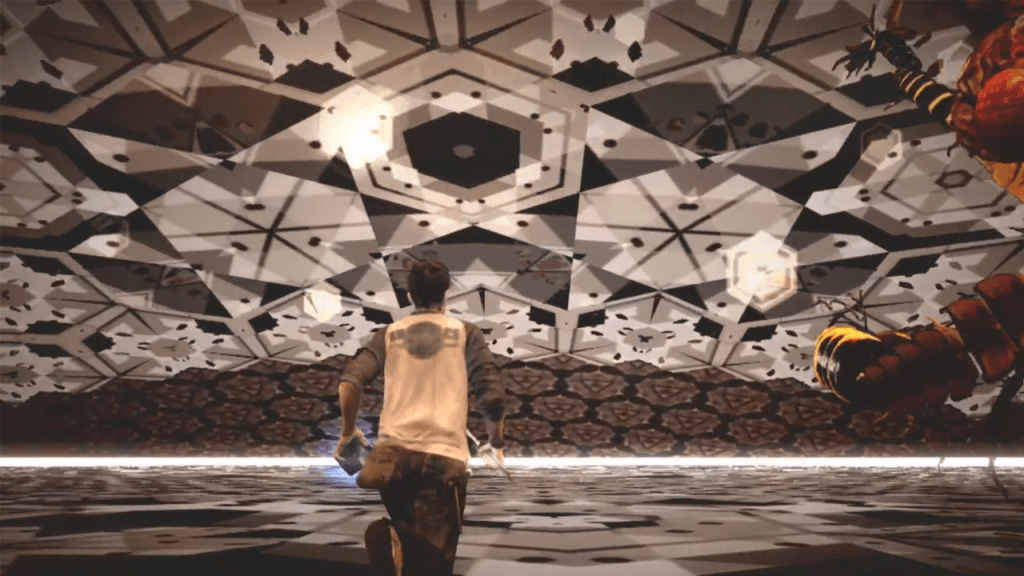
Complexity is the name of the game when it comes to the Siren series, and even Blood Curse does not escape its cruel grasp. Siren: Blood Curse tells the story of an American film crew that investigates the Japanese village, Hanuda, which mysteriously reappeared after vanishing in 1976. Howard Wright, one of the protagonists, gets involved in disrupting an occult ritual where a girl is murdered (documented by the film crew). After fleeing the scene, Howard is attacked by a seemingly zombie-like police officer. During the attack he suffers a splitting migraine that, quite literally, splits his vision and causes Howard to see through the eyes of the police officer who relentlessly pursues him. From here the mystery of the ritual slowly unravels as more and more citizens of Hanuda become possessed by something, turning them into zombie-like Shibito. The TV-crew, consisting of Sam Monroe the anthropologist, Melissa Gates the presenter, the 10 year old Bella Monroe, and camera-man Sol Jackson catch the ritual on camera. After being discovered, the crew gets split up, with Bella taking refuge in the Hospital. From here two main plot lines start to form; Howard’s hero’s quest to save Miyako from the Shibito, and the Monroe family desperately trying to reunite. With the entire experience wrapping up with a lightsaber battle outside of space and time against an extra-dimensional moth monster. The curtains close on Siren: Blood Curse as Howard is no turned into a time-traveling, cassette listening, lightsaber wielding Jedi superhero, ready to kill the Shibito in the past, present and future. Or all at once!
The game is divided into narrative cycles, where, upon the death of one of the characters within a story beat, a new time loop begins with increasing severity of stakes. The first time Howard gets killed brings him back to life in the river. A significant detail for those that played the first game. After trying to once again save Miyako from the clutches of the Shibito, you’ll notice that the possessed townsfolk have increased in number and the environment has warped. The cyclical nature of the game does get somewhat undercut by the linear progression of the supporting characters. In a confusing move from the developers, Howard’s part is a cycle of the same, or similar, events that move forward across the timeline. Think of it as a circle that moves from left to right on a straight line. So while Howard experiences the game in an ever-spiraling loop, the other characters do not. Or, at least, it isn’t portrayed as such. It gives the game a bit of a tonal contrast and makes following an already muddled and convoluted plot line extra difficult. Especially when you consider that this game is both a reimagining of the first game AND a canonical continuation.

In contrast to the game that it was based on, Siren: Blood Curse foregoes the interactive calendar that was a staple for the series in favor of an episodic format. Each episode plays a part of the story in a more linear fashion, whereas the original was a complicated web of entangled stories of various perspectives. While this sacrifices the unique experience that the original provided, it also sacrifices the obtuse and convoluted progression that plagued players since its release. Which makes actually playing the game a lot nicer. A large part of its original design is a remnant of the prominent message board culture in Japan. The game was meant to be a large puzzle to collectively solve, making playing it on one’s own a herculean task. More often to the game’s detriment, rather than adding to its unique premise and execution. Blood Curse manages to somewhat capture this interwoven narrative, but as a more digestible experience. As a complete package it feels like playing through a summary, or the clip notes, of an elaborate horror game.
Each episode is divided into small subsections and tasks that the player needs to complete, with the details behind the story being unlocked through optional tasks. This puts the perspective of the characters front and center, and allows you to breeze through the previously convoluted stages like a rampaging horde of geese. The main tasks usually require you to complete a puzzle, or sneak through an area infested with Shibito. Within each of the episodes you’ll progress a part of the story from multiple perspectives, each step unraveling a part of the mystery surrounding the mountain village. With a lot of the interaction between the characters now being almost exclusively through the story events, rather than the original’s butterfly effect, it does feel a bit less involved by contrast. On its own, it gives the story some pacing issues and tends to make the characters have a few less dimensions to them. The biggest change is an overhaul of the events of the first game. As part of the series nature, the execution of a reimagining is as obtuse as its progression mechanics. Blood Curse is both a reimagined remaster of the first game, but also the third game in the series. The events of the game parallel the events of the first game and are canonically attached to all previous entries. So if you’re left with quite a few question marks after reaching the lightsaber infused ending, then that’s completely understandable.
There’s something in my eye
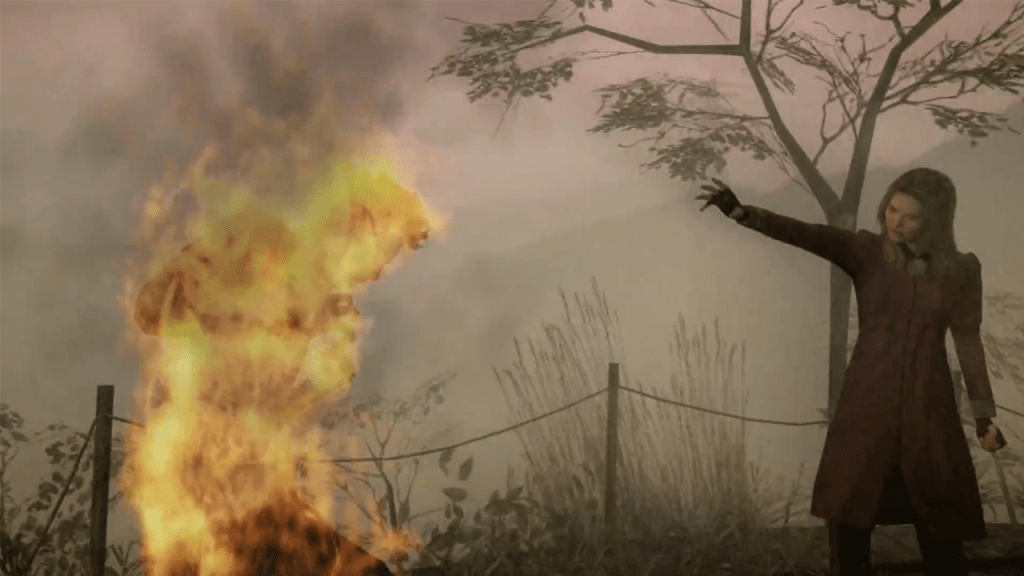
Siren: Blood Curse is the pinnacle of Playstation 2 horror design, with both the merits and flaws of that statement thoroughly embedded in its DNA. The game primarily focuses on approaching enemies stealthily and emphasizes avoiding combat, rather than storming into a room to beat someone up with a 2×4. You’re stuck in an over the shoulder camera perspective that is a little too close to the character to keep an overview of the entire scene. As a result, even the most open stages can end up feeling deeply claustrophobic, and keeps tensions high. The downside is that it can make navigating stages a bit cumbersome as you’ll often find yourself fumbling in the dark for things just out of your field of vision. It’s a constant tug of war between immersion and frustration. As polarizing as it might seem, this design choice adds a lot to the games’ identity. Characters feel small and extremely vulnerable by design, making the turning of a corner feel like life or death decisions. On top of that, the Shibito tend to be a bit more observant than your average video game ghoul.
Enemies are constantly patrolling stages and tend to adhere to certain patterns. In a lesson taken from the Metal Gear games, this changes the stages from an obstacle course to a puzzle with high stakes. It’s constantly encouraged to spend some time to internalize the paths that the Shibito take, but also where they’re going to be looking at what time. Our characters are not equipped with a Soliton Radar, but they are capable of using a mechanic that made this series incredibly unique amongst its survival horror peers; Sight Jacking. As the name implies, this mechanic allows you to look through the eyes of an enemy. When Sight Jacking, you can select a target and observe the world through their eyes. This helps you determine the way that the Shibito move around a stage as well as where they’ll be looking. As said, the Shibito are highly observant, so entering their field of view with so much as a pixel will cause them to lay in a pursuit course. When you’re spotted by a Shibito, the screen will split vertically to show you on the left and the hunter on the right.
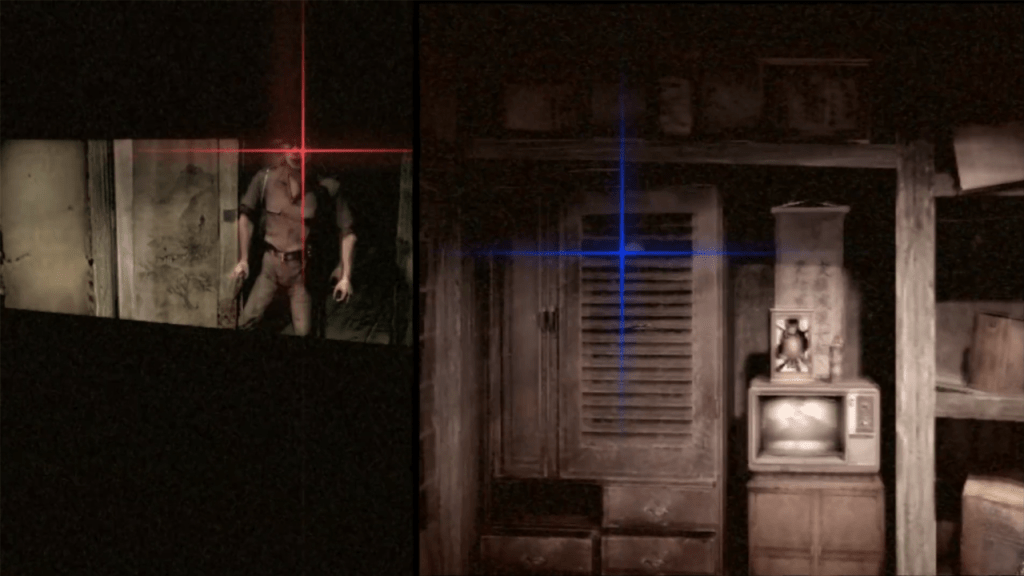
The first instance of this happening is in Howard’s first stage, when a Shibito police officer chases him down into an abandoned shack. Here you can hide in a closet and have the first hand experience of the pure dread of looking through the enemies eyes and seeing yourself in your hiding spot. It creates this unnerving feeling that you can get caught and killed at any point if your hide and seek skills aren’t optimized. The more open stages do allow you to circumvent this a bit by simply running to the other side of the map. The Shibito are also incredibly resilient to dying and will get up after being knocked out. They form a constant obstacle and companion for you to navigate in each stage. Throughout the game you’ll never not feel vulnerable. Which makes it all the more funny that you turn into a lightsaber wielding badass fighting a giant invisible moth in a kaleidoscope just for the end of the game.
Siren: Blood Curse consistently and constantly walks a very thin line between genius design and horribly frustrating. The grainy filter makes the game look like an 80’s grind house film. I do miss the uncanny valley of face design from the original, where faces were animated with pictures of the actor’s faces. This gave the original a really eerie aesthetic that was unmatched by any other horror game on the system. Blood Curse instead favors more 3D animation. It makes the game lose some of its visual identity, but it also sets it apart from the original. This is a reimagining and a sequel (and a prequel) at the same time after all. Some of the stages are also redesigned to favor more streamlined interactions, with certain stages being completely omitted from the equation. You can clear a stage in as little as 5 minutes or as long as an hour. Even though the game is streamlined, it still retains a lot of its puzzle elements. In particular surrounding the boss fights. Most of these monstrous Shibito tend to have very specific approaches to their demise. A good example is a fight in the maze of houses, where you have to impale a Shibito with a radio antenna, then lure it up to the highest point to get it hit by lightning.

I’m feeling a siren coming on
I can’t really fault the ambitious nature of this franchise, but I definitely can provide a small word of caution to those looking to get their foot in the door. Despite being a more streamlined experience as a total package, Siren: Blood Curse still stumbles over the obtuse thresholds on its way through the door. It’s definitely a package that is best enjoyed with the framing of the first game in mind. Still, it does a great job at turning a game that was meant to be a collaborative puzzle into a laser focused experience to interact with. The stages are short, and concise (with a few exceptions in the mines), and provide you with a decent challenge without too many of the drawbacks of the first game. It’s very much the cinema experience of an adaptation of a long running series. That said, while I may seem fairly critical about the game and its narrative implementation, it’s a game that I really enjoy playing. Blood Curse is a tasty breadcrumb trail of oversimplified complex storytelling that leads to a rabbit hole of unparalleled depth.
While the story may be hit or miss, the presentation of the game is a spot on oppressive assault on the senses, with immaculate visual presentation as ammunition. The Shibito are still an uncanny enemy that pull a threatening veil over each movement you make. The body horror that takes a more prominent place on stage in the later parts of the game does go to waste due to the immense darkness of the game. It’s already difficult to walk around without walking into the nearest wall due to the camera being so close over the character’s shoulders. The darkness further obfuscates any level of detail that might have otherwise been enjoyed. It both adds a lot of atmosphere to the game, but deflates tension with frustration in certain stages. Especially the hospital. Luckily the game allows you to complete side objectives to unlock tidbits of lore and artwork, where the phenomenal creature designs and morphed humans can be enjoyed to the fullest.
Like any game in the Siren series, its a recommendation that comes with a long list of caveats. Blood Curse does not make a whole lot of sense on its own, and requires the first game to fully present the story its trying to tell. The first game is one of my favorite horror games on the Playstation 2, but it’s also one of the most frustrating experiences I’ve had with the genre. It’s an obtuse nightmare of a labyrinth that strikes for lethal at each wrong turn for someone else entirely. The second game in the series is the easiest to get into if you want a complete Siren experience in a single package, but, despite the improvements over the first game, loses a lot of its identity in these improvements. So, why play Siren at all? The answer is quite simple actually; It’s endlessly fascinating! The complicated web of events create a feeding ground for people that like to sleuth through snippets of lore to create the full picture. If anything, the TanookiChickenAttack review of Slitterhead should give a decent indication of how deep I like to delve into the depths of a story. That said, Siren: Blood Curse provides a decent, albeit confusing, introduction to the series. Its role as a retelling of the first game, whilst also being the events of the first game isn’t conveyed super well, unless you grab every optional objective to unlock all the lore bits. It’s clumsy in how it likes to tell its story, but its also delightfully self indulgent with its premise. Would I recommend the game? Yes, but also; Read the fine print first.
Lightsaber kaleidoscope rave/10


TanookiChickenAttack is made possible by supporters on Ko-fi. If you enjoyed the review, consider becoming a supporter through https://ko-fi.com/tanookichickenattack

 TanookiChickenAttack