

2018 | Sega | Arcade

Development of the Dead
The long running arcade series from Sega’s AM1 division finds its origin point in 1995 with the development of the original House of the Dead cabinet. The first game in the now classic long running horror themed first person rail shooters, would eventually release as two upright cabinets, powered by Sega’s Model 2 hardware. Both the Japanese and international releases hit the arcade halls in either a 29” monitor variant, with a smaller designed cabinet, or a 50” monitor full sized cabinet. The cabinets themselves were designed by Sega’s AM4 division, based on screenshots from the game provided by AM1. The first game took heavy inspiration from Capcom’s Resident Evil and sought to create a more condensed and visceral experience. This caused the release of the game to be met with some controversy surrounding the violence depicted. As a result, the game had the option to set the blood to green (which also happened to some versions of Resident Evil), with later releases in Japan having this set as the default option. Despite the minor setbacks surrounding this controversy, House of the Dead remained a staple in arcade halls for years to come and would get a Sega Saturn port near the end of that consoles lifespan.
A sequel to the first game released in 1998 for Sega’s NAOMI boards and got a similarly sized and designed cabinet to go along with it. Alongside the arcade cabinet came a Dreamcast port of the game to bring the House of the Dead 2 experience to the living room. This entry in the series is, to this day, considered the strongest entry in the series and enjoys a large cult following. It also showcased the now mainstay campy and over the top voice acting as a mainstay for the franchise going forward! House of the Dead returned in 2002 with its third installment. This game somewhat departed from the original formula and expanded on the players weapons, as well as bringing the console and arcade versions closer together. The last mainline entry in the series released with House of the Dead 4 in 2005, after which the series would only release numerous spin-offs for home console and pc before going dormant post The Typing of the Dead: Overkill in 2013 ( I really need to play this again, fantastic game).
A fifth installment was being developed, but ended up getting shelved. This might have been due to the market for arcade cabinets shifting drastically internationally, with a lot of arcade halls closing their doors. It wasn’t until 2018 that Sega decided to bring the series out of cryostasis with the release of House of the Dead: Scarlet Dawn. This was the first main-line entry in the series to ditch the sequential number behind the title to welcome newer players. The game was developed in Unreal Engine 4 for Sega’s ALLS (Amusement Linkage Live System). This allowed things like online connectivity and worldwide leaderboards, as well as it allowed players to use a card to save their scores to an account. Scarlet Dawn released in the US primarily at Dave & Busters locations. The game can be found scattered in arcades across Europe, but this is more of a rarity.
The House of the Dead: Scarlet Dawn is a striking cabinet to see standing in any room. The exterior looks like a big box covered by a sheet that is being torn apart by zombies from the inside, with hands trying to push through the fabric. A hand pulls down the top to reveal the title marquee of the game. In the middle is a small window that provides onlookers a view of the game inside, but are also greeted with a holographic image of a screaming face. The entrances on both sides are covered with a half curtain to cover up the screen. Once seated, you’ll find yourself sitting in a dark box with nothing but you and the screen, which plays a demo sequence of the experience you’re about to embark on. One of the cool surprises that the cabinet has in store is that the image on the window is only visible from the outside, but when light is cast on it it still casts a shadow on the screen in front of you. It’s like an invisible entity is constantly looking over your shoulder. It may be a side effect of the graphic’s age, but it’s a neat little touch if intentional and just as neat if accidental.

Lightguns of the Dead
The cabinet seats two with both players getting their own lightgun to shoot some ghouls and ghosts with. The guns themselves have a nice weight to it, but don’t fall into the trap of aiming for a more realistic weight. It is a nice feeling to have a bulky and weighty lightgun, but that also means that, if you’re not used to holding something like this, your shoulders are going to feel very uncomfortable around the midway point. These are slightly heavier than what you’d get in a Time Crisis 4 cabinet, but lighter than the Rambo rail shooter. It’s a nice, comfortable weight. The controllers have three buttons to work with; the primary trigger to fire your weapon, a fire rate switch, and an alternate fire button on the front for weapon switching in game. At the start of each of the four main stages you get to select 2 extra weapons, ranging from a revolver to gatling guns and rocket launchers. You can work together to set up complimentary weapon load outs, or just pick whatever explodes the most or shoots the most bullets at the fastest rate.
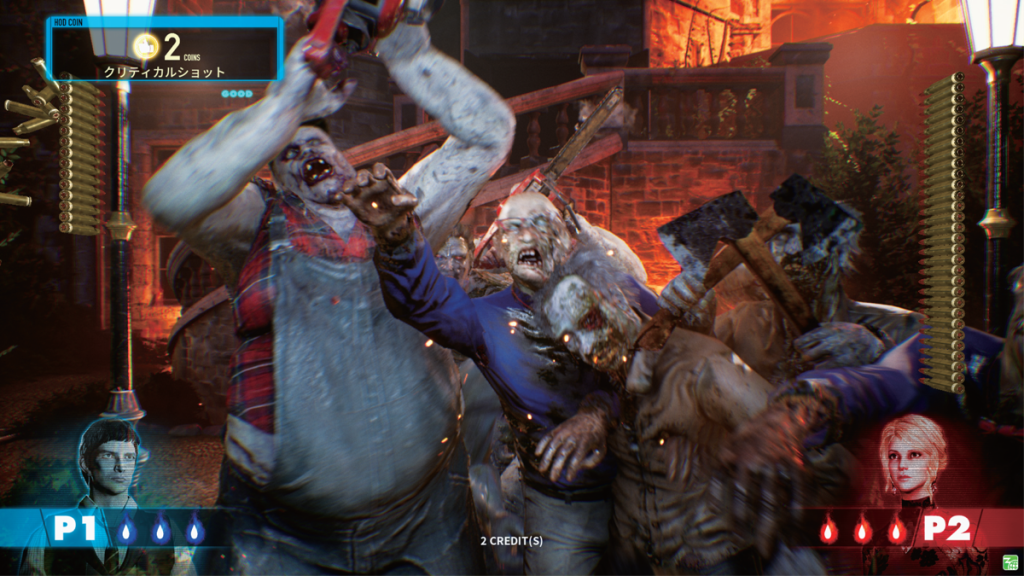
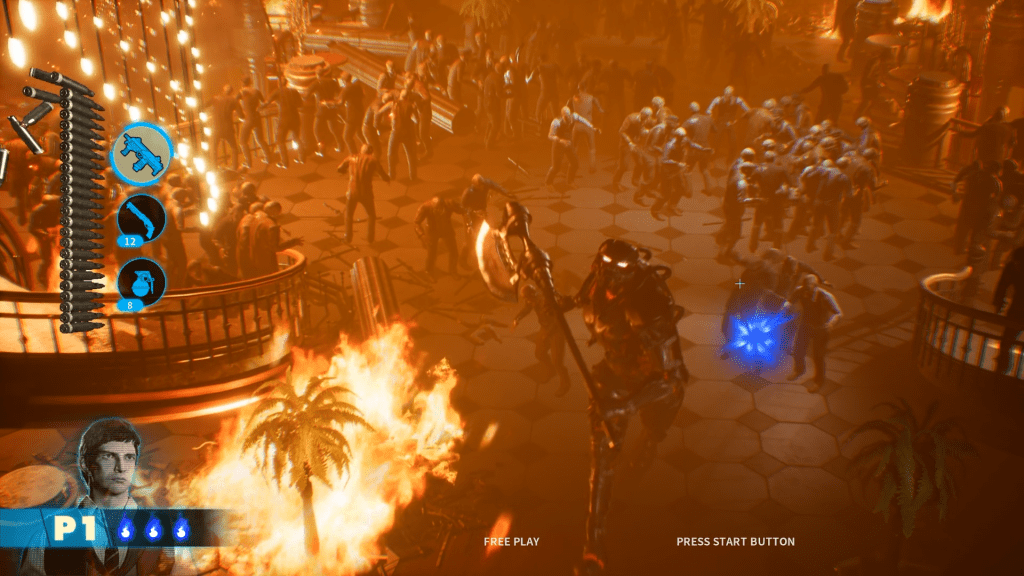
As with other games in the series, most of the gameplay consists of on rails sequences with zombies and monsters pouring out of the most improbable places. Both edges of the screen have the respective players ammo count and weapon selection visible, with your hit points being displayed in the players’ respective corner. There isn’t a crosshair for aiming — as far as I know of — during gameplay, but only visible when selecting stages. Both players are represented as either blue for James, or magenta for Kate when firing. I would’ve preferred a slightly more contrasting combination of colors, since magenta blends quite well with blue. In the chaos of shooting the zombies it can get a bit confusing who is firing at what. Throughout the stages you’ll face mini-bosses, which can be perforated with your preferred caliber, and stage bosses, which are more cinematic. With the latter it becomes a bit of a waiting game for the boss to reveal its weak spot before a health bar appears on said weak spot. Only then are they susceptible to lots of lead. The occasional stage hazard might provide additional targets to shoot that might explode in the boss’ face.
The gameplay in House of the Dead: Scarlet Dawn feels incredibly smooth, with only a few frames dropped during the extremely hectic areas. I only noticed this happening three times when multiple waves of zombies filled the screen. And I do mean filled. There’s so many targets on screen at all time that the moments when you clear a wave feel like you can take a deep breath, before diving under in the next wave. The game does seem a lot more forgiving in comparison to earlier entries in the series. Zombies have less of a tendency to continue moving after being dismembered, and the heavier enemies fall easily to the enthusiasm of two players. It makes this one of the more accessible games in the series, but do be prepared for the other entries to bare their fangs a lot more. Overall I think I only died 2 times in total, which felt impressive for an initial run of the game.

Synopsis of the Dead
Following up a few years after the events of House of the Dead 4, James Taylor and Kate Green are sent on a mission to investigate Scarecrow Manor on behalf of AMS. During a party, waves of monsters get sprung on the unsuspecting partygoers. The duo manages to escape the onslaught and decide to go deeper into the manor to investigate the cause of this massacre. The game is divided into five chapters, with the first one being a prologue. From here you can decide whether to check the Annex, Rooftops or Laboratory first. When the pair explore the Annex chapter, they are attacked by hordes of monsters in the dining room area, leading to a rather cool shootout on the dining table. After managing to push back the horde they escape to the outside area, where they travel to a different part of the grounds by quad bike. On their way there, the duo gets attacked by the Chariot, a recurring boss in the franchise that seemingly came back from the dead. They are forced to flee into the armory, where, after a brutal fight, they manage to kill Chariot, hopefully once and for all.
Kate and James proceed forward into a laboratory, but not before accidentally tripping the alarm. This causes the monsters to swarm to their location, and the pair has to once again fend off the endless hordes. This chapter also features a very goofy section during which you hijack a car to drive through a few meters of shallow water. As they make it deeper into the facility they’re attacked by High Priestess, a giant, very toothy squid. The final stop of the middle three chapters is the rooftop, with the goal of finding a means to escape. After battling their way through more zombies, the pair eventually arrives on the roof where the Hangedman destroys the helicopter they plan on using. At this point the chapters have felt more like an all-star session with each boss being a boss from a previous entry in the series. This feeling really hits home when you start to infiltrate the final area of the game and you run into busts of all the previous main villains in the series.
During the final confrontation it is revealed that Thornheart never died from his disease in House of the Dead 4, but instead continued his research into the forced evolution of humanity through genetic engineering. His plan, called Noah’s Ark, was to eradicate humanity to make way for a new version of it. He manages to escape by unleashing a gigantic, near indestructible creature called Moon. After it emerges from its cocoon it rapidly starts to evolve, with Kate and James only being able to helplessly watch it grow into a gigantic crowned demon. The newly hatched monster destroys most of Scarecrow Manor as it emerges and attacks the agents, eventually cornering them on a tower. Upon realizing that Moon might be impervious to bullets, James grabs a long, metal rod and jumps from the tower to impale Moon. The pole, now wedged into the head of Moon gets struck by lightning, and this seems to be enough to kill the creature. Despite their victory today, most of humanity is left destroyed after the incident. Depending on how well the player performed, they get one of the four endings, similar to the other installments.
Although its a series of arcade cabinets, House of the Dead has always had its fair share of complicated storytelling and world building. Each of the main-line entries tell a new chapter of the story, and build upon the previous entry. Scarlet Dawn is no exception. Despite the omitted number from the title, the game does feel more like a love letter for fans of the series. It’s not just that the familiar themes of the occult and the Major Arcana named bosses are present, but also the way that the game constantly gives nods to events from the other games. I love the near seamless implementation of the stage extensions, as well as the dedication to the sillier elements that concoct a good House of the Dead experience. I do wish that the final confrontation was a bit less anti-climactic, but I also understand that most of these types of games can cause a lot of player fatigue if they take too long to beat. Overall the presentation is fantastic, the cutscenes are great, the monsters incredibly designed, and the characters delightfully dressed for the wrong occasion. It makes me wish I had access to the volume settings so I could actually hear what they were saying!
Scarlet Dawn of the Dead
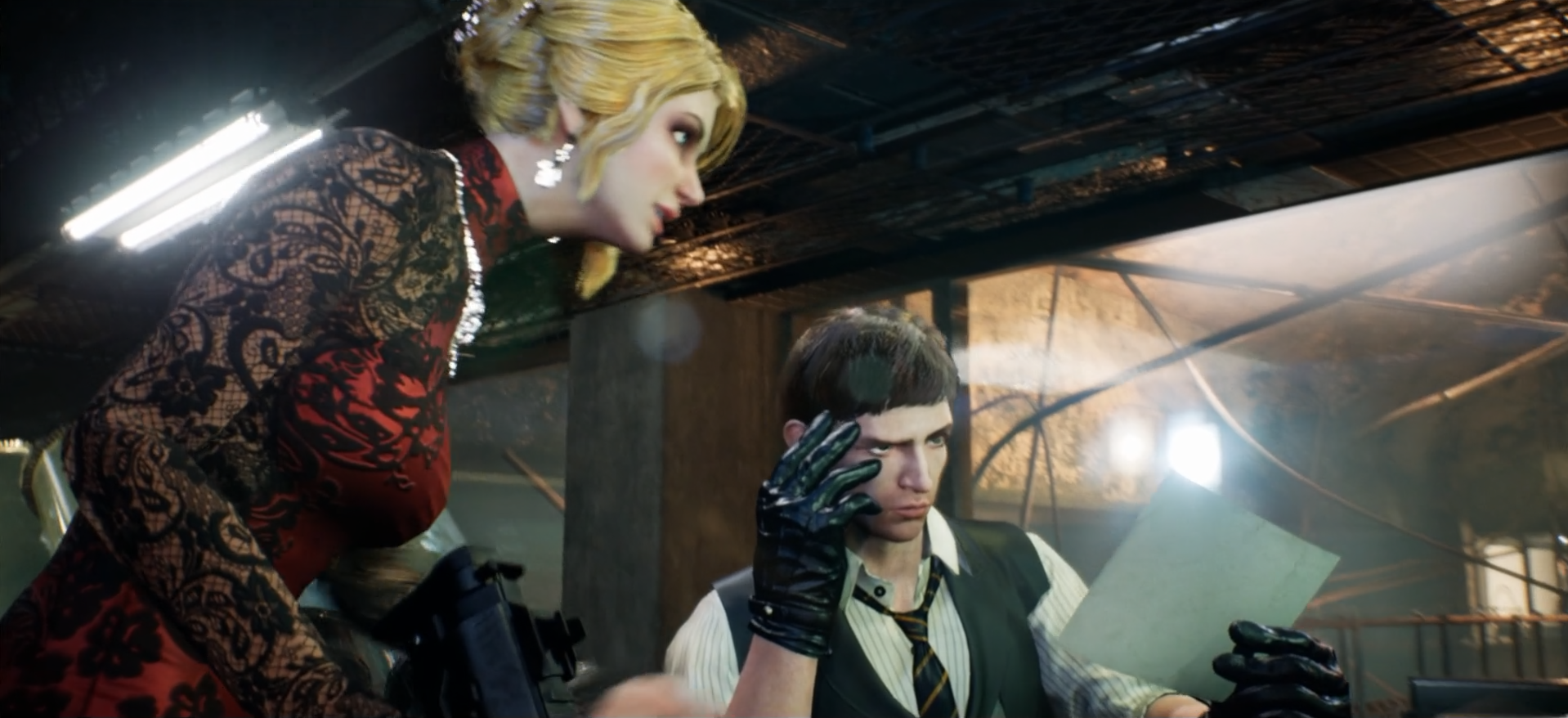
The game isn’t without a few goofs and laughs though. Kate pulling out a smartphone, looking like she’s figuring out the machinations of the world with the seriousness of a funeral procession, proudly proclaiming; “I know how to use this” had me cackling at embarrassing amount of decibels. It didn’t help that she then proceeds to unravel the fabric of reality by expertly having the answer to everything with a quick Google search. There is a beauty to the way this is portrayed is endless and one of the reasons I adore this franchise so much. It’s the epitome of silly fun with a light gun. Overall, Scarlet Dawn isn’t the best of the House of the Dead arcade experiences, but it does a valiant attempt at a spot in the top 3. Most of the problems aren’t exactly with the game itself, but rather the sound mixing and loud rumble. The game’s audio balancing tends to fly from mumbled dialogue to eardrum piercing explosions and background sounds. Sometimes at the same time. This makes the game a rather difficult full experience. The seat rumble also contributes to the symphonic noise making. I like to get a little bit of story as a side dish to this zombie slaying festival, and thanks to the poor mixing you get a lot of main course and little sides.
That isn’t to say this game isn’t a whole lot of fun, because it very much is. Over the course of the odd hour or so of gameplay I found myself howling with laughter with each ridiculous plot reveal, and tensing up when running through the dining hall whilst surrounded by a horde of undead. The weight of the light gun felt really comfortable when shouldered, and didn’t make my arms feel like wet noodles at the half-way point. The game is also not the most punishing of experiences, which allows you to just focus on creating as much chaos and mayhem as possible without the fear of your coins running out. I was on free-play mode so that wasn’t a problem to begin with, but still. Some of the immersive elements went a bit overboard in certain sequences, with the cabinet providing a slight seat rumble and the occasional gust of wind to the face. These additions do provide some extra immersion, but if you’re slightly off center from your intended position one of your eyes is going to feel extra dry by the end of the ride. House of the Dead: Scarlet Dawn is a striking cabinet, with beautiful graphics and a rocking soundtrack. The game is a fantastic thrill ride that is relentlessly over the top. It’s definitely a very high recommendation to play the game if you face this cabinet in the wild. You can never go wrong with some House of the Dead.
The new evolution human/10


TanookiChickenAttack is made possible by supporters on Ko-fi. If you enjoyed the review, consider becoming a supporter through https://ko-fi.com/tanookichickenattack

 TanookiChickenAttack