

2012 | Bandai Namco | Playstation 3
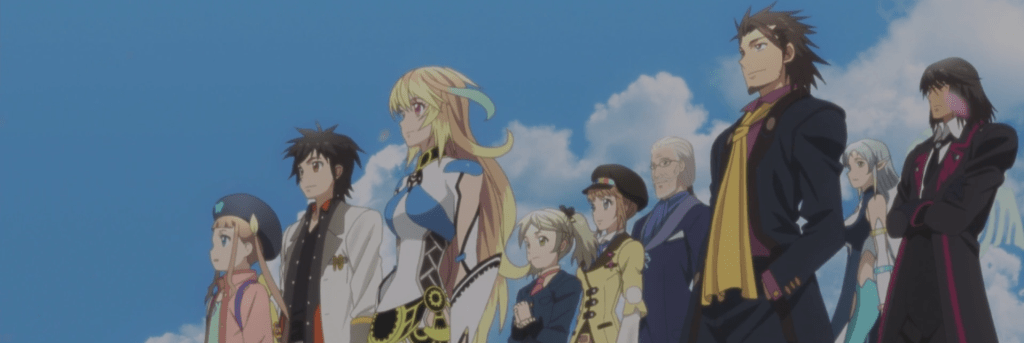
It’s not often that the phrase “Trust me, it gets better” rings true as much as it does with the PS3 Action RPG Tales of Xillia 2. What initially starts off as a trip and fall at the starting line, eventually manages to tell a compelling, albeit messy story with some massive upgrades over 2011’s Tales of Xillia. My initial attempt at playing through this game was met with endless waves of frustration at very obvious padding that makes pacing impossible to be maintained. After nearly a decade, and some convincing of a friend, I tried again. The frustrations were still there, but as the playthrough continued I ended up really liking this game, even loving some parts. So what changed?
Tales of Xillia 2 originally released in Japan in 2012, roughly a year after the first game, and only started development post Xillia 1 release. This gave Tales Studio less than a year to come up with a feasible plan to realize the concept that series producer, Hideo Baba, had cooked up during the development of the first game. It tries to envision a continuation of a story, that for all intents and purposes, was finished (somewhat hastily). The game continues the every day journey of the main cast and places them a year after the barrier that separated the two worlds of Rieze Maxia and Elympios. It builds on the foundation of the first game, by recycling most, if not all, areas. This allowed the team to cut deep into the development time as well as allowing them to focus more on a new story to tell in a world whose story is already told. However, the resulting Tales of Xillia 2 comes with a few monkey paws to curl that makes it not an easy game to get into.
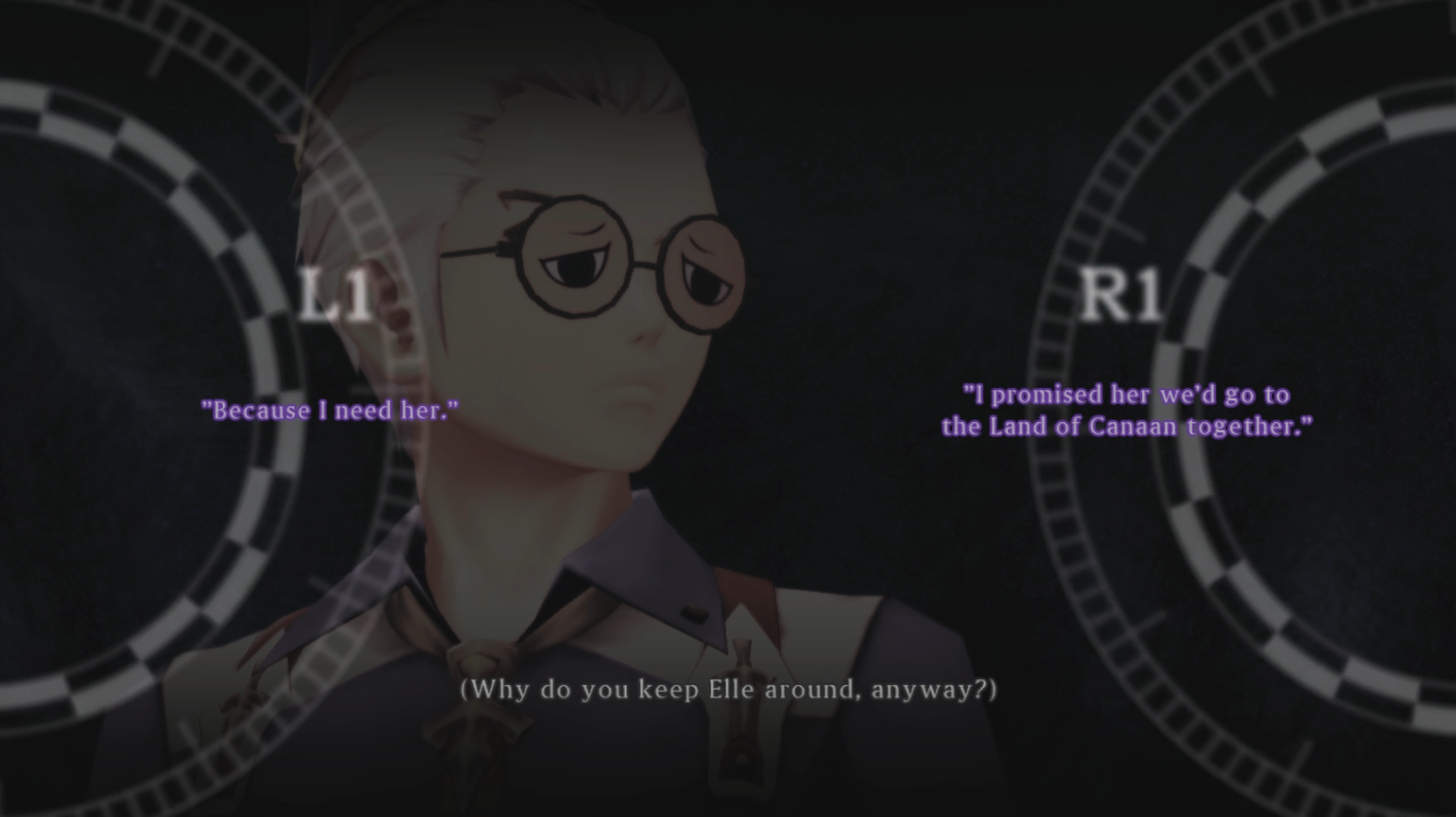
Tales of Xillia 2 follows the protagonist Ludger Kresnik, as he stumbles across a lost child by the name of Elle. Elle is under orders from her father to go to a mystical place called the Land of Canaan. Ludger chases after Elle as she boards a train that is promptly hijacked by a terrorist faction, and together with one of the protagonists of the first game, Jude, they manage to retake the vehicle right before it crashes.
The train crash leads to one of the biggest hurdles you’ll have to face when playing through Tales of Xillia 2, Elympion healthcare. As a result of the accident, Ludger nearly dies and is treated for his injuries. After he wakes up, he discovers that he now owes the bank money, a LOT of money. So now we’re faced with a mechanic that magically turns a 25 hour experience into a 45 hour mess of conflicting emotions. The bank now basically controls when you can continue the main story as well as your early game spending habits. This means that for each of the 4 to 5 early game chapters, you’re basically stuck in a gameplay loop of doing monotonous tasks, like “Kill 5 chickens” or “Find 5 seashells“, to get enough cash to buy your next bit of story dopamine. It’s essentially doing those tedious MMO side-quests, but instead of being ignored they are mandatory to get to the next chapter. This was the source of my immense frustration with the game, as well as a clear indication that this was done to pad the runtime to a more Tales of standard. So how does it get better, you ask?

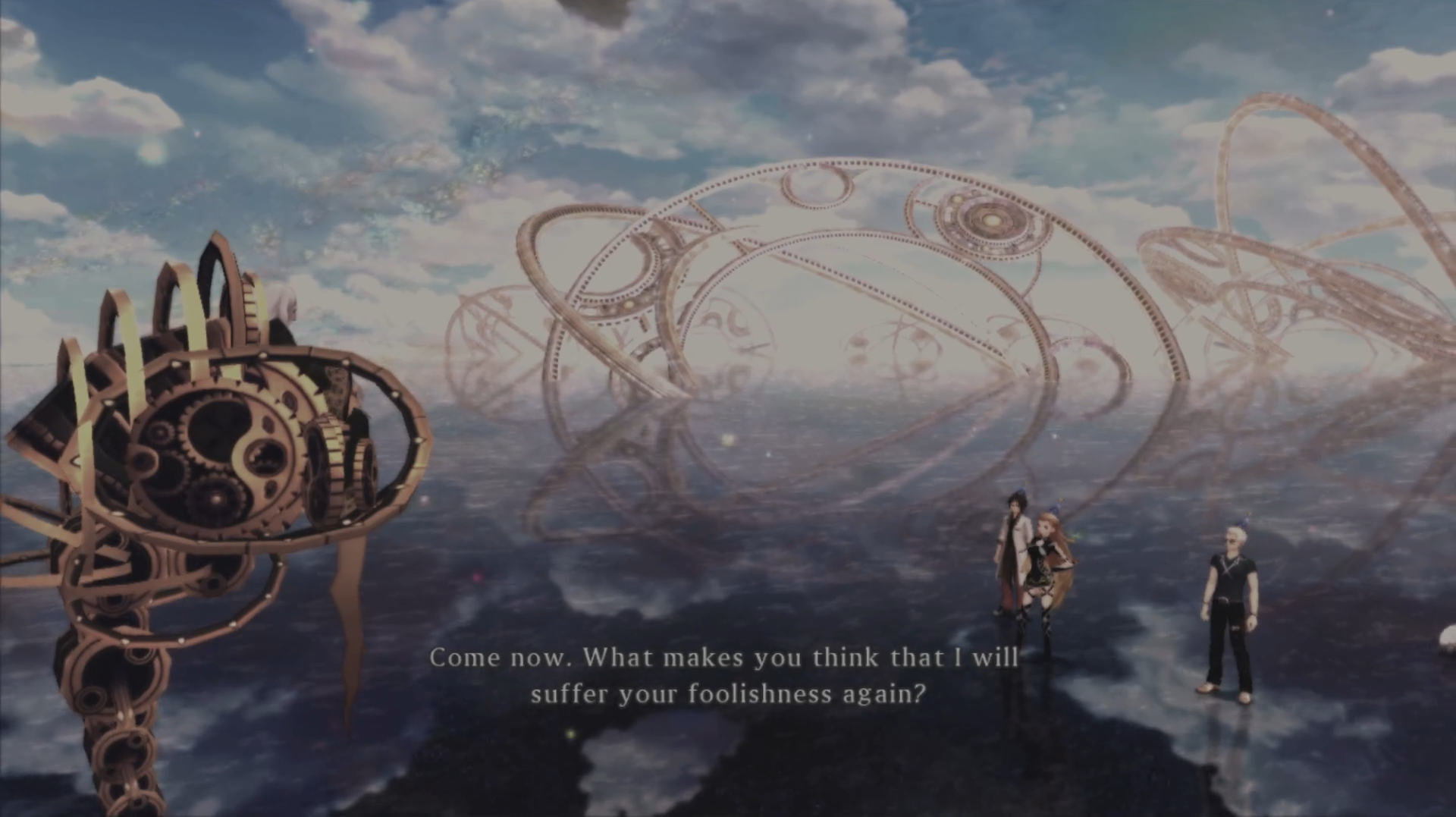
The main story involves anomalies from fractured dimensions wracking all kinds of havoc around Elympios. Our brother, Julius, who was once a prominent investigator for the Spirius corporation, is now wanted for the hijacking of the train that put us into debt (thanks Julius). These fractured dimensions are threatening to cause your “primary” reality to be torn asunder. In the midst of all that, we’re looking for a way to get Elle to the Land of Canaan to face a trial from a deity known as Origin, that will grant her any wish. The story of Tales of Xillia 2 is incredibly densely packed with story threads that weave surprisingly well together. Alongside all the previously mentioned, Ludger comes from a special bloodline that allows him to transform into something called the Chromatus. This allows him to travel to the different dimensions to find divergences to destroy. And this is where the game gets better, a lot better in fact.
The game explores the different paths the cast could’ve taken in the first game, as well as developing more of their backgrounds. It isn’t afraid to kick one or two of them in the stomach while they’re on the ground either. Some of these dimensional trips start off as exciting, but quickly devolve into existential hells. From being responsible for the death of your other selves’ fiancé and having to relive her death for the second time, watching your father get torn to shreds because he’s actually a really bad guy, to asking questions as to what it feels like to kill yourself and live to tell the tale. Not all of the trips are this grim, however, as characters also get a chance at a reunion with long dead friends, or actually discover a more familial bond with people they initially perceived as just being tools. I appreciate that Tales of Xillia 2 gives a lot of room for characters to come face to face with the gravity of their choices and grow from those experiences. It enriches an already very likeable cast and makes them more relatable as characters. The scars that the cast carries from these events are never treated without weight, and are never overindulged upon. The choices they make during and from that point onward are direct results of the weight they carry with them because of these interactions.
As you progress through the story, the debt becomes less of a hindrance due to there simply being more to do. While most of the side stories follow a largely similar structure of “Go to dimension”, they are drenched in great character moments and interactions. The best part of the game is that, from the second act onward, you get to frequently partake in chapters of these side stories for the entire party. You also get rewarded with wads of cash to pay off your debt, so there’s never a reason not to explore these. These bits are extra rewarding if you’ve previously played the first game, so it’s extra incentive to dive into that piece of Tales of Excellence.
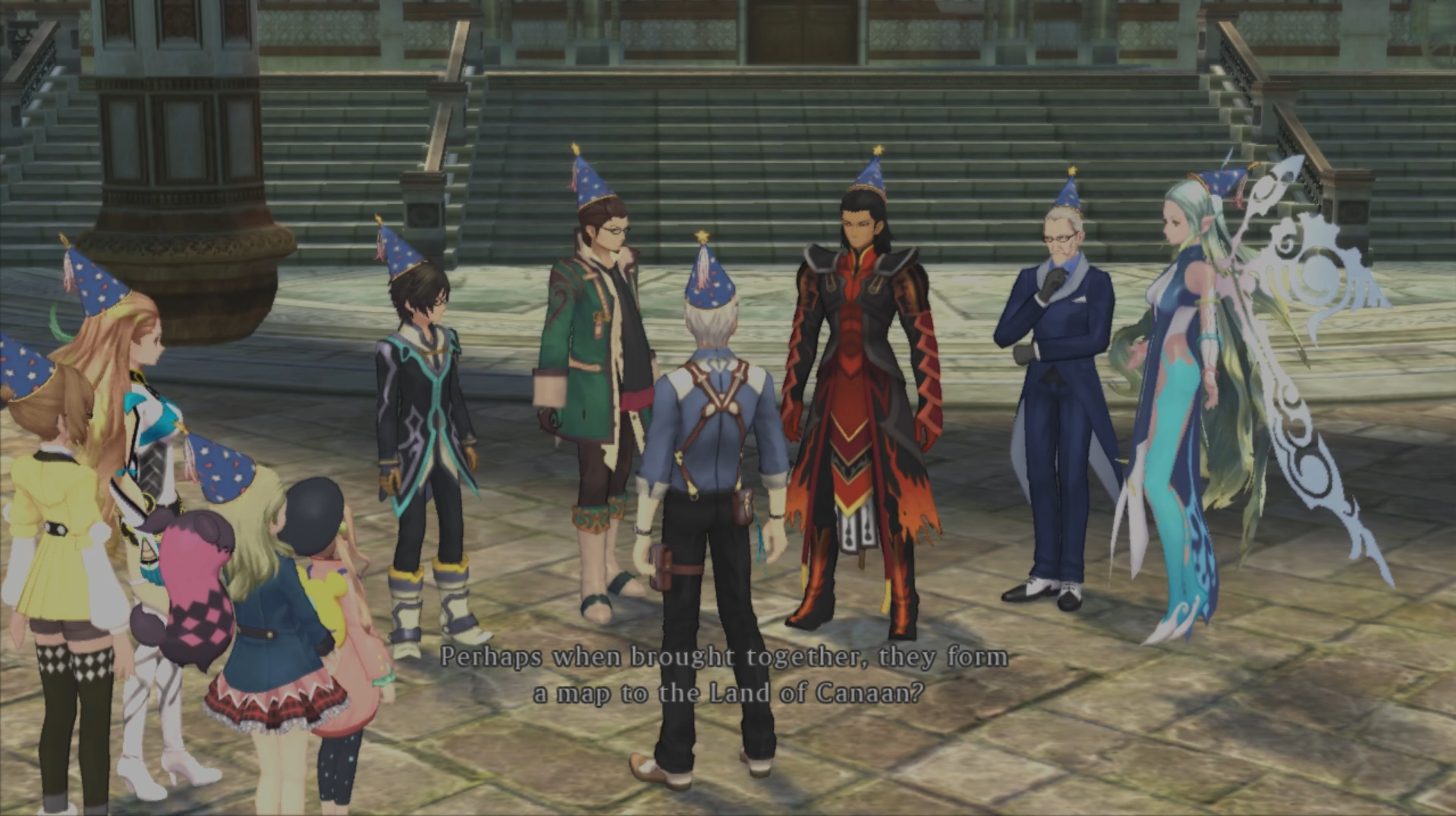
Through the exploration of the different dimensions we discover that Julius is gathering waymarks that will serve as keys to open the gates to the Land of Canaan and subsequently, Origins trial. This is also where the game becomes a bit muddied in how it wants Ludger to progress. At some point during the story, you’re hired by the Spirius corporation to find these waymarks, but at the same time every Spirius agent also serves as an enemy. Meanwhile Julius is still on the run, but also an ally, and also an enemy? The game isn’t really clear on who is, or who isn’t, an enemy or ally. The clear Big Bad in the room can go into a melodramatic villainous monologue and the rest would just shrug and go about their day, acting surprised when the obvious Big Bad was in fact the Big Bad. For me, it felt like there were a number of cool ideas and twists that they had in mind with no real way to give it any weight or narrative reasoning. This leaves a lot of the late game reveals as stale as week old bread without any water to wash it down. However, there are some aspects of the story that genuinely work. The ‘Tales of‘ franchise has always focused more strongly on how the characters tackle the difficulties ahead, often emphasizing the strong bond between the party members that develops over the course of the game. Tales of Xillia 2 takes its role as a sequel and spins this notion to its advantage, by letting the cast of the first game take a supportive role and laser focusing on the dynamic between Ludger and Elle. We still get to learn what happened to our old friends in the year between games, but not as the primary focus of the story. Instead, we find them through the optional content, which, given the debt system, becomes a welcome distraction from the monotonous money grind. Most of these stories are incredibly well executed and really play into the respective character’s strengths and weaknesses. As such we gain a greater appreciation for the choices they’ve made and the growth they’ve undergone. Ludger and Elle, however, form the center pillar of the game’s story. Whilst Elle starts off as a bit of a sassy brat, she quickly forms a bond with her involuntary guardian, and his ridiculously round cat, as they head off to the Land of Canaan together. It’s a trip that isn’t without its own hardships. Elle’s brutal awakening to the harsh reality around her isn’t downplayed at any point during the game, even giving whole chapters to give her room to comprehend things like death, loss and mortality. It’s easy for stories about multiple dimensions to undermine the weight of a character’s loss by simply reintroducing another version of that character. This game never does that. When any version of any character is lost, it’s treated as the loss of an individual. That person mattered to Elle and, frankly, you’re not that person, therefore you don’t have a say in how she should feel about that. The shellshock of losing a friend is given the weight appropriate to the loss and the time needed for the characters to process it. As a result of that weight, things feel more permanent, rather than disposable, and Elle becomes a much more sympathetic character as a result of that. Lucky for her, Ludger is always by her side to help her through whatever she’s going through. This really forms a strong connection that made the ending to the game activate a tear duct or two.
I found myself quickly softening to the bratty attitude, seeing it more as a child proudly presenting her fresh out of the pack Blue Eyes White Dragon or Charizard card to the whole class, battering the rest of the party with brutal jests that made me nearly fall out of my chair laughing a couple of times. I have never seen complimenting someone’s cooking skills being a measurable method of showing affection used in such an efficient way as well.
The only thing I don’t quite understand is why the developers decided on making Ludger a largely silent protagonist. Most of his character comes in through choices you can make throughout the story that will affect your relationship with the party. However, since the rest of the cast is all extremely well voiced, this leaves Ludger standing out like a sore thumb, with his only dialogue being yelling out attack names and “Yeah”. Most of his other voice lines will cut off just a fraction too soon, leaving a lot of his “Yeah” lines as little more than a “Ye”. How you develop his character, though, is entirely up to you and some of his choices range from friendly banter, to unintentionally hilariously brutal remarks, often at the expense of the rest of the party, or Rollo’s weight. If you raise the affection level of your party high enough, you get rewarded with a few bonus scenes in between the regular cutscenes. These feel incredibly naturally implemented and only break the illusion with a huge BONUS SCENE watermark in the top left of the screen. I was really impressed by the way that the Tales team managed to make the implementation of branching dialogue paths feels seamless and rewarding. It incentivizes you to really get to know the people you travel with and thusly form a deeper understanding and bond with them. In most other iterations of the franchise, these developments follow linear trajectories with any affinity systems mostly rewarding status increases.

Tales of Xillia 2 greatly improves on the gameplay of the original. It replaces the linear progression of the first game’s Lillium Orbs, which had you fill in nodes on a web, with the Allium Orb, an item which can be filled with points to learn specific moves and skills. By replacing the linear structure with item based learning, it gives the player substantially more freedom to pursue specific configurations for their party. My personal favorite is unlocking any and all vortex moves as early as possible to make the targets I’m supposed to hit as clustered together and as vulnerable as they can be (Gravity Well all the way!).
Some slight changes have been made to the Double-Raid Linear Motion Battle System from the first game, and got a fancy new name that’s even more elaborate, the Cross Double-Raid Linear Motion Battle System (XDR-LMBS for short). They aren’t really shy with the names in this series, you’ll get used to it eventually. So, allow me to take a brief moment to explain the systems and changes. Like in the first game, regular attacks can be chained freely together with Artes (special moves) as long as you have the points to pay for it. These Assault Counter points, AC, can be replenished by fulfilling specific conditions. You can take up to four party members with you in battle. Each party member has a unique ability to bring to the table and can be linked with to gain these special benefits. These range from gaining extra TP to being able to bail a character out of a situation by warping both characters to the edge of the field when back dashing. By mixing and matching different party compositions and linked party members you can basically create something that caters to your exact wants and needs. By linking with a character, a bar on the left of the screen fills in segments. Once a segment is full, you’ll be able to do a powerful linked attack, and once the bar fills completely you’ll go into overlimit state. In this state you’ll be able to chain linked attacks together until the bar runs out. Unlike the first game, party members aren’t able to swap between active and reserve on the fly. Instead, you pick your group before venturing into fields, dungeons and story chapters. So planning out your strategy in advance will help a bunch with some of the more difficult encounters in the game.
Much like the game’s story, the combat system is heavily catered towards Ludger. Tales of Xillia 2 introduces a very powerful ability; the aforementioned Chromatus, which allows Ludger to temporarily freeze time on the field and deal unrestricted damage to enemies. This form even gets a unique Mystic Arte, a super powerful move that’s usually only reserved for when the party goes into overlimit state. It’s an incredibly busted ability that is capable of interrupting any move on the field, and also interrupts enemies going into an overlimit state, which stops them from hitting your party with their own Mystic Arte. The downside to this is that the state is temporary and the timeframe gets reduced by taking damage. Because of this ability and Ludger’s ability to swap between weapons on the fly (sword, hammer and gun), the rest of the cast gets sort of left on the sidelines. It makes me less inclined to revisit the game to play through it with different characters, which is somewhat of a tradition for my Tales playthroughs. While the changes introduced with the XDR-LMBS streamline the combat and preparation exponentially, it also stops you from naturally wanting to try out other characters due to Ludger’s overwhelming potential and utility.
Tales of Xillia 2 is an absolutely stunning game to look at, but then again, almost all of the areas in this game are revisits from the first. The few new areas are still really nice to look at, but they are very few and far between. The whole game has a wonderful painted aesthetic to it, and while the models sometimes animate a bit stiff, they blend into the world wonderfully. Especially given that most of them now don more casual attires. Ufotable returns for the second time to work on the animated opening sequence and cutscenes, and these are absolutely stunning to see. They’ve brought their absolute A-game to the table to bring some of the hardest hitting and intense scenes to life with the same vigor as Unlimited Blade Works. The in-game cutscenes aren’t too far behind with some excellent camera work and snappy choreography, especially during some of the faster fight sequences. Instead of opting for some flashes and clashes, we now get to enjoy full combat choreography from wind-up to punch and kick landed. It’s fantastic and feels incredibly energetic in contrast to the normally somewhat stiff feeling cutscenes in other Tales of titles.
In tried and true Tales tradition, Motoi Sakuraba returns to the composer seat for this one, with a bit of an unorthodox flair to it. To accompany the blasting synthesizers and shredding guitars, he took a note from Go Shiina’s work on Tales of Legendia, and graced a lot of the overworld maps with some deliciously jazzy licks. It makes travelling in this game the best and deepest of vibes you can experience in the series. It’s a deeply satisfying soundtrack that elevates every interaction in the game with some good tonal seasoning. The game caused me to pause on multiple occasions to enjoy these tracks uninterrupted, before blasting back into the action. What more can you ask for in a soundtrack?
Tales of Xillia 2 starts off incredibly intriguing and immediately proceeds to fall flat on its face in a puddle of mud. The pacing throughout is pretty much non-existent and is constantly undermined by the debt system until the final act. It’s a problematic and intrusive system that kills the flow and any tension, but at the same time makes the game unintentionally comedic to a hilarious degree. I don’t think I have ever seen a game that manages to end a segment filled with death and misery, with a call from your bank’s overly cheerful representative demanding payment, with such frightening levels of accuracy and consistency. Fortunately, like I said at the start of this review, it does get better. Your story pacing is still dictated by the amount of cash you have in your wallet, but the means of getting said cash becomes infinitely more interesting the more the story progresses. A, probably, unintended side effect of this is that I took a lot more time with everything. I explored a lot more of the world, engaged in interesting side quests, defeated strong field bosses and I noticed that the more I did, the more I enjoyed it. It also helped that hurdles became easier to get over as you got more rewards.
What will ultimately deter a lot of people from the game are its first few chapters. It’s very slow and, frankly, not very fun. You’re mostly running back and forth between the job board and the field to find out what you need to kill next for that small hit of story dopamine. Beyond that threshold, however, is a wonderful game that’s rich with loveable characters, great music and a phenomenal battle system. The environments are still stunning and are a treat to walk through thanks to the amazing backing tracks.
Tales of Xillia 2 isn’t afraid to break the mold for Tales of games, but doesn’t quite manage to do so cleanly. It’s riddled with problems that come from wanting the game to last longer than it should and this stands in the way of it fully embracing a touching story about two strangers whose destiny unravels dimensions. The cast brings so much heart to this game and masks its problems with fantastic interactions and company. It may start off as a bit of rock, but once you chip away at the surface you’ll find a gemstone of moderate value. Trust me, it does get better!
A Direct Tether in Public/10


Enjoying the review? Consider supporting TanookiChickenAttack with a coffee at;
https://ko-fi.com/tanookichickenattack


 TanookiChickenAttack